
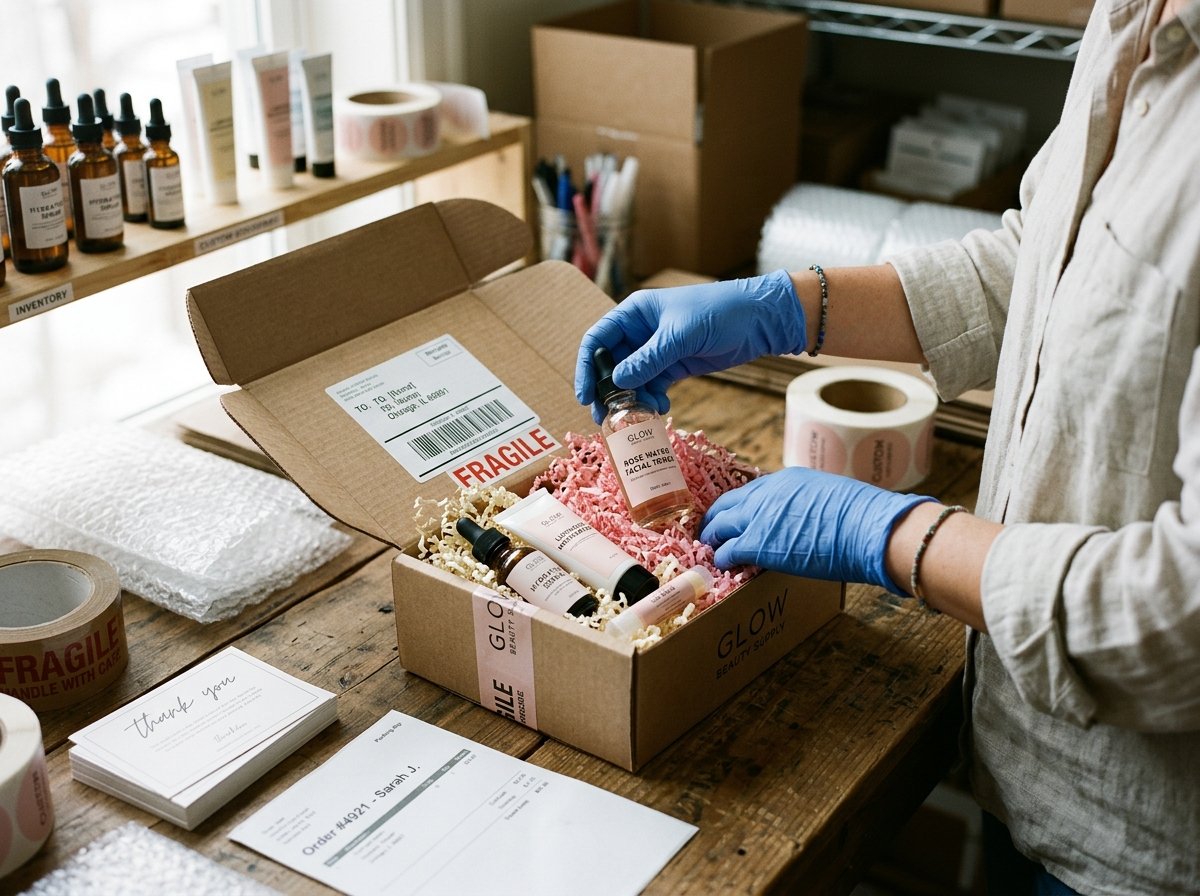
A single cracked serum bottle can ruin an entire shipment — and your customer’s trust along with it. The global beauty industry crossed $430 billion in revenue in 2024, and a massive chunk of cosmetics and skincare sales now happen online. Whether you’re a small indie brand shipping handmade lip balms or an individual sending a birthday gift of Korean skincare to a friend abroad, one thing stays the same: these products are tricky to ship.
Liquids leak. Glass breaks. Creams melt. Aerosols get flagged. And if you’re shipping internationally, customs regulations can turn a simple shipment into a headache.
But here’s the good news — once you understand the basics of packaging, labeling, and carrier rules, shipping cosmetics becomes pretty straightforward. This guide walks you through every step, from picking the right box to handling international regulations, so your products arrive exactly the way they left.
Why Shipping Cosmetics Needs Extra Attention
You might think, “It’s just a bottle of moisturizer — how hard can it be?” Well, harder than you’d expect.
Cosmetics and skincare products come in all forms — liquids, gels, powders, aerosols, oils, waxes. Each one behaves differently during transit. A foundation bottle that survived a short local trip might shatter during a cross-country journey because it wasn’t cushioned properly. A sunscreen left in a hot delivery truck for hours might expand, pop its cap, and leak all over the package.
Then there’s the regulatory side. Many beauty products contain alcohol, essential oils, or pressurized ingredients that carriers classify as hazardous materials. Nail polish remover? That’s a flammable liquid. Hair spray in an aerosol can? That’s a pressurized gas. Ignoring these classifications doesn’t just risk your shipment — it can lead to fines.
And let’s not forget the customer experience angle. Skincare buyers expect a certain level of care. A product that arrives with a dented box, a leaked bottle, or melted consistency immediately feels unreliable, no matter how good the formula actually is.
So yeah, cosmetics shipping deserves your full attention.
Know What You’re Shipping: Product Categories Matter
Before you even pick up a roll of bubble wrap, you need to understand what category your product falls into. This determines your packaging approach, carrier restrictions, and documentation needs.
Liquids and Gels
Foundations, toners, serums, liquid cleansers, shower gels — these are the most common culprits for shipping disasters. They leak, they spill, and temperature changes can alter their consistency. Always assume that a liquid product will try to escape its container during transit.
Aerosols and Pressurized Products
Hair sprays, setting sprays, dry shampoos, certain sunscreens — anything in a pressurized can falls under dangerous goods regulations with most carriers. DHL, FedEx, and UPS all have specific rules about aerosol shipments. Some carriers won’t accept them at all for air freight.
If you’re deciding between carriers for such products, understanding the differences between DHL and FedEx for international shipping can help you choose one that actually accepts your items.
Powders
Loose setting powders, eyeshadow palettes, blush compacts — powder products are fragile in a different way. They don’t leak, but they shatter easily. One drop from a conveyor belt, and your beautifully pressed highlighter palette becomes a pile of dust inside the box.
Oils and Wax-Based Products
Essential oils, lip balms, solid perfumes, body butters — these are heat-sensitive. Wax-based products can melt and reform into a messy blob. Oils can expand in warm temperatures and push past their seals.
Glass-Packaged Products
Perfumes, high-end serums, certain moisturizers — many premium beauty products come in glass bottles or jars. Glass looks luxurious but ships terribly unless you protect it properly. Think of it like shipping jewelry and valuables — the product inside might be small, but the packaging effort needs to be big.
How to Pack Cosmetics for Shipping: Step by Step
Packaging is where most shipping problems either get prevented or created. Here’s how to do it right.
Step 1: Secure Each Product Individually
Don’t just toss everything into a box together. Every single item needs its own protection.
For liquid products, make sure the cap is tightly sealed. Then wrap parafilm or strong tape around the cap-to-bottle junction — this creates an extra seal against leaks. After that, place each bottle inside a small ziplock bag. If it does leak, the mess stays contained.
For powder compacts and palettes, wrap them in a layer of bubble wrap. If the compact has a mirror, add extra cushioning over it. A small piece of cardboard on either side of the compact works great as a rigid shield.
For glass containers, wrap each one in at least two layers of bubble wrap. If you’re shipping multiple glass items, make sure they never touch each other directly inside the box. Glass-on-glass contact during vibration is a recipe for cracks.
Pro Tip: Wondering how much cushioning material you actually need? There’s a practical way to figure out the right amount of bubble wrap without overdoing it or underdoing it.
Step 2: Choose the Right Box
Your box should be just big enough to hold all the products plus cushioning material. Too big, and items slide around during transit. Too small, and there’s no room for protective padding.
Use a new, sturdy corrugated box — not a reused one with old labels and weakened corners. For heavier shipments (multiple glass bottles, for example), go with a double-walled box.
If you ship regularly and want to keep costs and waste under control, it’s worth learning how to choose the right box size for different product combinations.
Step 3: Add Cushioning and Fill Empty Space
This is the step people often rush through, and it’s the one that matters most. After placing your individually wrapped products inside the box, fill every gap with cushioning material.
Good options include crumpled kraft paper, bubble wrap, air pillows, or biodegradable packing peanuts. If you’re an eco-conscious brand, there are solid eco-friendly packaging options that protect just as well without the environmental guilt.
Here’s a simple test: close the box and give it a gentle shake. If you hear or feel anything moving inside, add more fill. Nothing should shift.
Step 4: Seal the Box Properly
Use strong packing tape — not regular scotch tape, not masking tape. Apply tape along the center seam and then reinforce both edges with an H-pattern. For heavier boxes, use the star pattern (tape along the center, both edges, and diagonally across corners).
Step 5: Label It Clearly
If your shipment contains liquids, mark the box with “THIS SIDE UP” arrows. If there’s glass inside, add a “FRAGILE” sticker. These labels don’t guarantee gentle handling, but they help, and most carrier workers do pay attention to them.
For international shipments, you’ll also need a customs declaration, ingredient list, and sometimes MSDS (Material Safety Data Sheets) — more on that below.
Shipping Cosmetics Internationally: Rules You Can’t Ignore
Domestic shipping is relatively simple. International shipping? That’s where it gets serious. Different countries have different rules about what beauty products can enter, how they must be labeled, and what documentation you need.
Customs Documentation
Every international cosmetics shipment needs a detailed customs form. This includes the product name, quantity, weight, value, and — this is key — a clear description of ingredients. Vague descriptions like “beauty product” or “cream” can get your package held up or returned.
Some countries require cosmetics to be registered with local health authorities before they can be imported. The EU’s Cosmetic Products Regulation (EC No. 1223/2009), for example, requires all cosmetics sold or shipped into EU countries to be registered in the CPNP (Cosmetic Products Notification Portal). The US FDA doesn’t require pre-market approval for most cosmetics, but products making drug claims (like anti-acne treatments or SPF sunscreens) fall under different rules.
Ingredient Restrictions
Here’s something that catches a lot of people off guard: a product that’s perfectly legal in one country might be banned in another.
Hydroquinone, a common skin-lightening ingredient, is banned in cosmetics across the EU, Japan, and Australia but is available over the counter in the US (in concentrations up to 2%). Certain essential oils, preservatives (like some parabens), and colorants are restricted in different markets.
Before shipping skincare internationally, check the destination country’s restricted ingredients list. If your product contains anything flagged, it could get seized at customs.
Aerosols and Hazardous Materials
Aerosol products (hair spray, spray deodorant, spray sunscreen) are classified as Class 2 dangerous goods under IATA regulations for air transport. Most major carriers will ship them, but only with proper MSDS documentation and specific packaging standards.
Nail polish and nail polish remover are Class 3 flammable liquids. Perfumes with high alcohol content often fall into the same category. These items usually can’t go through regular parcel post — you’ll need a carrier that handles dangerous goods shipping with proper certification.
Country-Specific Restrictions
Some quick examples to give you an idea:
USA: The FDA regulates cosmetics under the Federal Food, Drug, and Cosmetic Act. Products with drug claims need FDA approval. There are also specific shipping restrictions to the USA you should know about.
UK: Post-Brexit, the UK has its own cosmetics regulation separate from the EU. Products need a UK Responsible Person and proper labeling.
Australia: The Therapeutic Goods Administration (TGA) regulates products with therapeutic claims. Certain ingredients are prohibited, and there are separate shipping restrictions to Australia to keep in mind.
Temperature Control: The Silent Product Killer
Most skincare articles about shipping skip this part, but temperature is honestly one of the biggest threats to cosmetics during transit.
Heat causes oils to separate, emulsions to break, wax-based products to melt, and some active ingredients (like Vitamin C and retinol) to degrade faster. Cold can freeze water-based products, change their texture permanently, and crack glass containers as liquids expand.
If you’re shipping during summer months or to hot climates, consider these steps:
Use insulated liners inside your shipping box. These are foil-lined bubble wrap pouches that create a thermal barrier. For high-value or extremely heat-sensitive products, add a gel ice pack wrapped in a small towel (to prevent condensation from wetting the products).
For cold weather shipping, insulated liners also help retain heat. Some sellers add small heat packs for shipments going to areas with sub-zero temperatures.
Quick Fact: Retinol-based serums can lose up to 20-30% of their potency when exposed to temperatures above 40°C (104°F) for extended periods, according to cosmetic chemistry research. That’s easily reached inside a delivery van during a July afternoon.
If temperature control is critical, choose expedited shipping to minimize transit time. The difference between standard and expedited shipping isn’t just about speed — it’s about how long your product sits in uncontrolled environments.
Choosing the Right Carrier for Cosmetics
Not all carriers handle cosmetics the same way. Your choice depends on what you’re shipping, where it’s going, and how fast it needs to get there.
For domestic shipments of non-hazardous cosmetics (think: a box of moisturizers, lip glosses, or skincare sets), any major carrier works fine — USPS, Royal Mail, India Post, Canada Post, or their private equivalents like FedEx, UPS, and DHL.
For international shipments, especially if your products contain restricted ingredients or are classified as hazardous, you’ll want a carrier with a strong international network and dangerous goods handling capability. DHL and FedEx both offer specialized services for this. If you’re comparing international options, the Aramex vs DHL comparison might be useful, especially for shipments to the Middle East or South Asia where both carriers are popular.
For heavy or bulk shipments (like a wholesale order of 50 lotion bottles), consider ground vs air shipping — ground is cheaper and actually has fewer restrictions on liquids and aerosols since IATA air transport rules don’t apply.
Cost Considerations: What Affects Your Shipping Price?
Cosmetics shipments often cost more than people expect, and there are a few reasons for that.
Dimensional weight plays a big role. Skincare products are usually light but once you add proper cushioning, the box size increases, and carriers charge based on whichever is greater — actual weight or dimensional weight. A 500g moisturizer jar in a well-padded box might be billed as a 2kg package.
Insurance is another factor. If you’re shipping expensive serums, perfumes, or a large order, adding shipping insurance protects you against loss or damage claims. It’s a small cost that saves a lot of pain.
Customs duties and taxes apply to international shipments above certain thresholds. The buyer usually pays these, but you should clearly communicate that upfront to avoid complaints and returns.
Tips for Businesses Shipping Cosmetics Regularly
If you’re an online beauty brand — whether on your own website, Etsy, or eBay — there are some things that’ll make your shipping operation smoother over time.
Create a standard packing protocol. Document exactly how each product type should be packed. This removes guesswork, reduces errors, and speeds up your fulfillment process. If you’re selling on platforms like Etsy, the Etsy seller’s guide to international shipping has some platform-specific tips worth reading.
Negotiate bulk shipping rates. Once you’re shipping 20+ orders a week, you have leverage to negotiate with carriers. Understanding how bulk shipping discounts work can significantly reduce your per-order shipping cost.
Have a clear returns policy. Cosmetics returns are complicated because of hygiene concerns — most beauty products can’t be resold once opened. But you still need a policy that doesn’t scare customers away. Learning how to handle returns for your online business helps you strike that balance.
Brand your unboxing experience. Beauty customers love a good unboxing. Use tissue paper, a thank-you card, maybe a small sample. This doesn’t have to be expensive — it just has to feel intentional. A memorable unboxing turns a one-time buyer into a repeat customer.
Common Mistakes That Ruin Cosmetics Shipments
Let’s talk about what goes wrong — because knowing what not to do is just as valuable.
Using the original retail box as the shipping box. That pretty box your serum comes in? It’s designed for shelf display, not for surviving a sorting facility. Always put the retail packaging inside a proper shipping box with cushioning.
Skipping the leak-proof step. It takes 30 seconds to wrap tape around a bottle cap and put it in a ziplock bag. Skipping this step can ruin an entire multi-product order with one leaky toner.
Ignoring carrier restrictions. Shipping a nail polish via regular airmail without declaring it as flammable? That package is getting flagged, returned, or destroyed. Check your carrier’s prohibited and restricted items list before every shipment.
Under-declaring value on customs forms. Some sellers declare a lower value to help customers avoid customs duties. This is technically customs fraud, and if the package is lost or damaged, your insurance claim will be based on the declared value — not the actual value.
For a broader look at packaging errors, check out these common packaging mistakes that damage parcels.
FAQ
Can I ship perfume internationally?
Yes, but with restrictions. Perfumes contain alcohol, which makes them Class 3 flammable liquids under international shipping regulations. You can ship them through carriers that handle dangerous goods (like DHL Express or FedEx), but they usually can’t go via regular postal services by air. Ground shipping within the same country is often easier. Always declare the contents accurately and include an MSDS if required.
Do I need special labels for shipping skincare products?
For domestic shipments of non-hazardous products (moisturizers, cleansers, non-aerosol items), standard shipping labels are fine — just add “Fragile” and “This Side Up” if relevant. For international shipments, you’ll need detailed customs declarations listing ingredients, HS codes, product values, and country of manufacture. Hazardous items (aerosols, flammable liquids) require UN hazard labels.
How do I keep skincare products from melting during shipping?
Use insulated packaging liners (foil-lined bubble wrap pouches) and, for highly sensitive products, include gel ice packs. Choose faster shipping methods during summer to reduce transit time. Avoid shipping on Fridays — packages often sit in warehouses over the weekend. If your product contains ingredients that degrade in heat (like Vitamin C or retinol), mention storage instructions on the package so the customer also handles it properly after delivery.
What happens if my cosmetics shipment is stuck at customs?
Usually, customs holds packages when documentation is incomplete, ingredients aren’t declared properly, or the product contains a restricted substance. You’ll typically receive a notice explaining the issue. You can provide additional documentation (ingredient list, MSDS, certificate of origin) to get it released. If the product violates the destination country’s regulations, it may be returned or destroyed.
Can I ship homemade or handmade cosmetics?
Yes, but regulations vary by destination. In the US, the FDA requires that cosmetics be safe and properly labeled, but doesn’t require pre-market approval for most products. In the EU, even handmade cosmetics need a safety assessment and CPNP registration. If you’re selling handmade beauty products online and shipping them, make sure you understand the regulatory requirements for both your country and the destination country.
Your Next Step
Shipping cosmetics and skincare doesn’t have to be stressful. The products are a bit demanding — yes. The regulations need attention — absolutely. But once you set up a solid system for packaging, labeling, and choosing the right carrier, it becomes routine.
Start with your product category. Figure out if anything you’re shipping falls under hazardous materials. Get your packaging materials right — good boxes, bubble wrap, ziplock bags, tape. And if you’re shipping internationally, spend 15 minutes researching the destination country’s cosmetic import rules before your first shipment. That small investment of time saves you from returns, customs seizures, and unhappy customers.
Your skincare deserves to arrive looking as good as it did when you packed it. With the right approach, it will.