
Here’s a number that might surprise you: roughly 1.7 million packages go missing or get damaged every single day across the world. That’s not a typo. Every. Single. Day. And if one of those packages happens to be yours — carrying a birthday gift for your mom, an expensive laptop you sold on eBay, or a handmade painting someone ordered from your Etsy shop — that’s not just a number anymore. That’s your money, your time, and a whole lot of stress.
Now, most people don’t even think about shipping insurance until something goes wrong. You drop the package at the courier counter, pay for shipping, and hope for the best. But “hope” isn’t a great strategy when you’re sending something worth real money, is it?
So the real question is simple: should you buy insurance for shipped packages, or is it just another unnecessary add-on? The answer depends on what you’re shipping, how you’re shipping it, and honestly — on what you can afford to lose. Let’s break it all down so you can make a smart, informed decision the next time you ship anything.
What Exactly Is Shipping Insurance?
Before we talk about whether it’s worth it, let’s get clear on what shipping insurance actually does.
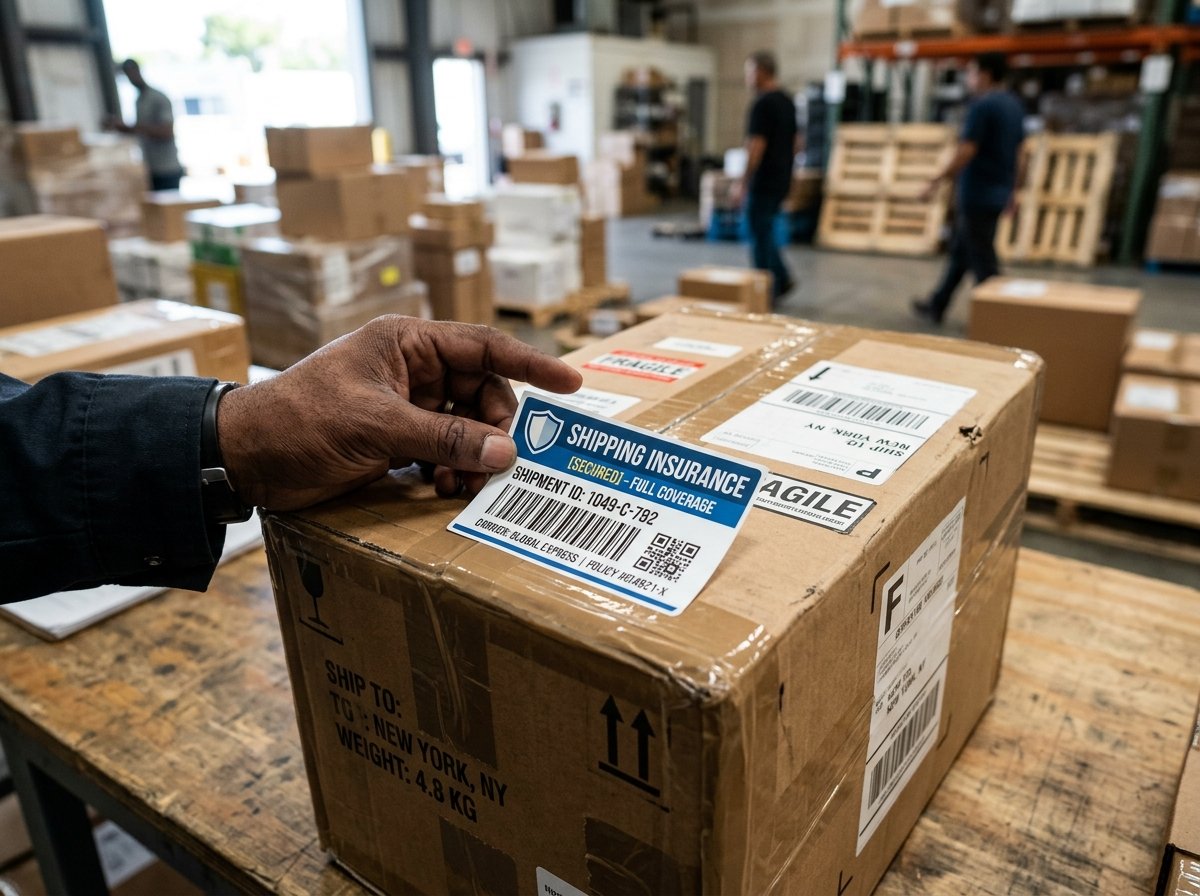
Shipping insurance is a service — offered by courier companies or third-party providers — that covers the declared value of your package if it gets lost, damaged, or stolen during transit. You pay a small premium (usually a percentage of the item’s value), and if something goes wrong, you file a claim and get reimbursed.
Think of it like car insurance, but for your parcel. You hope you’ll never need it. But when you do, you’re really glad you had it.
Quick Fact: Most major carriers like FedEx, DHL, UPS, and USPS include a small amount of built-in coverage — usually around $100. Anything beyond that, you need to pay extra for.
Here’s the thing most people miss: that $100 default coverage sounds nice, but it barely covers the cost of a decent pair of headphones. If you’re shipping something worth $500, $1000, or more, that default coverage is practically useless.
How Does Shipping Insurance Work?
The process is actually pretty straightforward, even though it sounds intimidating.
Step 1: Declare the value. When you book your shipment, you declare how much the contents are worth. Be honest here — overstating or understating the value can cause problems during claims.
Step 2: Pay the premium. The insurance cost is typically 1-3% of the declared value. So for a $500 item, you might pay $5 to $15 extra. That’s less than the price of a coffee for peace of mind.
Step 3: Ship your package. Make sure you pack it properly — and I really can’t stress this enough. Insurance companies can and will deny claims if they determine the item was poorly packaged. If you’re unsure about proper packaging, check out this guide on common packaging mistakes that damage parcels so you don’t accidentally void your own coverage.
Step 4: File a claim if needed. If your package arrives damaged, gets lost, or is stolen, you file a claim with the carrier or insurance provider. You’ll typically need your tracking number, proof of value (receipts, invoices), and photos of damage.
Step 5: Get reimbursed. If the claim is approved, you receive payment — usually within 7 to 30 days depending on the provider.
⚠️ Warning: Most carriers have a claim filing deadline. With FedEx, for example, you typically need to file within 60 days of the ship date. With USPS, it’s 60 days from the mailing date for damaged items. Miss that window, and your claim is gone — regardless of how valid it is.
What Does Shipping Insurance Cover (And What Doesn’t)?
This is where people get tripped up. They assume shipping insurance covers everything, and then they’re shocked when a claim gets denied. Let’s set the record straight.
What’s Typically Covered
Loss — Your package simply never arrives. The tracking shows it’s lost somewhere in the system, or it was delivered but you never received it. If you’ve had a package marked delivered but not actually arrived, you know how frustrating this is.
Damage during transit — The item arrives broken, cracked, bent, or otherwise messed up because of rough handling during shipping.
Theft — In some cases, if the package is confirmed stolen after delivery (like porch piracy), certain insurance policies cover this too. But this one varies a lot between providers, so read the fine print.
What’s Usually NOT Covered
Improper packaging — If you shipped a glass vase wrapped in a single layer of newspaper inside a flimsy box, don’t expect the insurance company to pay up. They’ll argue (correctly) that the damage was caused by inadequate packaging, not by transit.
Prohibited or restricted items — If you shipped something you weren’t supposed to — like certain chemicals, dangerous goods, or items banned from international shipping — your insurance is void.
Consequential losses — Lost a big business deal because your shipment was delayed? Insurance won’t cover that. It covers the item’s value, not the ripple effects.
Perishable items — Most standard shipping insurance doesn’t cover perishable goods that spoil during transit.
Wear and tear or pre-existing damage — If the item was already scratched or partially broken before you shipped it, that’s on you.
Pro Tip: Always take clear photos of your item AND your packaging before sealing the box. These photos become your best friend if you ever need to file a claim. Timestamp them if possible.
When Is Shipping Insurance Absolutely Worth It?
Alright, let’s get practical. Not every package needs insurance. But there are situations where skipping it is honestly a bad idea.
High-Value Items
This one’s obvious. If you’re shipping jewelry and valuables, electronics, or expensive equipment, the few extra dollars for insurance are nothing compared to what you’d lose if something goes wrong. Shipping a $2,000 gold necklace without insurance? That’s a gamble you don’t want to take.
Fragile or Breakable Items
Artwork and paintings, musical instruments, glassware, ceramics — these items are vulnerable no matter how well you pack them. One rough toss at a sorting facility and that’s a crack, a dent, or worse. Insurance gives you a safety net.
International Shipments
International shipping involves more hands, more stops, more customs checkpoints, and more chances for something to go wrong. A domestic shipment might pass through 3-4 touchpoints. An international one? Sometimes 8 to 12. Every touchpoint is a risk.
If you’re shipping belongings when moving abroad or sending personal effects for students studying overseas, insurance isn’t just “nice to have” — it’s practically essential.
E-Commerce Sellers
If you run an online business — whether on eBay, Etsy, Amazon, or your own store — shipping insurance protects both you and your customer. An Etsy seller shipping internationally who sends a handmade $300 pottery piece without insurance is one broken package away from a full refund out of pocket.
Think about it from a business perspective. If you ship 100 orders a month and even 2-3% get lost or damaged, that’s 2-3 orders where you’re eating the entire cost. Insurance premiums on all 100 orders would probably cost less than refunding even one of those lost shipments.
Sentimental or Irreplaceable Items
Here’s something people forget — insurance can cover monetary value, but it can’t replace sentimental value. Still, if you’re shipping grandma’s antique clock or a one-of-a-kind hand-painted portrait, at least having financial coverage takes some of the sting away if the worst happens.
When Can You Probably Skip It?
Let’s be fair. Not every single package needs insurance, and I’m not going to pretend otherwise.
Low-value items — If you’re shipping something worth $20 or less, the insurance premium might not make financial sense. The risk is there, sure, but the potential loss is small enough to absorb.
Items that are easy to replace — Shipping a mass-produced book, a basic phone case, or some standard office supplies? Even if it gets lost, replacing it isn’t going to break the bank.
Short-distance domestic shipments — A package traveling within the same city or state goes through fewer handling points and spends less time in transit. The risk is naturally lower.
When the carrier’s default coverage is enough — Remember that built-in $100 coverage most carriers offer? If your item is worth $75, you’re already covered without paying a single extra dollar.
Did You Know? Amazon, for instance, automatically covers most packages shipped through its platform. So if you’re buying from Amazon, you typically don’t need to worry about separate shipping insurance — their A-to-Z Guarantee handles most loss and damage issues.
How Much Does Shipping Insurance Actually Cost?
Let’s talk numbers, because that’s what it usually comes down to.
Shipping insurance costs vary depending on the carrier, the declared value, and whether you use a third-party provider. But here’s a rough idea:
USPS charges about $2.70 for coverage up to $50, and $4.60 for up to $100. Above that, it scales proportionally — around $2 to $4 for every additional $100 of value.
UPS and FedEx typically charge around $2.70 per $100 of declared value beyond their included coverage. If you’re choosing between carriers, this DHL vs FedEx international shipping comparison might help you see how different providers stack up overall.
Third-party insurance providers like Shipsurance, InsureShip, or Parcel Guard often offer rates that are 40-60% cheaper than carrier-provided insurance. These companies specialize in shipping insurance and can be a great option for e-commerce sellers who ship in volume.
Here’s a quick example to put it in perspective. Say you’re shipping a $1,000 laptop. Carrier insurance might cost you about $25-$30. A third-party provider might charge $10-$15. Compare that to losing $1,000 entirely. The math is pretty clear.
If you’re someone who regularly ships electronics, reading up on how to ship a mobile phone or laptop safely can help you combine smart packaging with the right insurance for maximum protection.
Carrier Insurance vs. Third-Party Insurance: Which One?
You’ve got two main routes, and each has its pros and cons.
Carrier Insurance (FedEx, UPS, DHL, USPS, etc.)
The biggest advantage here is convenience. You buy it right at the counter or during online booking. There’s no separate account to set up, no separate claim process to learn. Everything stays within one system.
The downside? It’s usually more expensive, and some carriers have a reputation for making the claims process difficult. You might wait weeks for a resolution, and the burden of proof can feel heavy.
Third-Party Insurance
Companies like Shipsurance, InsureShip, Parcel Guard, and U-PIC offer shipping insurance independently of any carrier. The premiums are usually lower — sometimes significantly so. Many of them also have faster, simpler claims processes because, well, insurance is their entire business.
The trade-off is that you’re dealing with a separate company. You need to register the shipment with them, keep your documentation organized, and coordinate between the carrier and the insurer if something goes wrong.
For occasional shippers — carrier insurance is probably the easiest route. Just add it when you book and don’t overthink it.
For e-commerce sellers or frequent shippers — third-party insurance can save you real money over time, especially if you’re processing dozens or hundreds of shipments monthly.
How to File a Shipping Insurance Claim (The Right Way)
Nobody wants to be in this situation, but if you are, here’s how to handle it without pulling your hair out.
Act fast. Don’t wait. As soon as you realize something is wrong — the package is missing, the tracking hasn’t updated in days, or the item arrived damaged — start the process. Remember those claim deadlines I mentioned earlier? Time matters.
Gather your documentation. You’ll need your tracking number, the receipt or proof of purchase for the item, the shipping receipt showing you paid for insurance, and (for damage claims) photos of the damaged item and packaging.
File through the right channel. If you used carrier insurance, file directly on the carrier’s website or at their local office. If you used third-party insurance, go through the provider’s claims portal. Don’t mix these up — filing in the wrong place just delays everything.
Be detailed and specific. When describing the damage or loss, don’t just write “item broken.” Write “the ceramic sculpture arrived with a crack running 6 inches along the base, and the left arm was completely detached.” Details matter. Photos matter even more.
Follow up. Claims don’t always resolve on their own. Set a reminder to check the status every few days. If it’s taking too long, call. Be polite but persistent.
For a step-by-step walkthrough on reclaiming your money for lost items, this guide on how to file a claim for a lost package covers the entire process in detail.
Real Scenarios: Insurance Saved the Day (and When It Didn’t)
Let me share a couple of real-world examples to make this tangible.
Scenario 1: The Wedding Gift That Never Arrived
Sarah shipped a $400 crystal vase to her cousin’s wedding across the country. She paid $8 for shipping insurance. The package got lost somewhere between distribution centers and never arrived. She filed a claim, provided her receipts, and got a full reimbursement within 15 days. That $8 saved her $400. Worth it? Absolutely.
Scenario 2: The Guitar That Arrived in Pieces
A musician sold his $1,200 acoustic guitar on Reverb and shipped it via ground shipping. He insured it for the full value. The guitar arrived with the neck snapped — clearly mishandled during transit. He filed a claim with photos and documentation. The insurance covered the full declared value. Without it, he would’ve been out $1,200 AND the guitar.
Scenario 3: The Denied Claim
Mike shipped a vintage action figure collection worth $800. He wrapped them in tissue paper and placed them in a box that was too large, with no filler material. The items arrived rattled and damaged. He filed a claim, but it was denied — the reason cited was “inadequate packaging.” Mike had insurance, but it didn’t matter because his packaging didn’t meet basic standards.
The lesson? Insurance only works when you hold up your end of the deal — and that means proper packaging. If you’re not sure how much protective material your shipment needs, check out this resource on how much bubble wrap you actually need.
Tips for E-Commerce Sellers: Building Insurance Into Your Business
If you sell products online and ship regularly, shipping insurance shouldn’t be an afterthought. It should be part of your business model.
Factor insurance costs into your pricing. If you’re selling a $200 item and shipping insurance costs $4, build that into your product price or shipping fee. Your customers won’t notice an extra $4, but you’ll sleep better knowing every shipment is protected.
Use third-party insurance to save money at scale. When you’re shipping 50-200 orders a month, even saving $1-2 per shipment on insurance premiums adds up fast. That’s $50-$400 back in your pocket every month.
Make insurance part of your customer experience. Some smart sellers offer optional shipping insurance at checkout. The customer pays for it if they want it, and both parties are protected. It’s transparent and builds trust.
Keep impeccable records. Save every receipt, every tracking number, every photo. Create a simple system — even a spreadsheet works — to track insured shipments. When you need to file a claim (and eventually you will), having organized records makes the process 10x smoother.
If you’re handling returns for your online business, consider whether your insurance covers return shipments too. Some policies do, some don’t. It’s worth checking.
How to Decide: A Simple Framework
Still not sure whether to buy insurance for your next shipment? Ask yourself these four questions:
1. Can I afford to lose this item entirely? If the answer is no — or even “it would really hurt” — get insurance.
2. Is the item fragile or easily damaged? If yes, and even good packaging can’t guarantee protection against rough handling, insure it.
3. How far is it traveling? The farther the distance and the more borders it crosses, the higher the risk. International shipments, in particular, deserve insurance.
4. Does the insurance cost make mathematical sense? Compare the premium to the item’s value. If insurance costs 2% of the item’s value, you’re essentially paying a small fraction to protect 100% of your investment. That’s almost always a smart trade.
If you answered “yes” to even two of these, shipping insurance is worth it for that particular shipment.
FAQ Section
Is shipping insurance the same as declared value coverage?
Not exactly, though people often use the terms interchangeably. “Declared value” with most carriers means you’re stating what the package is worth, but the carrier’s liability might be limited by their terms and conditions. True shipping insurance — especially from third-party providers — operates more like a traditional insurance policy, with clearer coverage terms and typically fewer loopholes. Always read the fine print to understand what you’re actually getting.
Does the sender or the receiver buy shipping insurance?
Usually, the sender purchases shipping insurance at the time of booking the shipment. The sender is the one who has the shipping contract with the carrier, so the claim process runs through them. Some e-commerce platforms let buyers add shipping insurance at checkout, but even then, the actual policy is typically tied to the shipment, not to a specific person.
Can I buy shipping insurance after I’ve already sent the package?
In most cases, no. Shipping insurance needs to be purchased at the time of shipment or, at most, before the carrier picks up the package. Some third-party providers allow you to add insurance within a small window after booking, but once the package is in transit, it’s almost always too late. This is why it’s better to decide upfront.
What’s the difference between carrier insurance and third-party insurance for claim approval rates?
Third-party insurance providers generally have a reputation for faster and more flexible claim processing compared to carriers. Companies like Shipsurance or InsureShip deal exclusively with shipping claims, so their systems are streamlined for it. Carrier claim departments, on the other hand, handle insurance alongside a million other operational tasks, which can slow things down. That said, major carriers have improved their claim processes in recent years, so the gap is narrowing.
Does shipping insurance cover international customs seizures?
Typically, no. If your package is seized by customs because it contains prohibited items, violates import regulations, or has incorrect documentation, shipping insurance won’t cover that loss. Insurance covers transit-related risks — damage, loss during shipping, theft — not regulatory or legal issues. This is why it’s crucial to know the shipping restrictions to countries like the USA, UK, or Australia before you send anything internationally.
Your Move
Look, shipping insurance isn’t some complicated financial product. It’s a small, practical safety net that protects your money and your sanity when things go sideways — and in the shipping world, things go sideways more often than any of us would like.
For cheap, easily replaceable items? You can probably skip it. For anything valuable, fragile, sentimental, or traveling a long distance? The cost of insurance is almost always a fraction of what you’d lose without it. That’s not a sales pitch — it’s just math.
Next time you’re at the shipping counter or clicking through an online booking form, take five seconds to consider the value of what’s inside that box. If losing it would genuinely bother you, spend the few extra dollars. Future you will either never think about it again (because the package arrived safely) or be deeply grateful (because it didn’t, and you were covered).
Either way, you win.