
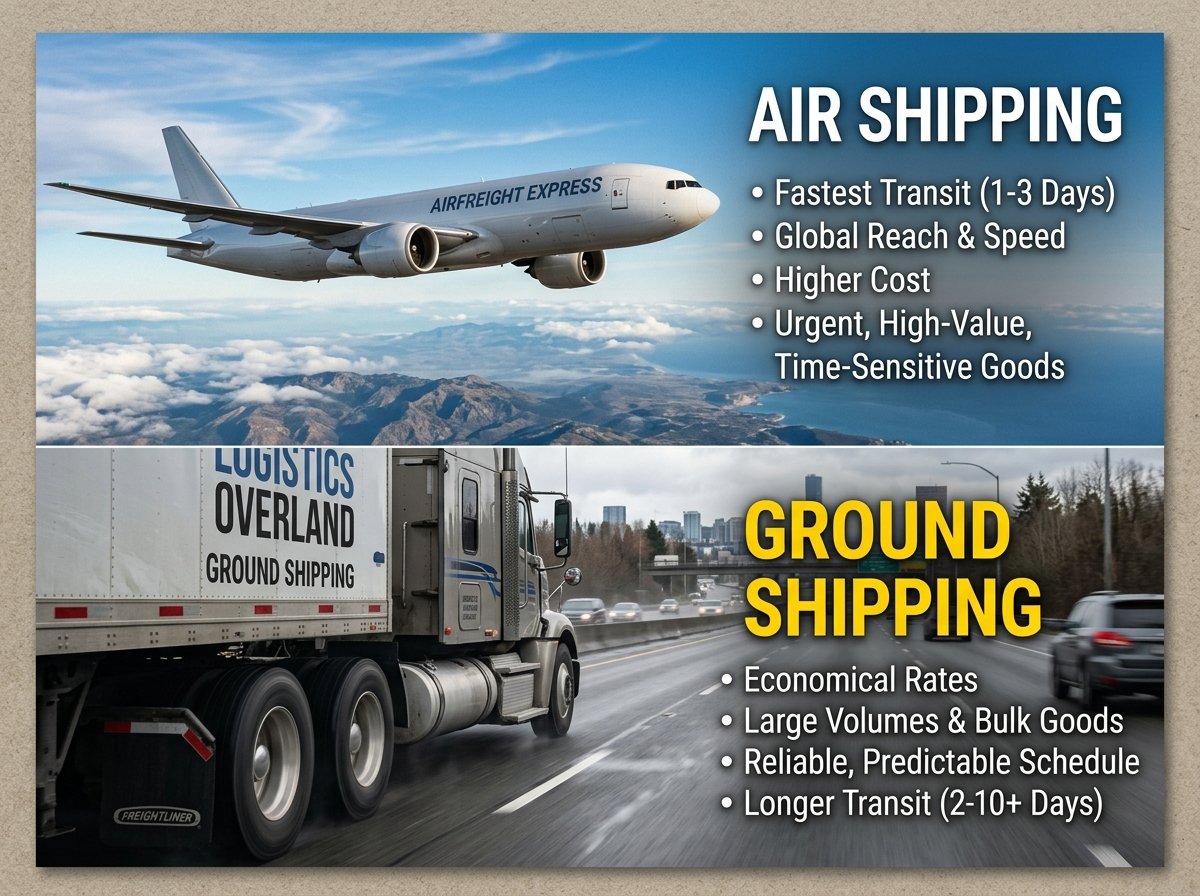
Here’s a number that might surprise you — nearly 65% of all domestic shipments in the United States still travel by ground, even though air shipping has become faster and more accessible than ever. Why? Because speed isn’t always the only thing that matters.
If you’ve ever stood at the checkout page of a shipping website, staring at “Ground” and “Air” options, you know the struggle. One’s cheaper, the other’s faster — but the real question is, which one actually makes sense for YOUR shipment?
That decision isn’t as straightforward as it seems. It depends on what you’re shipping, where it’s going, how fast you need it there, and honestly — how much you’re willing to spend. A small business owner shipping 200 orders a week thinks very differently from someone sending a birthday gift to a cousin across the country.
This article breaks down the real pros and cons of ground shipping and air shipping — not just the textbook stuff, but the practical details people actually care about. By the end, you’ll know exactly which option fits your situation.
What Ground Shipping Actually Means
Let’s start with the basics, because there’s often confusion here. Ground shipping means your package travels by road — in trucks, vans, or sometimes trains. It stays on the ground the entire time, moving through a network of distribution hubs until it reaches your door.
Major carriers like UPS, FedEx Ground, and USPS all offer ground services. The delivery window typically falls between 3 to 7 business days for domestic shipments, depending on distance. Ship something from New York to New Jersey? It might arrive in a day or two. New York to California? Expect closer to 5–7 days.
Ground shipping is the workhorse of the logistics world. It handles everything from small parcels to heavy freight. And if you’re sending something that’s big, bulky, or heavy, ground is often your only realistic option because airlines have strict weight and size restrictions.
Quick Fact: FedEx Ground alone delivers over 15 million packages every single day across the US and Canada.
What Air Shipping Actually Means
Air shipping does exactly what the name says — your package flies. It travels on cargo planes or sometimes shares space on commercial passenger flights. That’s why it’s dramatically faster, especially over long distances.
Carriers like FedEx Express, UPS Next Day Air, DHL Express, and others specialize in air freight. Domestic air shipments can arrive in 1 to 3 business days, and international air deliveries typically take 3 to 7 days depending on the destination and customs processing.
Air shipping is the go-to for urgent deliveries, time-sensitive documents, perishable goods, and high-value items where speed justifies the cost. If you’re comparing carriers for international routes, you might find our DHL vs FedEx international shipping comparison helpful.
Pro Tip: Air shipping costs are heavily influenced by dimensional weight — the size of your package relative to its actual weight. A large but light box can cost more than you’d expect by air. If you’re curious how that works, check out our guide on how dimensional weight is calculated.
The Real Pros of Ground Shipping
Ground shipping isn’t glamorous. Nobody brags about it at parties. But it quietly gets the job done — and there are solid reasons why most packages in the world still travel by road.
It’s Significantly Cheaper
This is the big one. Ground shipping costs 40% to 80% less than air shipping for the same package on the same route. That gap widens as your package gets heavier. Shipping a 30-pound box from Texas to Ohio by ground might cost you $15–$25. By air? You’re looking at $50–$90 or more.
For businesses shipping in bulk, this difference adds up fast. An eCommerce store shipping 500 packages a month could save thousands of dollars annually just by choosing ground over air. If you run an online shop and want to understand how to maximize those savings, our article on bulk shipping discounts goes deeper into this.
It Handles Heavy and Oversized Items
Try shipping a 70-pound box of car parts by air. You’ll either get rejected or pay a premium that makes you reconsider your life choices. Ground shipping handles heavy, bulky, and oversized items without batting an eye.
Furniture, machinery, auto accessories, large electronics — ground is built for this stuff. If you’re shipping something like car parts and auto accessories, ground is almost always the better route.
It’s More Environmentally Friendly
This matters more now than it did five years ago. A cargo truck emits significantly less CO₂ per ton-mile than a cargo plane. According to the International Council on Clean Transportation, air freight produces roughly 47 times more greenhouse gas emissions than ocean shipping and about 10 times more than trucking per ton-kilometer.
If sustainability is part of your brand or your personal values, ground shipping aligns better with that goal. And if you’re also thinking about eco-friendly packaging to go with it, here’s our guide on eco-friendly packaging options.
Fewer Restrictions on What You Can Ship
Airlines are strict. Really strict. Lithium batteries, aerosols, certain chemicals, perfumes, some electronics — many items face restrictions or outright bans on air transport. Ground shipping has fewer limitations, which makes it the default for anything that falls into the “hazardous” or “restricted” category.
That doesn’t mean ground shipping has zero rules. You still can’t ship illegal items or certain dangerous goods without proper classification. But compared to air, you have a lot more flexibility.
The Real Cons of Ground Shipping
No shipping method is perfect. Ground has its downsides, and you should know them before you choose.
It’s Slow Over Long Distances
This is the obvious one. If you’re shipping coast-to-coast — say, from Los Angeles to Miami — ground shipping can take a full week. For someone expecting quick delivery, that feels like an eternity. And if there’s a weekend in between, add more time.
For shorter distances (under 500 miles), ground is perfectly fine and sometimes arrives just as fast as air options at a fraction of the cost. But stretch that distance, and the gap between ground and air becomes painfully obvious.
Weather and Road Conditions Can Cause Delays
Trucks are vulnerable to things planes can often fly over — snowstorms, floods, road closures, accidents, and construction. During winter months, ground shipments across the northern US and Canada regularly face delays of 1–3 extra days. Hurricane season in the south creates similar problems.
Warning: During peak weather events, ground carriers sometimes suspend service entirely to certain regions. Always check service alerts from your carrier during winter months or storm season.
More Handling Points Mean More Risk
A ground shipment passes through multiple distribution centers, gets loaded and unloaded from several trucks, and sits in sorting facilities along the way. Each touchpoint is an opportunity for damage — or loss.
This doesn’t mean ground shipping is unreliable. Millions of packages arrive perfectly fine every day. But statistically, ground shipments have a slightly higher chance of damage compared to air, simply because of the number of handling points. Proper packaging makes a huge difference here. If you’re worried about this, read our guide on common packaging mistakes that damage parcels.
The Real Pros of Air Shipping
Air shipping exists because sometimes, speed isn’t a luxury — it’s a necessity. And it delivers on that promise consistently.
Speed Is Unmatched
Let’s not dance around this. Air shipping is fast. Really fast. A package that takes 5–7 days by ground can arrive in 1–2 days by air. For international shipping, the difference is even more dramatic. Ground/ocean freight to Europe from the US can take 2–6 weeks. Air gets it there in 3–5 days.
If you’re shipping perishable items — flowers, food, medical supplies, or live biological samples — air isn’t just preferred, it’s often required.
Better for High-Value and Fragile Items
This might sound counterintuitive, but air shipments generally experience less handling than ground ones. Your package goes from the origin facility to a plane, flies to the destination hub, and gets delivered. Fewer stops, fewer transfers, fewer opportunities for things to go wrong.
For high-value items like jewelry, expensive electronics, or artwork, air shipping combined with proper packaging and insurance gives you peace of mind. Speaking of which, our insurance for shipped packages guide explains how to protect valuable shipments.
Reliable Delivery Windows
Airlines operate on tight schedules. That predictability trickles down to shipping. Air shipping services typically have more reliable and narrower delivery windows compared to ground. When FedEx says “next day by 10:30 AM,” they mean it — and their on-time rate for priority air shipments hovers around 95–98%.
For businesses where delivery promises matter — like eCommerce stores competing with Amazon’s speed — air shipping helps you keep those promises. If you’re trying to decide between different speed tiers, our comparison of standard vs expedited shipping can help you figure out what works best.
Better Tracking and Security
Air shipments tend to have more detailed tracking updates and tighter security protocols. Cargo is screened, documented, and monitored at every stage. If you’ve ever wondered what all those tracking statuses actually mean, that’s a whole topic on its own — but the bottom line is that air shipments usually offer more visibility into where your package is at any given moment.
The Real Cons of Air Shipping
Speed comes at a price — literally and figuratively. Air shipping has drawbacks that can be deal-breakers depending on your situation.
It’s Expensive
There’s no sugarcoating this. Air shipping costs significantly more than ground. For domestic shipments, you might pay 2x to 4x more. For international shipments, the premium can be even higher.
Small, lightweight packages don’t feel the sting as much. But the moment your package gets heavier or larger, air freight costs climb steeply. And remember — airlines use dimensional weight pricing aggressively, so even a big but light package can get hit with a high bill.
Strict Size and Weight Limits
Most air carriers cap individual packages at around 150 pounds and have specific size restrictions. If your item exceeds those limits, you’re either paying massive surcharges or being told to use ground/ocean freight instead.
This makes air impractical for furniture, large equipment, bulk orders, and other oversized items. If you need to ship something like a bicycle or furniture internationally, ground or ocean freight will almost always be the better choice.
More Restrictions on Goods
We touched on this earlier, but it’s worth emphasizing as a con of air shipping specifically. Lithium-ion batteries (found in laptops, phones, power banks), flammable liquids, compressed gases, and many other items are either banned or heavily restricted on aircraft.
If you’re shipping a mobile phone or laptop, you need to know the specific airline regulations. Some carriers allow these items with proper documentation and packaging, while others refuse them entirely on air routes.
Vulnerable to Flight Delays and Cancellations
Ironically, while air shipping is generally more reliable in terms of scheduled delivery, when things go wrong, they can go really wrong. A major storm at a hub airport, air traffic control issues, or mechanical problems can cascade into significant delays. And unlike ground — where a truck can reroute — there aren’t always alternative flights available immediately.
Ground vs Air Shipping: A Side-by-Side Look
Sometimes you just want the facts laid out clearly. Here’s how the two stack up across the factors that matter most:
Cost: Ground wins by a large margin. Air is premium-priced.
Speed (Domestic): Air delivers in 1–3 days. Ground takes 3–7 days.
Speed (International): Air takes 3–7 days. Ground/ocean can take 2–8 weeks.
Weight Limits: Ground handles heavier shipments more easily. Air has strict caps.
Item Restrictions: Ground has fewer restrictions. Air bans many hazardous materials.
Reliability: Air has tighter delivery windows. Ground is more susceptible to weather and traffic.
Environmental Impact: Ground produces significantly lower emissions per package.
Tracking: Both offer tracking, but air often provides more detailed updates.
Handling/Damage Risk: Air involves fewer handling points. Ground passes through more hubs.
How to Decide: Ground or Air?
This is the part most articles skip over — the actual decision-making framework. Instead of just listing pros and cons and leaving you to figure it out, here’s how to think through your choice.
Ask Yourself These Four Questions
1. How urgent is this delivery?
If your package absolutely, positively needs to be there within 2 days — air. If you have 4+ days of flexibility, ground will save you money every time.
2. How heavy or large is the package?
Anything over 50 pounds starts making air shipping expensive. Over 100 pounds, and ground becomes almost the only sensible option for domestic routes.
3. What’s inside the package?
Hazmat items, lithium batteries, aerosols, or other restricted goods? Ground shipping will give you fewer headaches. Perishables or time-sensitive medical items? Air is likely required. Understanding what items are banned from international shipping helps you avoid surprises.
4. What’s your budget?
If cost is the primary concern and you have time flexibility, ground is the clear winner. If the cost of a late delivery (lost customer, missed deadline, expired product) outweighs the shipping premium, air pays for itself.
The Hybrid Approach Most People Don’t Consider
Here’s something smart shippers do — they mix both methods. A business might ship 80% of its orders by ground and reserve air for rush orders or VIP customers. This keeps overall shipping costs low while still offering fast delivery when it counts.
Some carriers even offer services that blend both — your package travels by air for the long-haul portion and then switches to ground for the last leg of delivery. This gives you faster-than-ground, cheaper-than-air results. It’s worth asking your carrier about these hybrid options.
If you’re running an online store and want to build a shipping strategy that balances speed and cost, our guide on how to set up automated shipping for your online store walks you through the setup process.
Real-World Scenarios: Which Shipping Makes Sense?
Let’s put this into practice with situations you might actually face.
Scenario 1: You sell handmade candles on Etsy and ship across the US.
Ground shipping, without question. Candles aren’t time-sensitive, they can be heavy in bulk, and your profit margins need protection from high shipping costs.
Scenario 2: You need to send important legal documents from New York to London.
Air. Documents are lightweight, time-sensitive, and the cost difference is minimal for small envelopes.
Scenario 3: You’re relocating abroad and need to ship personal belongings.
Ground or ocean freight for the bulk of your stuff, with maybe one air shipment for essentials you need immediately. Our guide on shipping belongings when moving abroad covers this exact situation in detail.
Scenario 4: You’re sending a birthday gift to a friend and the birthday is in 2 days.
Air. You waited too long (we’ve all been there), and ground won’t make it. Pay the premium, learn the lesson.
Scenario 5: A small business ships 300 orders per month, average weight 5 pounds, all domestic.
Start with ground as your default. Offer air as an upgrade option at checkout. Most customers choose the cheaper option. The ones who need speed will gladly pay for air.
How Shipping Costs Are Actually Calculated
Understanding how carriers price their services helps you make smarter choices. Both ground and air carriers use a combination of factors:
Actual weight vs dimensional weight — carriers compare your package’s real weight to its dimensional weight (a formula based on size) and charge based on whichever is higher. A big, light box might cost more than a small, heavy one.
Distance/zones — carriers divide delivery areas into zones. More zones between origin and destination means higher cost. This affects ground more dramatically since each zone adds road miles and time.
Service level — even within ground or air, there are tiers. Ground has economy and standard options. Air has priority, express, and overnight. Each tier has a different price point.
Surcharges — fuel surcharges, residential delivery fees, signature requirements, and peak season surcharges all add up. These apply to both ground and air but tend to be higher for air services.
If you want to get better at comparing actual prices across carriers, our guide on how to compare courier quotes gives you a practical framework.
FAQ Section
Is ground shipping always cheaper than air shipping?
For the vast majority of shipments, yes — ground is cheaper. The exception comes with very small, lightweight packages traveling short distances, where the price difference between ground and air can be negligible. Some carriers also run promotions on air services that occasionally bring the cost close to ground rates. But as a general rule, ground saves you money, especially on heavier packages.
How much faster is air shipping compared to ground?
On domestic routes, air shipping is typically 2–5 days faster. A cross-country ground shipment takes 5–7 business days, while air can deliver the same package in 1–2 days. On international routes, the gap is even wider — air takes days where ground/ocean takes weeks. The speed advantage is most dramatic over long distances.
Can I ship lithium batteries by air?
It depends on the carrier and the type of battery. Lithium-ion batteries (found in phones, laptops, and power banks) face strict regulations for air transport. Some carriers allow them if they’re installed inside a device and properly packaged. Standalone lithium batteries are often banned from air freight or require special hazmat documentation. Ground shipping is usually the easier option for items containing lithium batteries.
Which is safer for fragile items — ground or air?
Air shipping generally involves fewer handling points, which can mean less risk of damage. Your package gets loaded onto a plane, flies directly to a hub near the destination, and goes out for delivery. Ground shipments pass through multiple sorting facilities and truck transfers. That said, proper packaging matters far more than the shipping method. A well-packed fragile item will survive ground shipping just fine. A poorly packed one can break even on a short air trip.
Does ground shipping have a carbon footprint advantage?
Yes, significantly. According to environmental research data, air freight produces roughly 10 times more CO₂ emissions per ton-kilometer compared to road transport. If you’re trying to reduce your environmental impact — whether for personal reasons or as a business sustainability initiative — ground shipping is the greener choice.
Your Next Move
Choosing between ground and air shipping isn’t about which one is “better” — it’s about which one fits your specific situation right now. The package weight, the distance, the urgency, the contents, and your budget all play a role.
For most everyday shipments, ground gives you the best balance of cost and reliability. Save air for when speed genuinely matters — rush orders, perishables, time-sensitive documents, or international deliveries where you can’t afford to wait weeks.
And if you’re shipping regularly — whether for business or personal reasons — take 20 minutes to compare actual quotes from multiple carriers. You’d be surprised how much prices vary for the exact same route and package size. That small effort can save you real money over time.
The smartest shippers don’t pick one method and stick with it forever. They pick the right method for each shipment. That flexibility is what separates someone who’s good at shipping from someone who just ships.