
A lithium battery sitting inside your laptop can cause a cargo fire at 35,000 feet. Sounds dramatic? Between 2006 and 2023, the FAA recorded over 400 aviation incidents linked to lithium batteries alone. And that’s just one type of dangerous good — there are thousands of products, from perfumes to paint cans, that fall under strict shipping regulations most people don’t even know about.
Here’s the thing — you might already be shipping dangerous goods without realizing it. That bottle of nail polish remover your online store sells? Dangerous good. The car batteries your auto parts business ships weekly? Dangerous good. Even some cleaning sprays and aerosol deodorants qualify.
The rules around dangerous goods shipping aren’t just bureaucratic formalities. They exist because one mislabeled package can endanger lives, shut down transportation routes, and land you with fines running into thousands of dollars. If you ship products — whether you’re a small business owner, an e-commerce seller, or someone sending personal items abroad — you need to understand these rules.
This article breaks down everything: what counts as dangerous goods, how they’re classified, the paperwork involved, packaging requirements, and how to stay on the right side of the law. No jargon overload, no unnecessary complexity — just practical, usable knowledge.
What Exactly Are Dangerous Goods?
Let’s clear up one confusion right away. People often use “dangerous goods” and “hazardous materials” (hazmat) interchangeably. Technically, they mean different things depending on who’s talking. The International Air Transport Association (IATA) and International Maritime Organization (IMO) use “dangerous goods.” The U.S. Department of Transportation (DOT) prefers “hazardous materials.” But for practical purposes, both terms refer to the same idea: substances or items that pose a risk to health, safety, property, or the environment during transportation.
The keyword here is “during transportation.” A bottle of bleach sitting under your kitchen sink isn’t classified as a dangerous good. But the moment you put it in a box and hand it to a courier, the rules kick in.
Dangerous goods aren’t limited to obviously scary stuff like explosives or radioactive material. Everyday products qualify too. Think about perfumes (flammable liquids), lithium batteries inside phones and laptops, compressed gas cylinders, fertilizers, even certain types of food seasoning with high alcohol content.
If you’re someone who ships cosmetics and skincare products, you’ve probably already bumped into this — many beauty products contain ingredients classified as flammable or corrosive. Same goes for anyone who ships alcohol and wine, since ethanol is a Class 3 flammable liquid by definition.
The golden rule? If you’re not sure whether something qualifies as a dangerous good, check before you ship. Assuming it’s fine can be an expensive mistake.
The 9 Classes of Dangerous Goods — And Why They Matter
The United Nations (UN) has created a globally recognized classification system that groups dangerous goods into 9 classes based on the type of hazard they present. Every shipping regulation worldwide — whether it’s IATA for air, IMDG Code for sea, or ADR for road — uses these same 9 classes.
Here’s what each class covers:
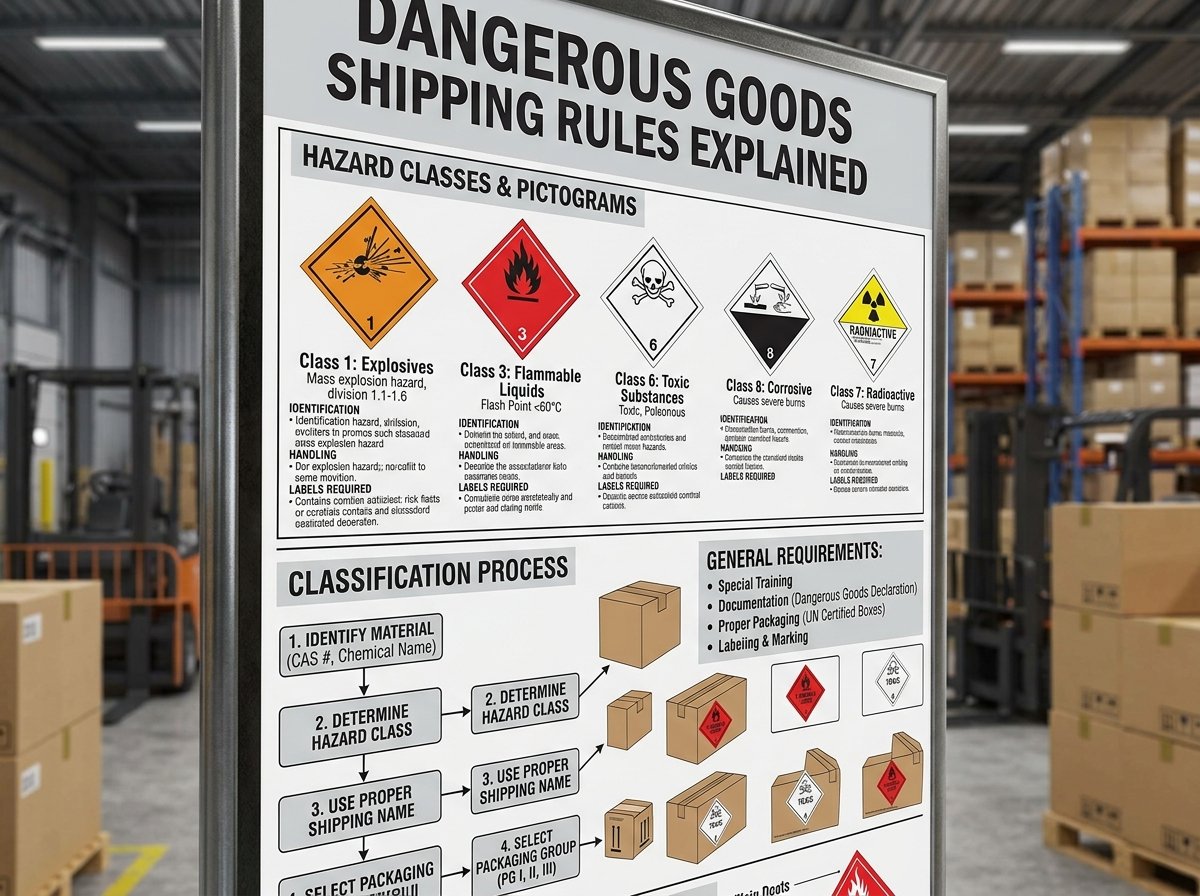
Class 1: Explosives — Fireworks, ammunition, detonators, flares. These are divided into 6 sub-divisions based on the blast risk and whether they produce fragments, fire, or just minor effects.
Class 2: Gases — Compressed, liquefied, or dissolved gases. This includes propane tanks, aerosol sprays, fire extinguishers, and even small camping gas cartridges. Class 2 is split into flammable gases (2.1), non-flammable/non-toxic gases (2.2), and toxic gases (2.3).
Class 3: Flammable Liquids — Gasoline, acetone, alcohol, paint, perfume, nail polish remover. If it has a flash point below 60°C, it likely falls here.
Class 4: Flammable Solids — Matches, sulfur, magnesium, certain metal powders. Includes substances that can spontaneously combust or produce flammable gases when wet.
Class 5: Oxidizing Substances & Organic Peroxides — Hydrogen peroxide, ammonium nitrate, bleach in concentrated forms. These substances can intensify a fire even without an external ignition source.
Class 6: Toxic & Infectious Substances — Pesticides, clinical waste, biological samples, certain medical products. Sub-divided into toxic substances (6.1) and infectious substances (6.2).
Class 7: Radioactive Material — Medical isotopes, certain industrial testing equipment, smoke detectors (yes, some contain small amounts of radioactive material).
Class 8: Corrosives — Batteries (especially lead-acid), sulfuric acid, sodium hydroxide, mercury. Anything that can destroy living tissue or corrode metals on contact.
Class 9: Miscellaneous Dangerous Goods — The “catch-all” category. Lithium batteries, dry ice, magnetized material, environmentally hazardous substances, and asbestos all sit here.
⚠️ Warning: A single product can fall into multiple risk categories. A lithium battery, for example, is Class 9 normally but can become a fire risk (Class 4-adjacent behavior) if damaged. Classification isn’t always straightforward, and getting it wrong has real consequences.
Understanding which class your product belongs to is the first step in the entire process. Everything that follows — the packaging, labeling, documentation, and choice of carrier — depends on this classification.
Who Sets the Rules? The Regulatory Bodies You Need to Know
Dangerous goods shipping isn’t governed by a single set of rules. Multiple organizations create and enforce regulations depending on the mode of transport and the countries involved.
For air freight, the International Air Transport Association (IATA) publishes the Dangerous Goods Regulations (DGR) — a manual updated every year. If you’re flying anything classified as dangerous, IATA DGR is your bible. Airlines follow these rules without exception, and IATA-trained staff inspect shipments before they go on any aircraft.
For sea shipping, the International Maritime Organization (IMO) maintains the International Maritime Dangerous Goods (IMDG) Code. This governs how dangerous goods move on cargo and container ships globally.
For road transport within Europe, the ADR (Agreement concerning the International Carriage of Dangerous Goods by Road) applies. In the United States, the DOT’s 49 CFR (Code of Federal Regulations) covers ground transportation of hazmat.
And then there’s the UN Model Regulations, which serve as the foundation that all these other bodies build upon. The UN assigns each dangerous substance a four-digit UN number (like UN 1203 for gasoline or UN 3481 for lithium-ion batteries packed with equipment) that’s universally recognized.
📌 Quick Fact: IATA’s Dangerous Goods Regulations manual runs over 1,000 pages and costs around $300 per annual edition. That tells you just how detailed these rules get.
The practical takeaway? You need to know which regulatory body applies to your shipment. Shipping a package by air from London to New York? IATA rules, UK CAA regulations, and FAA rules all apply simultaneously. Sounds overwhelming, but most commercial couriers handle the regulatory layering for you — as long as you declare your goods correctly.
Packaging Dangerous Goods: It’s Not Optional, It’s Law
Packaging for dangerous goods isn’t a suggestion. It’s a legally mandated process with UN-certified packaging specifications that you must follow.
Every package carrying dangerous goods needs to use containers that have been tested and certified to UN performance standards. You’ll recognize these by the UN marking stamped on them — a code that starts with the UN emblem (a circle with “UN” inside) followed by numbers and letters indicating the packaging type, material, performance level, and what it’s certified to carry.
Here’s what the testing involves: UN-certified packaging goes through drop tests, stacking tests, leak-proofing tests, and internal pressure tests. A regular Amazon shipping box doesn’t cut it. You need packaging specifically designed and tested for the hazard class you’re shipping.
The packaging has three layers of protection:
Inner packaging holds the actual dangerous substance — this could be a glass bottle, plastic container, or metal can depending on the material.
Intermediate packaging goes around the inner container and provides cushioning and absorption. For liquids, this often includes absorbent material that can soak up the full quantity if the inner container breaks.
Outer packaging is the final shipping box or drum. It must be sturdy enough to withstand normal transportation conditions — drops, vibrations, stacking, temperature changes.
If you ship mobile phones or laptops, you already know lithium batteries require special attention. Devices with batteries installed must be protected from short circuits — that means ensuring the device can’t accidentally turn on during transit and the battery terminals aren’t exposed. Damaged or recalled batteries? Most carriers won’t accept them at all.
The packaging requirements change based on whether you’re shipping by air, sea, or ground. Air transport has the strictest rules because the consequences of a packaging failure at altitude are the most severe. Even the allowable quantities per package differ between transport modes.
💡 Pro Tip: Don’t try to save money by reusing old packaging for dangerous goods shipments. Regulators inspect packaging conditions, and used or damaged UN-certified packaging can lead to your shipment being rejected — or worse, fines if an incident occurs.
If you’re unsure about packaging choices, our guide on common packaging mistakes that damage parcels covers general principles, but for dangerous goods specifically, always refer to the packaging instructions published in the IATA DGR or IMDG Code for your specific UN number.
Labeling and Marking: The Visual Warning System
Think of dangerous goods labels as a universal language. A firefighter in Tokyo, a cargo handler in Dubai, and an emergency responder in São Paulo all need to instantly understand what’s inside a package without opening it. That’s what the labeling system achieves.
Every dangerous goods package must display the correct hazard label — a diamond-shaped symbol that corresponds to the UN class. You know those diamonds on the back of tanker trucks? Same system, scaled down for packages.
Class 1 has an exploding bomb symbol. Class 3 shows a flame. Class 6 has a skull and crossbones. Class 7 uses the trefoil radiation symbol. Each label is color-coded too — red for flammables, yellow for oxidizers, white for toxic or infectious, and so on.
Beyond the hazard label, packages must also show:
The UN number preceded by the letters “UN” — for example, “UN 1993” for a flammable liquid. This number is specific to the substance, not the hazard class.
The Proper Shipping Name (PSN) — the official, standardized name for the substance. You can’t write “perfume” on the label; the proper shipping name is “Perfumery products with flammable solvents.” The PSN comes from the UN’s dangerous goods list, and using the wrong name is a compliance violation.
Shipper and consignee details — full name, address, and contact information for both the sender and the receiver.
Handling labels where applicable — “This Way Up” arrows for liquids, “Cargo Aircraft Only” labels for items not permitted on passenger flights, quantity limitations marks, and overpack indicators.
⚠️ Warning: Placing labels in the wrong position on the package, using labels that are too small, or using labels that have faded or become unreadable can all result in your shipment being rejected or penalized. Labels must be printed, not handwritten, and placed on the same surface of the package (not across a seam or fold).
Documentation: The Paperwork Nobody Enjoys But Everyone Needs
You can’t ship dangerous goods with just a standard shipping label and a prayer. There’s specific documentation required, and missing even one field on a form can delay or block your shipment entirely.
The most critical document is the Dangerous Goods Declaration (DGD) — sometimes called the Shipper’s Declaration for Dangerous Goods. This is a standardized form (IATA has a specific format for air shipments) where the shipper provides detailed information about what’s being shipped.
A proper DGD includes the UN number, the proper shipping name, the hazard class, the packing group (I, II, or III — indicating how dangerous the substance is within its class), the quantity and type of packaging, and a signed certification that the shipment has been prepared according to applicable regulations.
That signature matters. By signing the DGD, you’re legally certifying that you’ve correctly identified, classified, packaged, marked, and labeled the shipment. If something goes wrong and investigators find that the declaration was inaccurate, the person who signed it faces personal liability — not just the company.
For international shipments, you’ll also need customs documentation that accurately describes the dangerous goods, along with any Safety Data Sheets (SDS) for chemical products. Some countries require additional permits or pre-notification for specific hazard classes.
📌 Did You Know? Between 2019 and 2024, IATA reported that approximately 35% of dangerous goods violations found during audits were related to incorrect or incomplete documentation — making it the single most common compliance failure.
If you’re shipping across borders, understanding the items banned from international shipping in your destination country is equally critical. Some dangerous goods that are legal to transport domestically might be completely prohibited for import in another country.
Shipping Modes: Different Rules for Air, Sea, and Ground
The rules for dangerous goods aren’t the same across all transport modes, and this trips up a lot of shippers.
Air transport is the strictest. IATA classifies certain dangerous goods as “Forbidden on all aircraft” — full stop, no exceptions, no special permits. Other items fall under “Cargo Aircraft Only (CAO)” — meaning they can fly, but not on passenger planes. And then there are items permitted on passenger aircraft but only within strict quantity limits.
Lithium batteries are a good example. A small lithium-ion battery inside a phone (under 100 watt-hours) can fly on a passenger aircraft. A large lithium-ion battery over 300 watt-hours? Forbidden on all aircraft without special approval. The thresholds are very specific, and airlines check them rigorously.
Sea transport under the IMDG Code is generally more accommodating in terms of quantity. Ships can carry larger volumes of dangerous goods than planes, and the packaging requirements, while still strict, allow for heavier and bulkier containers. But sea transport introduces other challenges — the salt air, humidity, temperature fluctuations, and the sheer duration of voyages (weeks instead of hours) create corrosion and degradation risks that air freight doesn’t have.
Ground transport is usually the most flexible, especially for domestic shipments. Most countries have a “limited quantity” or “small quantity” exemption that allows you to ship certain dangerous goods by road with simplified packaging and labeling — as long as the quantity per package stays below a specified threshold. This is how your local courier delivers aerosol cans and consumer goods containing hazardous ingredients without requiring full DG compliance.
If you’re weighing your options between air and ground, our comparison of ground vs air shipping pros and cons covers the general tradeoffs. But for dangerous goods specifically, ground shipping is often not just cheaper — it’s sometimes the only viable option for certain hazard classes.
Training Requirements: You Can’t Wing It
Here’s something many small business owners miss: you legally need training to ship dangerous goods. This isn’t optional, and “I didn’t know” isn’t a defense that works with regulators.
Under IATA rules, anyone involved in preparing dangerous goods for air transport — that includes the person packing the shipment, the person completing the documentation, and the person offering the package to the airline or courier — must complete a certified dangerous goods training program and pass an assessment. This training is valid for 24 months (recently changed from 24 to 24 months — IATA harmonized this across categories), after which you need recurrent training.
The DOT in the United States has similar requirements under 49 CFR. Even ground shippers of hazmat must be trained, and the employer is responsible for ensuring their employees are qualified.
Training programs are offered by IATA itself, by national aviation authorities, and by dozens of private training companies worldwide. Costs range from $200 for basic online courses to over $1,000 for comprehensive classroom-based programs covering all transport modes.
💡 Pro Tip: If you only occasionally ship dangerous goods and the training requirement feels like overkill, consider using a dangerous goods shipping agent or a freight forwarder certified in DG handling. They’ll prepare the shipment on your behalf. You’ll pay a service fee, but you’ll avoid the training costs, compliance risks, and the headache of staying current with annual regulation changes.
Penalties for Getting It Wrong
Let’s talk consequences, because the penalties for non-compliant dangerous goods shipping are genuinely severe.
In the United States, the Pipeline and Hazardous Materials Safety Administration (PHMSA) can impose civil penalties up to $96,624 per violation per day (as of 2024, adjusted annually for inflation). Criminal penalties for knowingly violating hazmat regulations can reach $500,000 in fines and up to 10 years in prison.
In the UK, the Civil Aviation Authority can prosecute under the Air Navigation (Dangerous Goods) Regulations. Fines are unlimited, and imprisonment is possible for serious violations.
Airlines themselves also impose penalties. If a carrier discovers an undeclared or mis-declared dangerous goods shipment, they’ll typically issue a IATA Dangerous Goods Occurrence Report, which can lead to the shipper being blacklisted from that carrier. Some airlines share these reports across the industry.
And beyond formal penalties, there’s the practical damage. An incident caused by improperly shipped dangerous goods can lead to lawsuits, insurance claim denials, reputation damage, and loss of shipping privileges with major carriers.
📌 Real Example: In 2023, a freight forwarder in California was fined over $150,000 by PHMSA for repeatedly shipping undeclared lithium batteries by air. The batteries had been described as “electronic accessories” on the shipping documents — a deliberate misdeclaration that investigators uncovered during a routine audit.
The message is clear: cutting corners on dangerous goods compliance isn’t a calculated risk — it’s a gamble with terrible odds.
Practical Tips for Shipping Dangerous Goods Safely
After all the regulation talk, let’s get practical. If you need to ship dangerous goods, here’s how to approach it step by step.
Start with the Safety Data Sheet (SDS). If you’re shipping a chemical product, the manufacturer’s SDS will tell you the UN number, hazard class, and packing group. This single document gives you 80% of the information you need to classify your shipment correctly.
Contact your carrier early. Don’t pack and label everything, then show up at the courier counter expecting them to accept it. Call ahead. Major carriers like DHL, FedEx, and UPS all have dedicated dangerous goods departments. Tell them what you’re shipping, the quantity, and the destination. They’ll tell you if they can carry it, what documentation they need, and any specific packaging requirements they enforce on top of the regulatory minimum.
Use a DG-certified packing company if you’re not trained or if you’re shipping high-risk items. These companies specialize in dangerous goods preparation and will handle the classification, packaging, labeling, and documentation for you. They carry their own insurance, which adds another layer of protection.
Keep records of everything. Copies of your DGD, training certificates, packaging test reports, carrier acceptance confirmations — file all of it. Regulators can request documentation for shipments going back several years, and having organized records turns a potential nightmare audit into a smooth process.
If you’re running an e-commerce business that ships products falling into dangerous goods categories, integrating compliance checks into your automated shipping setup for your online store can save you enormous time and reduce human error.
Special Attention: Lithium Batteries
Lithium batteries deserve their own section because they’re the single most commonly shipped dangerous good and the single most common source of violations.
Almost every consumer electronic device contains a lithium battery — phones, laptops, tablets, e-readers, wireless headphones, power banks, drones, electric toothbrushes. If you ship mobile phones or laptops regularly, you’re shipping dangerous goods every single time.
There are two types: lithium-ion (rechargeable, UN 3480/3481) and lithium metal (non-rechargeable, UN 3090/3091). The rules differ slightly between them, but both are classified as Class 9 dangerous goods.
The key variables are whether the batteries are shipped alone (standalone), packed with equipment (battery and device in the same box but not installed), or contained in equipment (battery installed in the device). Each scenario has different packaging, labeling, and quantity requirements.
For air shipments, standalone lithium-ion batteries must be shipped at a state of charge no higher than 30% of their rated capacity. This rule exists specifically because fully charged batteries are more likely to experience thermal runaway — the chain reaction that causes fires.
⚠️ Warning: Damaged, defective, or recalled lithium batteries are forbidden for air transport under any circumstances. If you’re handling returns of electronic devices, inspect the battery condition before offering the return shipment to any carrier for air transport.
FAQ Section
Can I ship dangerous goods through regular courier services like FedEx or UPS?
Yes, but with conditions. Major couriers like FedEx, UPS, and DHL all accept certain dangerous goods, but they require proper classification, UN-certified packaging, correct labeling, and a completed Dangerous Goods Declaration. Not all their services support DG shipments — often only specific service tiers handle them. You also need to be a registered DG shipper with the carrier, which usually means providing proof of training. Consumer drop-off locations generally won’t accept dangerous goods; you’ll need to arrange a pickup or use a specialized shipping center.
What happens if I accidentally ship something without knowing it’s a dangerous good?
Ignorance doesn’t exempt you from liability. If the shipment is discovered during transit — through X-ray screening, routine inspections, or after an incident — the carrier will quarantine the package and file a report. You could face fines, be banned from the carrier’s services, and in serious cases, face criminal prosecution. This is why it’s so important to check the classification of everything you ship. If you’re not sure, look up the product’s Safety Data Sheet, consult the UN dangerous goods list, or call your carrier’s DG support team before shipping.
Are there any dangerous goods I can ship without full DG compliance?
Yes — many dangerous goods qualify for “limited quantity” or “excepted quantity” exemptions. These exemptions apply when the amount per inner container and per package falls below specific thresholds. Products shipped under limited quantity rules still need special marking (a diamond-shaped “LTD QTY” mark), but the full DGD paperwork and UN-certified packaging aren’t required. Consumer products like aerosol hairsprays, small perfume bottles, and nail polish often fall within these limits. But the exemptions have strict quantity caps and don’t apply to all hazard classes — explosives and radioactive materials, for instance, generally don’t qualify.
Do shipping costs increase for dangerous goods?
Almost always, yes. Carriers charge a DG surcharge on top of standard shipping rates — this can range from $30 to $150+ per package depending on the carrier, the hazard class, and the transport mode. Air freight for dangerous goods costs significantly more than ground. You might want to understand how shipping rates are calculated and compare quotes from multiple carriers, since DG surcharges vary widely.
Do I need to worry about dangerous goods rules for domestic shipping too?
Absolutely. While international shipments face the combined scrutiny of multiple regulatory bodies, domestic shipments are still governed by national regulations — DOT’s 49 CFR in the US, ADR-adapted rules in European countries, and equivalent legislation elsewhere. The training, packaging, and documentation requirements still apply. Ground transport offers more exemptions and higher quantity thresholds than air, but “domestic” doesn’t mean “unregulated.”
Your Next Step
Shipping dangerous goods isn’t something you figure out on the fly. The regulations are detailed, the penalties are real, and the safety stakes couldn’t be higher. But here’s the encouraging part — once you understand the system, it’s logical. Classify the product. Choose the right packaging. Label it correctly. Complete the documentation. Use a carrier that accepts DG shipments. That’s the flow, and each step has clear guidelines telling you exactly what to do.
If you’re shipping products that might be classified as dangerous goods, take 20 minutes today and look up the Safety Data Sheets for your top-selling items. You might discover you’ve been shipping hazardous materials all along — and now’s the time to get it right before a regulator, a carrier, or an accident forces the issue.
For a broader look at what you can and can’t ship across borders, check out our guide on items banned from international shipping — it covers restrictions you might not expect, even for products that seem completely harmless.