
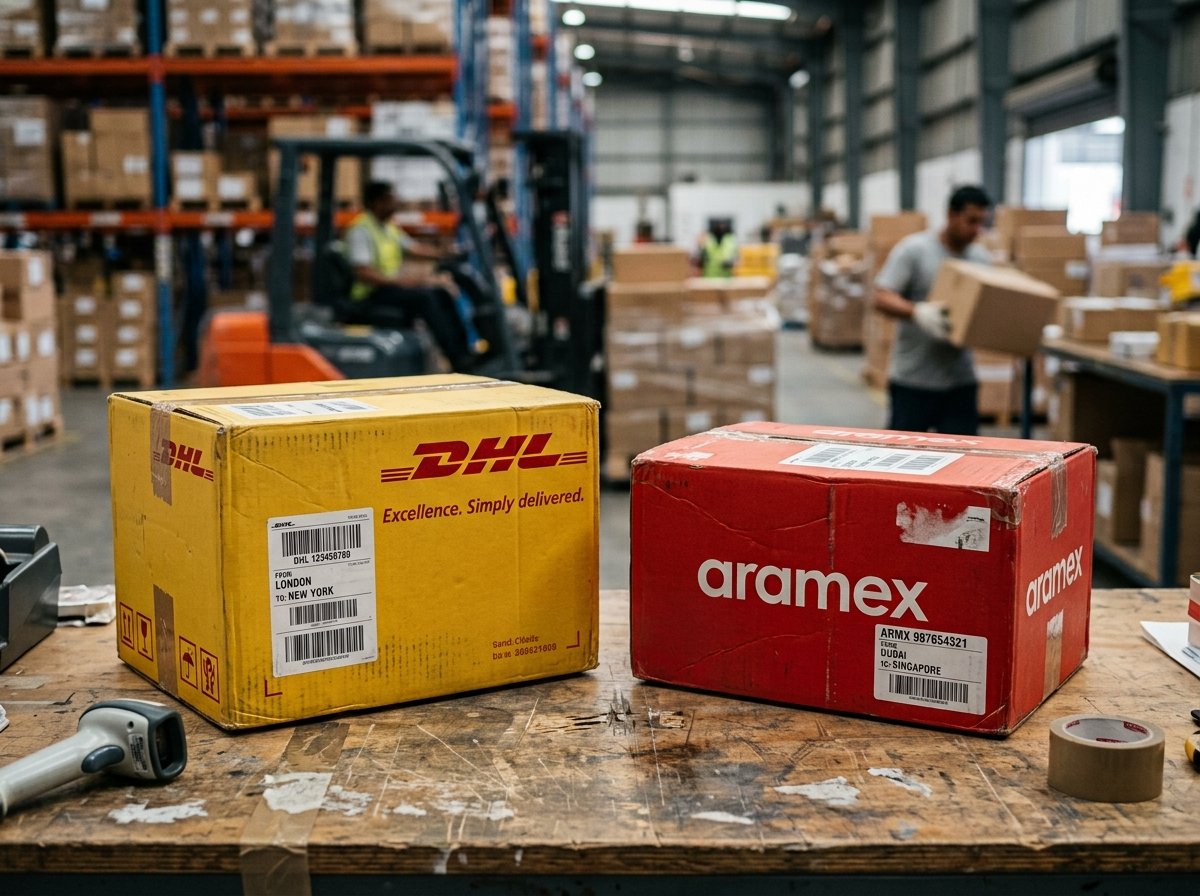
You’ve got a package to send — maybe it’s going to Dubai, maybe Berlin, maybe across the street in Riyadh. You open two tabs: Aramex and DHL. Both look legit. Both promise fast delivery. And both have enough service options to make your head spin.
So here’s the real question: which one should you actually trust with your shipment?
This isn’t a simple “one is better than the other” situation. Aramex and DHL serve very different customers in very different ways. The right pick depends on where you’re shipping, what you’re sending, how fast you need it there, and honestly — how much you’re willing to spend.
Let me break this down properly so you can make a decision that actually makes sense for your situation.
A Quick Look at Both Companies
Before we compare anything, let’s understand who we’re dealing with here.
DHL is a German logistics giant founded in 1969. It’s part of the Deutsche Post DHL Group — one of the largest postal and logistics companies on the planet. DHL operates in over 220 countries and territories, employs more than 600,000 people, and generated revenue exceeding €81 billion in 2023. They’ve built an enormous global infrastructure with dedicated air freight networks, massive sorting hubs, and their own fleet of cargo aircraft.
Aramex, on the other hand, was founded in 1982 in Amman, Jordan. It’s a much smaller company by comparison, but that doesn’t mean it’s a lightweight. Aramex operates across 65+ countries, has a strong presence in the Middle East, North Africa, and South Asia, and was actually the first Arab-based company to be listed on the NASDAQ. In 2022, Abu Dhabi’s sovereign wealth fund acquired Aramex, giving it fresh financial muscle.
Think of it this way — DHL is the international airline with routes everywhere. Aramex is the regional carrier that knows certain routes better than anyone else.
Coverage and Network Reach
This is where the difference gets really obvious.
DHL’s global network is massive. If you’re shipping from São Paulo to Seoul, from Lagos to London, or from Toronto to Tokyo, DHL has direct routes and established infrastructure. Their Express division alone operates around 260 dedicated aircraft and uses more than 36,000 service points worldwide. No matter how remote the destination, DHL probably has a way to get your package there.
Aramex plays a different game. Their strength is regional depth, not global breadth. If you’re shipping within the Middle East — say from Dubai to Jeddah, or from Cairo to Amman — Aramex often delivers faster and cheaper than DHL. Their ground network in GCC countries and the broader MENA region is genuinely excellent. They also have solid operations in South Asia, particularly in India and Pakistan.
But try shipping from Aramex’s network to somewhere in South America or Central Africa, and you’ll probably notice the limitations. They rely on partner networks for many destinations outside their core regions.
Quick Fact: DHL handles approximately 1.8 billion parcels per year globally. Aramex handles a fraction of that, but their per-shipment attention in regional corridors is often stronger.
The takeaway? If your shipments cross continents regularly, DHL gives you broader reach. If most of your shipping stays within the Middle East or connects to South Asia, Aramex could actually serve you better.
Shipping Speed – Who Delivers Faster?
Speed is tricky to compare because it depends on the route, service level, and what you’re sending. But let’s look at the general picture.
DHL Express is one of the fastest international shipping services available. For their Express Worldwide service, typical delivery times look like this:
- Within Europe: 1–2 business days
- Europe to North America: 2–3 business days
- Middle East to Europe/US: 2–4 business days
- Asia to Europe: 2–3 business days
DHL also offers Same Day and Time Definite services for urgent shipments, guaranteeing delivery by a specific time. These premium services cost more, but the reliability is hard to beat.
Aramex Express offers competitive speeds, especially on their home turf:
- Within GCC countries: 1–2 business days
- Within MENA region: 2–3 business days
- Middle East to Europe: 3–5 business days
- Middle East to US: 4–7 business days
For domestic and regional deliveries in the Middle East, Aramex often matches or beats DHL’s speed. That last-mile delivery network they’ve built in cities like Dubai, Riyadh, and Cairo is genuinely fast.
Once you go international though — especially to destinations in the Americas or East Asia — DHL’s dedicated air network gives it a clear speed advantage. If you’re curious about the difference between standard and expedited shipping, understanding transit time expectations can help you pick the right service tier.
Pro Tip: Don’t just compare advertised delivery times. Check real customer reviews for your specific route. A courier might promise 3-day delivery but consistently take 5 days on certain corridors.
Pricing – Who’s Easier on Your Wallet?
Let’s be honest — this is probably why you’re reading this article.
Aramex is generally cheaper than DHL, especially for shipments within the Middle East and to South Asia. Their pricing structure tends to be more accessible for individuals and small businesses. Aramex also runs frequent promotions, particularly for e-commerce sellers, and their Shop & Ship service (which gives you a US/UK address for online shopping) has attracted millions of users because of competitive forwarding rates.
DHL is more expensive, and they don’t hide from that fact. You’re paying for their massive infrastructure, reliability, and global reach. A package that costs you $30 to send via Aramex within the Gulf might cost $45–60 through DHL Express.
Here’s a rough comparison for a 2kg package:
Dubai to London:
- Aramex Express: ~$35–50
- DHL Express: ~$55–80
Dubai to New York:
- Aramex: ~$45–65
- DHL Express: ~$70–100
Riyadh to Cairo:
- Aramex: ~$20–30
- DHL Express: ~$35–50
These numbers fluctuate based on dimensions, fuel surcharges, and seasonal demand. Always get a fresh quote. Understanding how shipping rates are calculated can help you anticipate costs better — things like dimensional weight can completely change your final bill.
Did You Know? Aramex’s Shop & Ship service has over 5 million registered users across the Middle East, making it one of the most popular cross-border shopping solutions in the region.
The pricing verdict: If budget matters and you’re shipping regionally, Aramex saves you real money. For international shipments where speed and reliability are non-negotiable, DHL’s premium price comes with premium performance.
Tracking and Technology
Both companies offer real-time tracking, but the experience differs.
DHL’s tracking system is one of the most detailed in the industry. You get updates at almost every stage — pickup, sorting facility, customs clearance, departure scan, arrival scan, out for delivery, delivered. Their app and website provide estimated delivery windows, and you can reroute packages, schedule specific delivery times, and even authorize delivery to neighbors. DHL’s On Demand Delivery feature gives recipients real control.
Aramex’s tracking has improved a lot over the past few years, but it’s still not quite as granular as DHL’s. You get the essential updates — pickup, in transit, out for delivery, delivered — but the in-between scans can sometimes be sparse, especially on international routes. Their app works well for Shop & Ship users, but the overall tracking experience feels a step behind DHL’s.
If tracking accuracy is important to you, it’s worth knowing how to understand different tracking statuses so you’re not left guessing what “in transit” actually means.
Warning: Neither company is perfect with tracking notifications. Occasional delays in scan updates happen with both, especially during customs processing. Don’t panic if tracking goes quiet for 24–48 hours during international transit.
Customer Service Experience
This is where personal experiences vary wildly, so let me share what the general pattern looks like based on thousands of customer reviews across Trustpilot, Google Reviews, and regional platforms.
DHL’s customer service benefits from their scale. They have dedicated phone lines in most countries, email support, live chat, and even WhatsApp support in some regions. Response times are generally reasonable — you can usually reach a human within minutes during business hours. Their complaints resolution process is structured, and for Express shipments, there’s a clear escalation path.
That said, DHL isn’t perfect. Common complaints include rigid policies on redelivery, and sometimes the local delivery partner’s quality doesn’t match the global brand’s standards.
Aramex customer service is… a mixed bag. In their core markets (UAE, Saudi Arabia, Jordan), support is generally responsive. But outside those regions, reaching someone who can actually solve your problem gets harder. Social media complaints about Aramex’s customer service are more frequent, particularly around delayed deliveries and difficulty getting refunds.
If something goes wrong — say your package is marked delivered but hasn’t arrived — having a responsive customer support team makes all the difference. DHL has a slight edge here on consistency.
Customs Handling and International Expertise
Here’s where DHL really flexes its muscles.
DHL has dedicated customs brokerage teams in virtually every country they operate in. They handle duty calculations, pre-clearance documentation, and can even prepay customs duties on your behalf (DHL Duty Tax Paid service). For businesses doing regular international shipments, this expertise saves enormous headaches.
Aramex handles customs too, and they’re quite efficient within the MENA region. Their understanding of Gulf Cooperation Council customs regulations is deep. But for shipments going to the EU, US, or Australia — where customs rules can get complicated — DHL’s experience and automation give it a noticeable advantage.
If you’re shipping to specific countries, checking the shipping restrictions to the USA, UK, or Australia before booking with either courier will save you from nasty surprises at customs.
Pro Tip: Always include a detailed commercial invoice with international shipments through either courier. Vague descriptions like “gift” or “goods” cause customs delays regardless of which company you use.
E-Commerce and Business Solutions
Both companies want your business if you’re running an online store. But their offerings differ in interesting ways.
DHL eCommerce Solutions is a separate division built specifically for online retailers. They offer international packet delivery, fulfillment services, returns management, and integration with major platforms like Shopify, WooCommerce, and Magento. DHL’s global fulfillment network means you can store inventory in multiple countries and ship locally — reducing both cost and delivery time for your customers.
Aramex has built a solid e-commerce toolkit for the Middle Eastern market. Their services include cash-on-delivery (still huge in the Gulf and North Africa), last-mile delivery with flexible scheduling, and warehouse/fulfillment services in key MENA markets. For online sellers targeting customers in Saudi Arabia, UAE, Egypt, or Kuwait, Aramex’s understanding of local buyer behavior — including the preference for COD — gives them a real advantage.
If you’re an online seller trying to figure out how to handle returns for your business, both companies offer reverse logistics. DHL’s returns system is more polished globally, while Aramex’s is well-suited for Middle Eastern customers.
For high-volume shippers, understanding bulk shipping discounts from both providers can significantly impact your margins.
What Are People Actually Saying?
I went through hundreds of recent reviews (2024–2025) on Trustpilot, Reddit, and regional forums. Here’s the honest summary:
What DHL users praise:
- Reliable and fast international delivery
- Excellent tracking granularity
- Professional handling of fragile items
- Strong customs clearance process
What DHL users complain about:
- High prices, especially for small/light packages
- Rigid redelivery windows
- Extra fees that aren’t always clear upfront (remote area surcharges, for example)
What Aramex users praise:
- Affordable regional shipping
- Shop & Ship is a lifesaver for online shopping
- Good last-mile delivery in Gulf cities
- Cash-on-delivery option for e-commerce
What Aramex users complain about:
- International shipments take longer than promised
- Tracking can go silent for days
- Customer service responsiveness outside the Gulf
Head-to-Head: Which One Wins in Specific Scenarios?
Let me give you direct answers for common shipping situations:
Shipping within the Middle East? Aramex wins. Better prices, faster regional delivery, deeper local network.
Shipping from the Middle East to Europe or the US? DHL wins. Faster transit, better customs handling, more reliable tracking.
Running an e-commerce store in the Gulf? Aramex wins for local/regional fulfillment, especially with COD. DHL wins if you’re shipping globally.
Sending something fragile or high-value internationally? DHL wins. Their handling standards and insurance options for shipped packages are more comprehensive.
Budget shipping for personal items? Aramex wins on price. If you’re sending personal belongings — say you’re shipping belongings while moving abroad — Aramex’s rates for the MENA/South Asia corridor are hard to beat.
Need guaranteed delivery by a specific time? DHL wins. Their Time Definite services come with real guarantees backed by refund policies.
You might also find it helpful to see how DHL stacks up against FedEx if you’re considering other international options beyond Aramex.
So, Which Should You Actually Choose?
There’s no single winner here, and anyone telling you otherwise is oversimplifying.
Choose Aramex if:
- Your shipments mostly stay within the Middle East, North Africa, or South Asia
- Budget is a primary concern
- You sell online and need COD in the Gulf
- You use Shop & Ship for personal international purchases
- You’re a small business or individual shipper looking for value
Choose DHL if:
- You ship internationally across multiple continents
- Speed and reliability are your top priorities
- You need strong customs brokerage support
- Your shipments are high-value, fragile, or time-sensitive
- You run a global e-commerce operation
- You need guaranteed delivery windows
And here’s something most comparison articles won’t tell you: many smart businesses use both. They ship regionally through Aramex (saving money) and internationally through DHL (buying reliability). That’s not a cop-out answer — it’s genuinely the most practical approach if you ship regularly.
Your best move right now? Get quotes from both for your specific shipment. Compare the actual prices, transit times, and service terms for your exact route. That ten minutes of research will tell you more than any comparison article ever could.
FAQ
Is Aramex cheaper than DHL?
Yes, Aramex is generally cheaper, especially for shipments within the Middle East and to South Asia. The difference can be 30–50% on regional routes. For international shipments to Europe or the Americas, the price gap narrows, and DHL sometimes offers better value when you factor in speed and reliability.
Does Aramex deliver faster than DHL internationally?
Not typically. DHL’s dedicated air network and global infrastructure give it faster international transit times. Within the Middle East and Gulf region though, Aramex often matches or beats DHL’s delivery speed because of their deeper last-mile network in those markets.
Can I use Aramex Shop & Ship with DHL?
No. Shop & Ship is an Aramex-exclusive service that gives you forwarding addresses in the US, UK, and other countries. You shop online, ship to your Aramex address, and they forward it to you. DHL doesn’t offer an equivalent consumer-facing mail forwarding service — their focus is on direct shipping solutions.
Which is better for e-commerce businesses — Aramex or DHL?
It depends on where your customers are. For sellers focused on the Gulf, MENA, or South Asian markets, Aramex offers better regional rates and critical features like cash-on-delivery. For global e-commerce with customers spread across continents, DHL’s broader network and fulfillment infrastructure make it the stronger choice.
What happens if my Aramex or DHL package gets lost?
Both companies have claims processes for lost or damaged packages. DHL’s process is more standardized globally, and their Express services come with built-in limited liability coverage. Aramex also handles claims but response times can vary by region. With either courier, purchasing additional shipping insurance is worth considering for valuable items.
Pick the courier that fits your route, your budget, and your priorities. And if you’re still unsure? Start with a single test shipment through each. Real experience beats every comparison guide — including this one.