
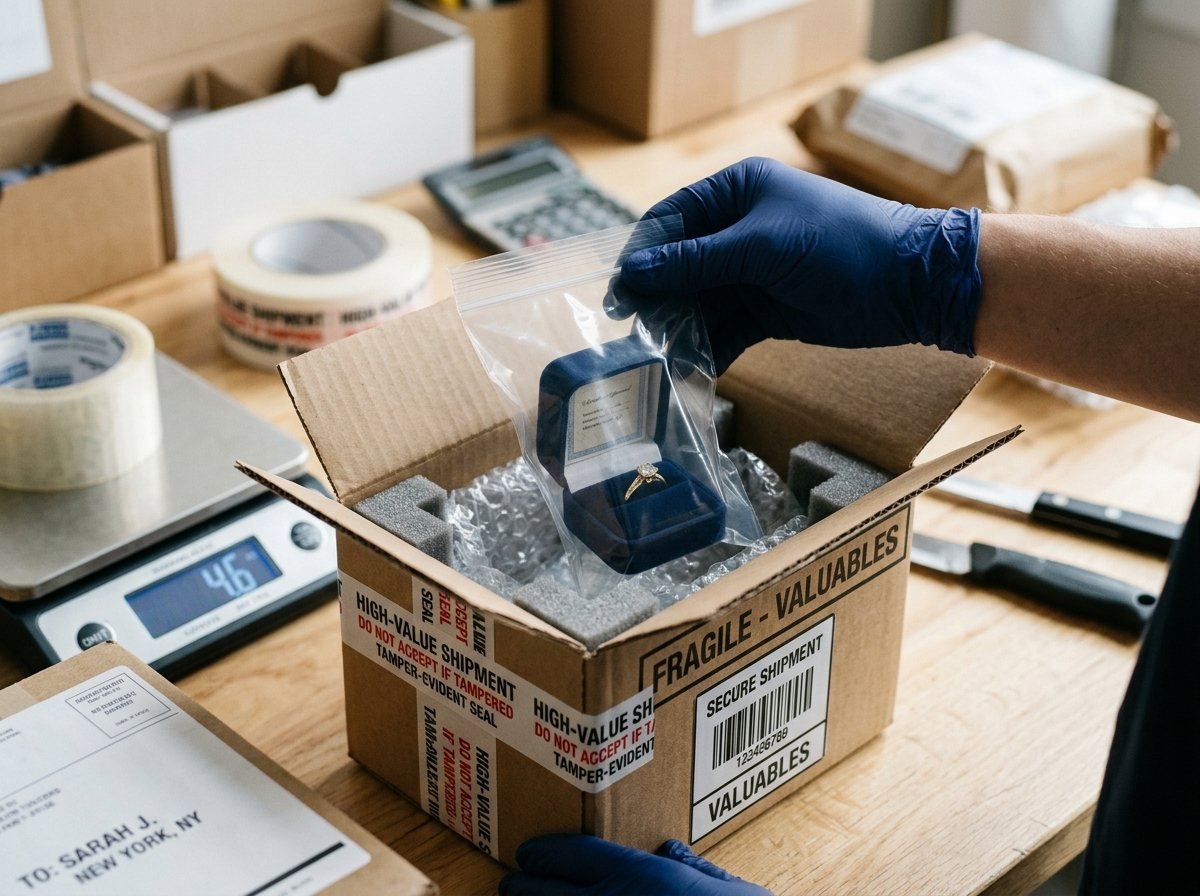
A diamond ring worth $3,000, tossed into a padded envelope with a prayer and a tracking number. That’s literally how someone I know shipped an engagement ring to their partner in another city. The ring arrived — thankfully — but with a bent prong and a scratched band. The “savings” on packaging? They cost more in repairs than proper shipping would’ve ever cost.
Jewelry and valuables aren’t like shipping a pair of sneakers or a book. You’re dealing with items that are small, fragile, often irreplaceable, and sometimes worth more than the car you’re driving. One wrong move — a crushed box, a lost parcel, a missing insurance form — and you’re looking at real financial and emotional loss.
Whether you’re an online jewelry seller shipping daily orders, someone sending a family heirloom across the country, or a small business owner on Etsy, this guide covers every single thing you need to know. From picking the right box to choosing the right courier, from insurance that actually protects you to customs paperwork for international shipments — it’s all here.
Let’s get into it.
Why Jewelry Shipping Needs Special Attention
You might think, “It’s tiny, lightweight, how hard can it be?” And that’s exactly where most people go wrong.
Jewelry is uniquely tricky to ship for a few reasons that don’t apply to most other products.
Size works against you. Small packages get lost more easily in sorting facilities. They can slip between conveyor belts, get buried under bigger boxes, or simply get overlooked during delivery. A tiny ring box rattling inside a large shipping box is a recipe for damage — and sometimes, disappearance.
Value-to-size ratio is extreme. A package the size of your fist could hold something worth $500, $5,000, or $50,000. Most standard shipping processes don’t account for that kind of value density. The regular handling process — tossing, stacking, belt sorting — isn’t designed for something this precious.
Emotional value can’t be insured. Your grandmother’s antique brooch or your late father’s watch — these things carry weight that no insurance claim can replace. You can get financial compensation, sure. But the item itself? Gone forever.
Theft risk is real. Let’s be honest about this — jewelry is a high-theft category in shipping. Small, valuable, easy to conceal. If your package screams “expensive item inside,” you’re increasing risk unnecessarily.
That’s why every step matters. The packing, the courier choice, the insurance, even how you label the box — everything plays a role.
How to Pack Jewelry for Shipping — Step by Step
Packing is where 80% of shipping damage gets prevented. Get this right, and you’ve already won most of the battle.
Start With the Jewelry Itself
Before you even think about boxes, focus on the piece itself.
For rings: Place each ring in its own ring box or wrap it individually in soft tissue paper, then a layer of bubble wrap. Never ship two rings loose together — they’ll scratch each other within minutes of movement.
For necklaces and chains: This is the nightmare category. Chains tangle, pendants snap, clasps break. Thread the chain through a straw or a small piece of cardboard with slits cut into it. This keeps the chain straight and prevents tangling. Then wrap the whole thing in tissue paper. Trust me, this simple straw trick saves so many headaches.
For earrings: Push the earring posts through a small piece of foam or cardboard, then secure the backs. Wrap in tissue paper. For dangly earrings, extra bubble wrap around the hanging parts is essential.
For bracelets and bangles: Wrap each one individually. For delicate chain bracelets, use the same straw method as necklaces. For solid bangles, tissue paper and a snug-fitting box work perfectly.
For watches: Remove the watch from any loose strap position. If possible, ship it in its original box. If you don’t have that, wrap the watch face with a soft cloth first, then bubble wrap. The crystal and bezel are the most vulnerable parts.
⚠️ Warning: Never use newspaper for wrapping jewelry. The ink transfers onto metal and gemstones, and cleaning it off certain stones (like pearls or opals) can actually cause damage.
Choose the Right Inner Packaging
Once each piece is individually protected, you need a proper inner container.
A small, sturdy jewelry box is ideal. If you’re a seller shipping regularly, invest in decent jewelry boxes — they don’t cost much in bulk and they dramatically reduce damage claims. For one-off shipments, even a small rigid cardboard box works.
The key rule: the jewelry piece should not move inside the inner box. If you shake the box and hear rattling, add more padding. Cotton pads, foam inserts, or crumpled acid-free tissue paper all work. You want that piece held snugly in place, almost like it’s suspended in a cocoon.
Pick the Right Outer Shipping Box
Here’s where most people make a critical mistake — they either use a box that’s way too big or a padded envelope that offers zero crush protection.
Don’t use padded envelopes for anything valuable. They offer almost no protection against impact or crushing. A heavy box dropped on top of your padded envelope in the delivery truck? Your piece is toast.
Your outer shipping box should be sturdy corrugated cardboard. Not too big, not too small. You want about 2–3 inches of space on all sides of your inner jewelry box. That space gets filled with cushioning material.
If you’re unsure about choosing the right box size for your shipment, a small 6x6x6 inch box works perfectly for most jewelry shipments.
Fill the Void Space Properly
That 2–3 inches of space between the inner box and outer box? Fill it completely. Bubble wrap is your best friend here. Crumpled packing paper works too. Some people use packing peanuts, but they tend to shift during transit and leave gaps.
Pro Tip: Place a layer of bubble wrap at the bottom of the outer box, then center your jewelry box, then fill all sides, then add a final layer on top before closing. Think of it as building a protective nest.
The amount of cushioning matters more than people realize. If you need guidance on how much bubble wrap you actually need, a good rule for jewelry is at least two layers of small-bubble wrap around the inner box, plus filled void space.
Seal It Like You Mean It
Use strong packing tape — not masking tape, not scotch tape, not duct tape. Quality clear packing tape, applied in an “H” pattern on both top and bottom of the box. Run tape along all seams. For high-value items, I’d even recommend reinforced packing tape with fiberglass strands.
One thing people forget: tape over the box edges too, not just the flaps. Edges are where boxes most commonly split open during rough handling.
Choosing the Right Shipping Carrier for Valuables
Not all carriers treat valuable shipments the same way. Your choice of courier directly impacts safety, speed, tracking accuracy, and what happens if something goes wrong.
What to Look For in a Carrier
Signature confirmation — For anything valuable, you want proof that a real person received the package. Without this, a thief can grab your package from a doorstep and you’ll have limited recourse.
Real-time tracking — Not just “in transit” updates. You want detailed scan points so you know exactly where your package is at any given time. If you’re not familiar with what different tracking statuses actually mean, it’s worth learning before shipping expensive items.
Insurance options — We’ll cover this in detail below, but your carrier should offer declared value coverage for the full worth of your item. Some carriers cap this; others don’t.
Discreet packaging support — Some carriers offer plain, unmarked packaging or allow you to ship without any indication of contents on the outside. Use this option whenever available.
Carrier Comparison for Jewelry Shipping
USPS (United States): Registered Mail is actually the gold standard for shipping high-value items within the US. It sounds old-school, but Registered Mail is handled completely differently from regular mail — it’s locked in cages, signed for at every transfer point, and insurable up to $50,000. The downside? It’s slow — often 10–14 days. But for a $10,000 necklace, speed isn’t your top priority. Safety is.
UPS and FedEx: Both offer declared value coverage and excellent tracking. They’re faster than USPS Registered Mail and work well for items in the $500–$5,000 range. FedEx Custom Critical and UPS High Value Shipping services exist specifically for luxury items.
DHL: Strong option for international jewelry shipments, especially to Europe and Asia. They handle customs documentation well and offer On Demand Delivery options. If you’re deciding between carriers for international shipments, a DHL vs FedEx comparison can help you figure out which works better for your specific route.
Royal Mail / Parcelforce (UK): Royal Mail Special Delivery guarantees next-day delivery with tracking and insurance up to £2,500. For higher values, Parcelforce offers better coverage. There’s a solid Royal Mail vs Parcelforce breakdown if you’re shipping from the UK.
Speed vs. Safety — Finding the Balance
Faster shipping means less time your package spends in the system, which means fewer handoffs and lower risk. But express shipping costs significantly more, especially for insured valuables.
Here’s my honest take: for items worth over $1,000, always choose express or priority shipping. The extra $20–$50 you spend is nothing compared to the risk reduction. For items under $500, priority mail with tracking and signature confirmation is usually sufficient.
Understanding the real difference between standard and expedited shipping helps you make this call based on both budget and risk tolerance.
Insurance: The Non-Negotiable Step Most People Skip
Let me be blunt — if you’re shipping jewelry worth more than $100 without insurance, you’re gambling. And the house always wins eventually.
Carrier Insurance vs. Third-Party Insurance
Carrier-declared value coverage is what UPS, FedEx, and others offer built-in. It’s convenient, but it comes with fine print. Most carriers cap automatic coverage at $100. You can purchase additional declared value coverage, but the claims process can be frustrating, and carriers sometimes deny claims if they determine your packaging was “insufficient.”
Third-party shipping insurance from companies like Shipsurance, InsurePost, or ParcelGuard often offers better rates and more straightforward claims processes. For high-value jewelry, third-party insurance typically costs 1–3% of the declared value.
Pro Tip: Take detailed photos of the jewelry piece before packing — from multiple angles, including any identifying marks, serial numbers, or certification details. Then photograph each stage of your packing process. If you ever need to file a claim, this documentation is worth its weight in gold. And if the worst happens and your package goes missing, knowing how to file a claim for a lost package quickly can make the difference between getting compensated and getting nothing.
What Insurance Typically Doesn’t Cover
Be aware of common exclusions. Most policies won’t cover items that were inadequately packed (their judgment), items with pre-existing damage, or shipments where you can’t prove the value of what was inside. This is why appraisal certificates, purchase receipts, and those pre-shipping photos are so critical.
Also, some policies exclude certain gemstones or antique jewelry unless separately appraised. Read the fine print before you ship, not after something goes wrong.
Shipping Jewelry Internationally — Extra Steps You Can’t Ignore
Sending a gold bracelet from New York to London, or a pearl necklace from Mumbai to Toronto? International jewelry shipping adds several layers of complexity.
Customs Declarations and Duties
Every country treats jewelry imports differently. You’ll need to fill out a customs declaration form (CN22 or CN23 for postal services, commercial invoice for couriers) that accurately describes the item, its material composition, and its value.
Never undervalue jewelry on customs forms. People do this thinking they’ll help the recipient avoid import duties. It’s fraud — and if the package gets lost or damaged, your insurance claim is limited to the declared value. So if you wrote “$50” on a $2,000 ring, that’s all you’re getting back.
Common customs duties on jewelry range from 5% to 20% depending on the destination country. Some countries also charge GST/VAT on imported jewelry. The recipient usually pays these duties, so give them a heads-up about potential charges.
Country-Specific Restrictions
Some countries have strict rules about importing precious metals and gemstones. India, for example, has tight regulations on gold imports. Australia requires certain certifications for items containing animal products (like mother of pearl or coral). The US has specific rules about conflict diamonds under the Kimberley Process.
Check shipping restrictions for your destination before you ship. Getting your package seized at customs because you didn’t know about a restriction is a nightmare you don’t want.
Hallmarking Requirements
Several countries — the UK, India, France, the Netherlands — require precious metal jewelry to carry a recognized hallmark. If you’re shipping gold, silver, or platinum jewelry for sale in these countries, make sure the pieces meet local hallmarking standards. Without proper hallmarks, customs might hold or reject the shipment.
Smart Labeling and Security Tips
How you label your package matters more than you’d think.
What to Put on the Label
Keep it boring. Your shipping label should have the sender’s address, recipient’s address, and tracking barcode. That’s it. Don’t write “FRAGILE — CONTAINS JEWELRY” on the outside. Don’t use branded jewelry store packaging that screams “valuable item inside.” Don’t put any indication of what’s in the box.
The most secure jewelry shipment looks exactly like every other boring brown box in the delivery truck. Anonymity is your friend.
Return Address Considerations
Always include a return address — carriers can refuse packages without one. But use a business name or generic name rather than something like “Diamond Palace Fine Jewelry.” Again, discretion is everything.
Tracking and Delivery Instructions
Set up tracking notifications on your phone for real-time updates. Most carriers let you do this through their app or website. Also, consider requesting hold at location for very high-value items. Instead of the package sitting on someone’s porch for hours, the recipient picks it up directly from the carrier’s facility, shows ID, and signs for it.
If the recipient won’t be home, it’s important to know what happens when no one’s available for delivery — because a jewelry package getting left at a door or redirected to a neighbor isn’t something you want.
Special Considerations for Online Jewelry Sellers
If you’re selling jewelry on platforms like Etsy, eBay, or your own website, shipping isn’t just a one-time thing — it’s a core part of your business. Getting it wrong repeatedly means damaged reputation, refund requests, and lost customers.
Standardize Your Packaging Process
Create a repeatable packing routine. Same box type, same cushioning method, same tape, same inner packaging every single time. This consistency reduces errors and speeds up your workflow. Buy your supplies in bulk — jewelry boxes, bubble wrap, 6x6x6 corrugated boxes, packing tape. Buying in bulk through packaging suppliers can cut your per-shipment cost by 30–40%.
If you’re running an Etsy shop, the Etsy seller’s international shipping guide covers platform-specific tips that’ll save you time and money.
Include a Packing Slip, Not a Price Tag
Always include a packing slip inside the box with the order details, but be smart about what goes on it. For gift orders especially, leave the price off. For international orders, keep a copy of the commercial invoice inside the package as well — customs sometimes opens packages and needs to verify contents against the declaration.
Handle Returns Gracefully
Returns are part of selling jewelry online. A customer might not like how a ring looks in person, or the size might be off. Have a clear returns policy and include return shipping instructions with every order. Using pre-paid return labels makes the process smoother for everyone. Handling returns for your online business efficiently is actually a competitive advantage — it builds trust.
Shipping Cost Strategy
Jewelry is lightweight, so shipping costs are primarily driven by speed, insurance, and distance rather than weight. Understand how shipping rates are actually calculated so you can price your shipping accurately. Many successful jewelry sellers build shipping costs into their product pricing and offer “free shipping” — it converts better.
Common Mistakes That Lead to Disaster
I’ve seen enough jewelry shipping horror stories to fill a book. Here are the mistakes that show up again and again.
Using the original retail jewelry box as the shipping box. That beautiful velvet box your ring came in? Great for presentation. Terrible for shipping. It offers zero impact protection. Use it as the inner container, but always place it inside a proper corrugated shipping box with cushioning.
Shipping multiple loose pieces in one package. Rings scratch each other. Chains tangle with chains. Pendants crack against bracelets. Wrap and separate every single piece individually, even if they’re all going to the same person.
Skipping signature confirmation to save $3. Three dollars. That’s what stands between you and proof of delivery. Without it, if the recipient claims they never got the package — or if it genuinely gets stolen from their porch — you have almost no recourse. For jewelry, signature confirmation isn’t optional.
Choosing the cheapest carrier regardless of value. I get it — shipping costs eat into margins. But saving $8 on shipping a $400 necklace by choosing an untracked, uninsured economy service is false economy. One lost package wipes out the “savings” from dozens of shipments.
Not understanding common packaging mistakes that damage parcels can also be a blind spot. Things like using old recycled boxes with weakened walls, under-filling void space, or using the wrong type of tape cause more damage than people realize.
A Quick Checklist Before You Ship
Before you hand over that box to the carrier, run through this mental checklist:
Is every piece individually wrapped and protected? Does the inner jewelry box hold items snugly without any movement? Is the outer box sturdy, properly sized, and filled with cushioning on all sides? Did you seal all seams with quality packing tape? Is the shipping label plain and discreet, with no hint of contents? Have you purchased adequate insurance for the full value? Did you take photos of the item and the packing process? Is signature confirmation or hold-at-location enabled? For international shipments — is the customs form accurate and complete?
If you can honestly say yes to all of these, you’ve done everything in your power to get that jewelry there safely.
FAQ
Can I ship jewelry through regular mail?
You can, but you really shouldn’t for anything worth more than $50–$100. Regular mail typically doesn’t include tracking, signature confirmation, or insurance. If the piece has value — financial or sentimental — use a service with full tracking and insurance. USPS Registered Mail, FedEx, UPS, or DHL are all better choices than dropping a jewelry package in a regular mailbox.
How should I declare jewelry on customs forms for international shipping?
Be completely accurate. List the item description (e.g., “14K gold ring with cubic zirconia”), the material, the weight in grams, and the fair market value. Don’t inflate the value for insurance purposes, and definitely don’t deflate it to dodge customs duties. Both can create serious legal and claims-related problems. Include any gemstone certifications or appraissal documents in a clear sleeve attached to the commercial invoice.
Is it safe to ship expensive jewelry worth $5,000 or more?
Yes, but only if you take every precaution. Use a carrier’s high-value shipping service (FedEx Custom Critical, UPS High Value, USPS Registered Mail). Get full insurance — either through the carrier or a third-party insurer. Use discreet packaging, require signature, and consider hold-at-location delivery. Some jewelers even split very high-value orders into two separate shipments to reduce risk concentration.
Do I need to tell the carrier that the package contains jewelry?
You need to accurately declare the contents and value for insurance and customs purposes. But you don’t need to — and shouldn’t — advertise the contents on the outside of the package. Keep external labeling generic. The carrier’s internal records will have the declared value information, which is what matters for insurance claims.
What’s the best way to ship an engagement ring as a surprise?
Ship it to your own address first, not directly to the recipient’s home — the tracking notifications or delivery attempt notices could ruin the surprise. Use express shipping with signature required (you sign for it yourself). Pack it in a ring box inside a small shipping box with plenty of bubble wrap. Full insurance is a must. And maybe don’t mention it on social media until after it arrives.
Your Jewelry, Your Responsibility
Here’s the thing about shipping jewelry — no carrier, no insurance company, no amount of packaging can guarantee a perfect outcome with 100% certainty. Packages get dropped. Trucks get into accidents. Theft happens. That’s the reality.
But what you can control is how well you prepare. Proper packing, the right carrier, adequate insurance, smart labeling — these things stack the odds overwhelmingly in your favor. The vast majority of well-packed, properly insured jewelry shipments arrive perfectly fine.
Take the extra 15 minutes to pack it right. Spend the extra few dollars on insurance and signature confirmation. Be accurate on your customs forms. Skip the flashy external packaging.
Your future self — or your customer — will thank you for it.