
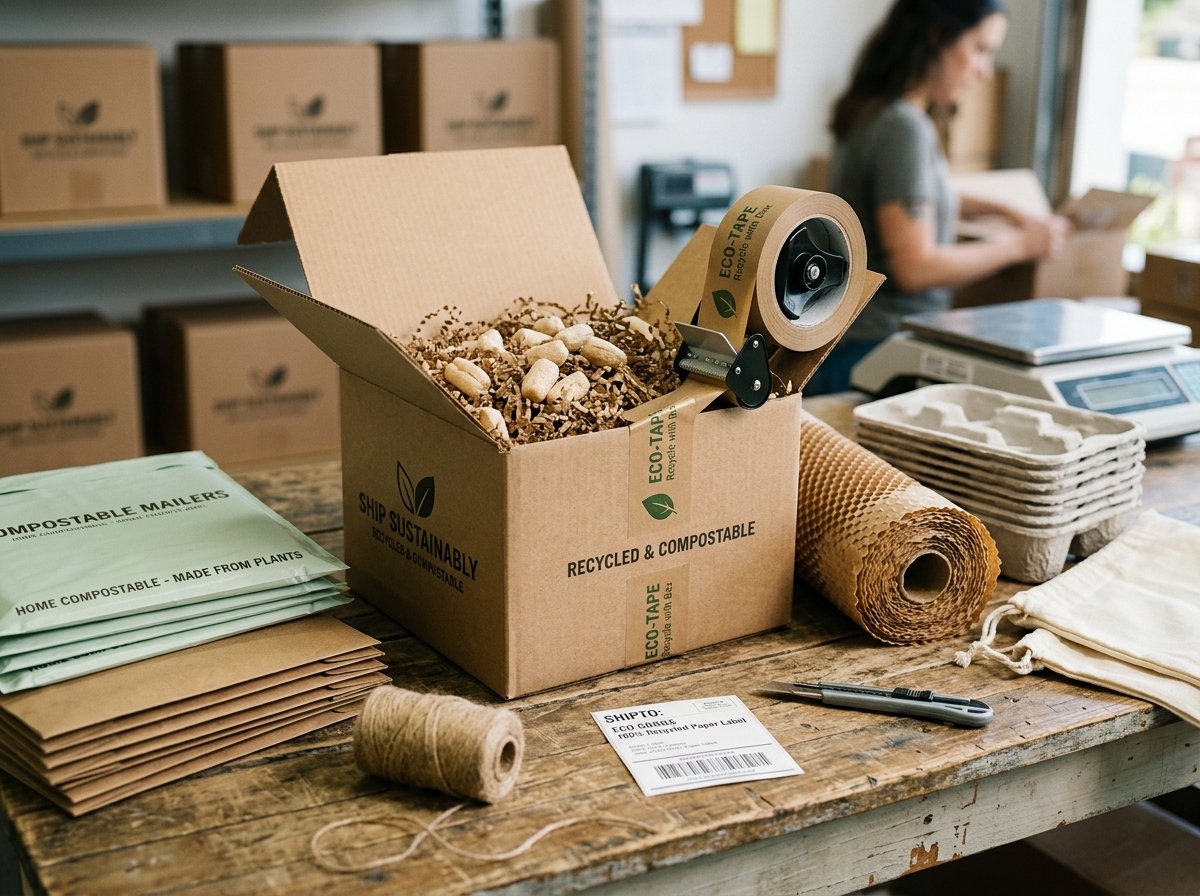
Here’s a number that might make you uncomfortable: the global packaging industry produces roughly 141 million tonnes of plastic waste every year. And a massive chunk of that comes from shipping — those bubble wraps, Styrofoam peanuts, and plastic mailers that get ripped open and tossed into the bin within seconds.
Now picture this. You run a small online store, or maybe you ship products regularly for your business. Every order you send out leaves behind a trail of waste that your customer has to deal with. And here’s the thing — your customers notice. A 2023 Trivium Packaging survey found that 82% of consumers are willing to pay more for sustainably packaged products.
So the question isn’t really “should you switch to eco-friendly packaging?” anymore. The real question is: what are your best options, and how do you pick the right one without blowing your budget?
That’s exactly what we’re going to figure out together.
Why Eco-Friendly Packaging Matters for Shippers Right Now
Let’s get one thing straight — going green with your packaging isn’t just about feeling good. There are real, tangible reasons why shippers are making the switch in 2025.
Customer expectations have shifted. People are actively choosing brands that align with their values. If two sellers offer the same product at a similar price, the one with recyclable packaging often wins. It’s not a trend anymore. It’s a buying decision filter.
Regulations are tightening. The European Union’s Packaging and Packaging Waste Regulation (PPWR), updated in 2024, is pushing businesses toward mandatory recyclability standards by 2030. Countries like Canada, India, and several U.S. states have introduced or are planning bans on single-use plastic packaging. If you ship internationally — say you’re comparing options between DHL and FedEx for international shipping — you’ll increasingly run into customs and compliance issues if your packaging materials aren’t meeting local environmental standards.
Cost savings are real. This surprises a lot of people. Eco-friendly packaging can actually reduce your shipping costs. How? Sustainable materials tend to be lighter. Lighter packages mean lower dimensional weight charges. And if you’ve ever looked at how dimensional weight is calculated, you know even small reductions in package weight or size can save you real money over hundreds of shipments.
Brand perception goes up. Unboxing videos aren’t going away. When someone opens a package filled with biodegradable packing material and a kraft paper mailer, it tells a story. It says you care. That kind of impression sticks.
The Most Practical Eco-Friendly Packaging Materials
Alright, let’s talk specifics. You want to know what’s actually available, what works, and what’s realistic for your shipping needs. Here are the materials that are genuinely making a difference.
Corrugated Cardboard (The Reliable Classic)
You probably already use corrugated cardboard boxes, and here’s the good news — they’re already one of the most eco-friendly options out there. Corrugated cardboard is made from a high percentage of recycled content (often 70–100%), and it’s recyclable, biodegradable, and compostable.
The key is to use the right size box. An oversized box means more void fill, more material waste, and higher shipping costs. If you’re unsure about sizing, check out this guide on how to choose the right box size for your shipment. Getting the box size right is honestly one of the simplest green moves you can make.
Pro Tip: Look for boxes with FSC (Forest Stewardship Council) certification. It confirms the cardboard comes from responsibly managed forests.
Biodegradable Packing Peanuts
Traditional Styrofoam peanuts are an environmental nightmare — they take around 500 years to decompose. But biodegradable packing peanuts, usually made from cornstarch or wheat starch, dissolve in water and break down naturally within weeks.
They offer the same cushioning protection. They’re static-free. And they won’t leave that annoying Styrofoam dust all over your customer’s living room floor.
The catch? They’re slightly more expensive than Styrofoam — typically 20–30% more. But given how little void fill material most shipments need, the cost difference per package is usually just a few cents.
Recycled and Recyclable Poly Mailers
If you ship clothing, accessories, or non-fragile items, poly mailers are popular because they’re lightweight and flexible. The eco-friendly versions are now made from 100% recycled plastic (often post-consumer recycled content) and are themselves recyclable.
Brands like EcoEnclose and noissue have made recycled poly mailers widely accessible. Some newer versions are even compostable, made from cornstarch-based bioplastics that break down in industrial composting facilities within 90–180 days.
This is especially relevant if you’re selling on platforms like Etsy. If you’re an Etsy seller shipping internationally, switching to compostable mailers can actually become a selling point in your shop description.
Mushroom Packaging (Mycelium-Based)
This one sounds futuristic, but it’s very much real and commercially available. Companies like Ecovative Design grow packaging from agricultural waste and mushroom mycelium (the root structure of fungi). The mycelium binds the waste material into custom-molded shapes that work as cushioning inserts.
It’s fully compostable — you can literally put it in your garden. IKEA started using mushroom packaging back in 2016 for some product lines, and Dell has used it for shipping servers and electronics.
The downside? Custom molds take time to produce, and it’s more expensive than standard foam. For high-value or fragile items, though, it’s an option worth exploring — particularly if you’re shipping things like artwork and paintings or musical instruments where you need both protection and presentation.
Honeycomb Paper Wrap
You’ve probably seen this on social media — the kraft paper with a honeycomb die-cut pattern that stretches into a cushioning wrap. It’s become one of the fastest-growing alternatives to bubble wrap.
Honeycomb paper wrap is made from 100% recycled paper, is curbside recyclable, and biodegrades naturally. It provides surprisingly good cushioning for lightweight to medium-weight items. It looks great too, which adds to the unboxing experience.
If you’ve been wondering how much bubble wrap you actually need for your packages, you might find that honeycomb wrap handles the job while being kinder to the planet.
Seaweed-Based Packaging
This is one of the newer innovations. Companies like Notpla (backed by investors and recognized at the 2022 Earthshot Prize) are developing packaging from seaweed and plant extracts. The material is edible, biodegrades in 4–6 weeks, and requires no freshwater or fertilizer to produce.
Right now, seaweed packaging is mainly used for food and beverage packaging (those dissolvable sauce packets you might’ve seen). But the technology is expanding rapidly, and we’ll likely see shipping applications within the next few years.
How to Choose the Right Eco-Friendly Packaging for Your Products
Having options is great. But how do you actually decide which material to use? It depends on a few practical factors.
Consider Your Product’s Fragility
A t-shirt doesn’t need the same protection as a ceramic vase. Match the packaging to the risk. For soft, non-fragile goods, recycled poly mailers or paper mailers work perfectly. For fragile or valuable items, you’ll want corrugated boxes with honeycomb wrap, biodegradable peanuts, or molded pulp inserts.
If you regularly ship delicate items like jewelry and valuables or cosmetics and skincare products, investing in custom-fit sustainable inserts makes sense. They protect the product AND reduce the need for excessive void fill.
Think About Shipping Distance and Method
Packages traveling internationally go through more handling, more stacking, and more climate variation. If you’re shipping via ground versus air, the packaging requirements change too. Air shipments face pressure changes. Ground shipments face more vibration over longer periods.
For long-distance or international shipments, double-wall corrugated boxes with sustainable cushioning are your safest bet. Don’t sacrifice product protection for eco-friendliness — a damaged product that gets returned and re-shipped creates far more waste than using slightly more packaging material the first time.
Factor in Cost at Your Volume
Here’s the honest truth about pricing. Eco-friendly packaging costs more per unit at small volumes. But as your order volume increases, the price gap narrows significantly. Many sustainable packaging suppliers offer bulk shipping discounts that make the switch financially manageable.
At 500+ units per month, most eco-friendly options are only 5–15% more expensive than conventional alternatives. At 5,000+ units, some options (like recycled cardboard) are essentially the same price or even cheaper.
Check Your Customer’s Recycling Infrastructure
This is something most guides completely ignore, and it matters a lot. If your customer doesn’t have access to industrial composting, your compostable mailer will probably end up in a landfill anyway — where it won’t decompose properly due to lack of oxygen.
The most universally eco-friendly option is curbside-recyclable packaging — corrugated cardboard, paper tape, paper void fill. Almost everyone can recycle these at home. If you’re using compostable materials, include a small note explaining how to dispose of them properly.
Common Packaging Mistakes That Hurt the Environment (and Your Wallet)
Switching to eco-friendly materials is a great start. But even green packaging can create problems if you’re making some basic errors.
Over-packaging is the biggest one. Using a massive box for a small item means more material, more void fill, and a higher shipping weight. It’s wasteful in every direction. This ties directly into common packaging mistakes that damage parcels — because ironically, an oversized box with too little cushioning actually offers less protection than a snug, properly sized one.
Mixing materials is another problem. A cardboard box sealed with plastic tape, filled with plastic bubble wrap, and stuffed with a mix of paper and foam becomes a recycling headache. Your customer would have to separate each material before recycling anything. Most people won’t bother. They’ll just throw the whole thing in the trash.
Try to keep your packaging mono-material as much as possible. Cardboard box + paper tape + paper cushioning = everything goes in the recycling bin together. Simple.
Ignoring weight optimization is the third big miss. Even with eco-friendly materials, you’re still paying for weight. Honeycomb paper is lighter than crumpled newsprint. Biodegradable peanuts are lighter than shredded cardboard. These small differences add up when you’re shipping hundreds of packages per month.
Real-World Examples: Brands Doing Eco-Friendly Packaging Right
It always helps to see what’s actually working in practice.
Patagonia ships orders in recycled and recyclable bags, uses minimal packaging, and includes information on how to recycle or reuse the packaging. Their approach proves that premium brands can go green without sacrificing the customer experience.
Lush Cosmetics takes things further — many of their products ship completely packaging-free (the “naked” product line). When packaging is needed, they use recycled, biodegradable, or compostable materials. Their packing peanuts are made from cornstarch and literally dissolve under running water.
Puma replaced traditional shoeboxes with the “Clever Little Bag” — a reusable bag with a minimal cardboard frame that uses 65% less cardboard than a standard shoebox. It reduced their carbon footprint and became a talking point for the brand.
These aren’t billion-dollar-exclusive strategies. A small eCommerce seller can apply the same principles at a smaller scale.
A Quick Comparison: Traditional vs. Eco-Friendly Packaging
Let’s put some of this into perspective.
Styrofoam peanuts take 500+ years to decompose. Cornstarch peanuts dissolve in water and compost within weeks. Performance-wise, both provide similar cushioning for light to medium items.
Plastic bubble wrap is technically recyclable but rarely gets recycled (recycling rate below 5% for flexible plastics). Honeycomb paper wrap is recyclable and biodegradable, and most customers can toss it directly in their recycling bin.
Virgin plastic poly mailers take 400+ years to decompose. Compostable mailers break down in 90–180 days in industrial compost. Recycled poly mailers, while still plastic, at least reduce new plastic production.
Standard cardboard might use virgin pulp. FSC-certified recycled cardboard uses post-consumer waste and comes from responsibly managed sources. The protection level is identical.
The performance gap between conventional and sustainable packaging has shrunk dramatically over the past five years. In most cases, you’re not compromising on protection anymore. You’re just choosing a material that doesn’t sit in a landfill for centuries.
How to Transition to Green Packaging Without Disrupting Your Operations
If you’re currently using conventional packaging, you don’t need to overhaul everything overnight. Here’s a practical approach.
Start with your highest-volume product. Identify the one product you ship most often and find an eco-friendly packaging solution for just that item. Test it thoroughly — ship 50–100 packages and check for damage rates, customer feedback, and cost impact.
Switch your tape first. It’s the easiest change. Replace plastic packing tape with paper tape (water-activated kraft tape works brilliantly and actually provides a stronger seal on cardboard). This one swap makes your entire cardboard box recyclable without any separation needed.
Replace void fill next. Swap plastic bubble wrap and Styrofoam with honeycomb paper, crinkled kraft paper, or biodegradable peanuts. This is usually the second-easiest change and has a big visual impact during unboxing.
Talk to your packaging supplier. Most packaging distributors now carry eco-friendly lines. Ask for samples. Compare prices at your volume level. You might be surprised at how competitive the pricing is.
Tell your customers. Add a small note inside the package or a line in your shipping confirmation email. Something like: “This package is 100% recyclable — just toss the whole thing in your recycling bin.” It takes zero effort and reinforces your brand’s values.
FAQ Section
Is eco-friendly packaging strong enough for heavy or fragile items?
Yes, absolutely. Double-wall corrugated cardboard is incredibly strong and handles heavy items well. For fragile goods, molded pulp inserts and mushroom-based packaging provide custom-fit protection that rivals (and sometimes exceeds) Styrofoam. The key is matching the right eco-friendly material to your product’s specific protection needs.
Does sustainable packaging cost a lot more than regular packaging?
At small quantities, eco-friendly options can be 15–30% more expensive. But the gap closes quickly at higher volumes. Recycled corrugated cardboard is often priced the same as or lower than virgin cardboard. And when you factor in potential savings from reduced weight (which lowers your shipping rates), the total cost difference becomes minimal for most shippers.
Can I use eco-friendly packaging for international shipments?
You can, and in many cases you should. International shipments to the EU, UK, and Australia face increasingly strict packaging waste regulations. Using recyclable or compostable packaging helps you stay compliant. Just make sure the packaging is sturdy enough for the longer journey — international shipments face more handling points. Check any shipping restrictions to the UK or Australia that might affect your packaging material choices.
What’s the difference between biodegradable and compostable packaging?
Biodegradable means the material will break down eventually — but “eventually” could mean years, and it might leave behind micro-residues. Compostable is a stricter standard: the material breaks down into natural elements within a specific timeframe (usually 90–180 days) in composting conditions, leaving no toxic residue. Look for certifications like BPI (Biodegradable Products Institute) or EN 13432 (European compostability standard) for genuine compostable products.
How do I know if a packaging supplier is genuinely eco-friendly or just greenwashing?
Look for third-party certifications: FSC certification for paper products, BPI or TÜV AUSTRIA OK Compost for compostable claims, and SFI (Sustainable Forestry Initiative) for wood-based materials. If a supplier can’t show you any certification and just calls their product “green” or “earth-friendly” without specifics, that’s a red flag. Ask for material composition data sheets — genuine eco-friendly suppliers are happy to share them.
Your Next Step Toward Greener Shipping
Switching to eco-friendly packaging isn’t an all-or-nothing decision. You don’t need to transform your entire packaging setup this week. Start with one change — maybe it’s paper tape, maybe it’s swapping out your bubble wrap for honeycomb paper. See how it feels. See how your customers respond.
The materials exist. The pricing has become reasonable. The technology has matured to the point where you’re not sacrificing protection for sustainability. What you are doing is sending a signal — to your customers, to your industry, and honestly, to yourself — that packaging doesn’t have to end up in a landfill for the next five centuries.
Your packages travel the world. Make sure they don’t leave a mess behind.