
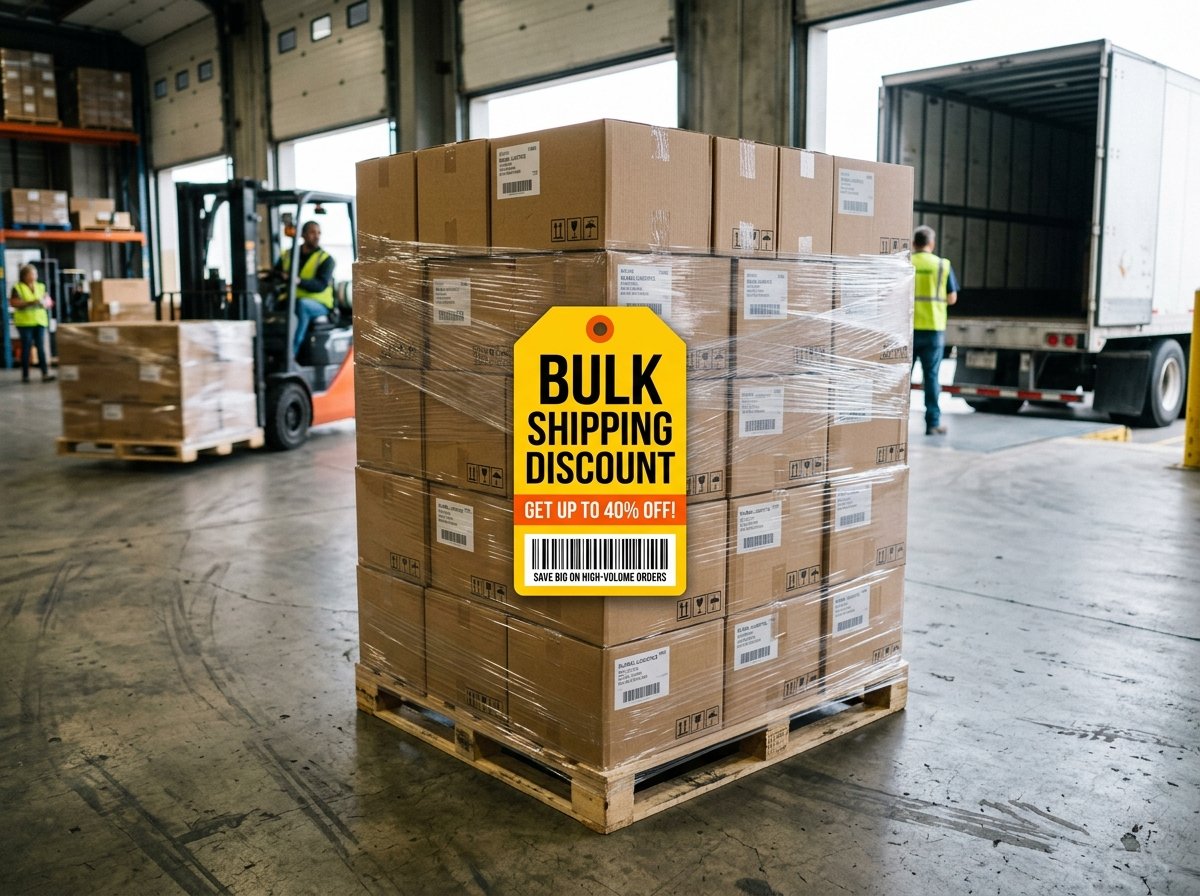
Here’s a number that might sting a little — small eCommerce businesses spend an average of 8% to 15% of their total revenue just on shipping. If you’re sending out 200+ packages a month, that’s a serious chunk of money flying out the door. And the frustrating part? The business next door, shipping the same kind of products with the same carrier, might be paying way less per package than you.
The difference? They figured out bulk shipping discounts.
You’ve probably heard the term thrown around, but nobody really breaks down how these discounts actually work, who qualifies, and what you need to do to grab them. That’s exactly what we’re going to sort out today. Whether you’re running an online store, managing a warehouse, or just starting to scale your shipping volume, this guide will walk you through the real mechanics behind bulk shipping discounts — and show you practical ways to start saving.
What Exactly Are Bulk Shipping Discounts?
Think of it like buying rice from a wholesale market versus a grocery store. The more you buy, the less you pay per kilo. Bulk shipping discounts work on the same basic principle — when you commit to shipping a large number of packages through a carrier, they reward you with lower per-shipment rates.
Carriers like FedEx, UPS, DHL, and USPS all offer some version of bulk pricing. The logic from their side is simple: guaranteed, consistent volume means predictable revenue and better route optimization. They’d rather give you a 20% discount and keep your 500 monthly shipments than lose you to a competitor.
These discounts aren’t always advertised openly. Sometimes you have to ask. Sometimes you have to negotiate. And sometimes, you access them through third-party platforms that have already negotiated rates on behalf of thousands of small shippers. We’ll get into all of that.
Quick Fact: FedEx and UPS typically offer volume-based discounts starting at around 100–200 weekly shipments, but third-party shipping platforms can get you discounted rates with as few as 20–30 monthly shipments.
How Do Bulk Shipping Discounts Actually Work?
This is where most articles get vague. Let’s break down the actual mechanics.
Volume-Based Tier Pricing
Most carriers use a tiered pricing model. The more packages you ship, the higher your tier, and the deeper your discount. For example, a carrier might structure it like this:
- Tier 1 (1–100 shipments/month): Standard published rates
- Tier 2 (101–500 shipments/month): 10–15% off standard rates
- Tier 3 (501–2000 shipments/month): 20–30% off
- Tier 4 (2000+ shipments/month): 30–50% off, sometimes more
These tiers aren’t always fixed. If you’re between tiers but growing fast, you can often negotiate your way into a higher discount bracket by showing the carrier your growth trajectory.
Negotiated Contract Rates
If your shipping volume is significant — say, 500+ packages per week — you can directly approach a carrier’s sales team and negotiate a custom contract. These contracts usually lock in discounted rates for 1–3 years, and they’re based on your specific shipping profile: average package weight, destinations, service types, and total volume.
Here’s something most people don’t realize: everything in these contracts is negotiable. The base rate, the surcharges, the residential delivery fees, even the fuel surcharges. Carriers expect you to push back. If you just accept the first offer, you’re leaving money on the table.
Aggregate Volume Through Third-Party Platforms
Don’t have enough volume to negotiate directly? No problem. Platforms like Pirate Ship, ShipStation, ShipBob, and Easyship pool together shipments from thousands of small businesses. Because their combined volume is massive, they’ve already secured deep discounts from carriers — and they pass those savings on to you.
This is honestly the easiest entry point for smaller sellers. You don’t need a contract, you don’t need to hit minimum volumes, and you can often start saving from your very first shipment.
If you’re already comparing courier quotes from different providers, adding these aggregator platforms to your comparison list can reveal surprisingly lower rates.
Prepaid Shipping Credits
Some carriers offer a different flavor of bulk discount: prepaid credit programs. You pay upfront for a block of shipping credits at a discounted rate. Think of it like buying a prepaid phone card — you pay ₹8,000 worth of shipping for ₹6,500 because you committed the money upfront.
USPS Commercial Plus Pricing and DHL’s eCommerce prepaid programs work somewhat like this. The discount isn’t always huge (5–15%), but it stacks nicely on top of other savings.
Who Can Get Bulk Shipping Discounts?
There’s a common assumption that you need to be Amazon-sized to qualify. That’s not true, but your options do vary based on your volume.
Large Businesses (1000+ Shipments/Month)
If you’re at this level, you’re in the best position. Carriers will actively court you. You can negotiate custom contracts, get a dedicated account manager, and sometimes even get special pickup schedules. Companies shipping at this volume through carriers like DHL or FedEx can negotiate rates 40–55% below published prices.
Mid-Size Businesses (200–1000 Shipments/Month)
You’re in a sweet spot. You have enough volume to negotiate directly with carriers, but you might not get the absolute deepest cuts. This is where it helps to get quotes from multiple carriers and play them against each other. Carriers don’t want to lose a mid-size account that’s clearly growing.
Pro Tip: When negotiating, always bring data. Show your shipping history for the past 6–12 months, your average package dimensions, your top destination zones, and your projected growth. Carriers take you more seriously when you come prepared with numbers.
Small Businesses & Startups (Under 200 Shipments/Month)
Direct negotiation is tough at this level, but third-party platforms and shipping aggregators are your best friends. You can also look into regional carriers who might offer better rates for local and domestic shipments.
Another smart move: if you sell on platforms like eBay or Etsy, both platforms have negotiated shipping discounts with major carriers that are available to their sellers. If you’re selling on Etsy and shipping internationally, you’re likely already getting some form of discounted rate through the platform — you just might not realize it.
What Factors Affect Your Bulk Discount Rate?
Getting a bulk discount isn’t just about volume. Several factors influence how much you’ll actually save.
Package Weight and Dimensions
Carriers care a lot about dimensional weight — the amount of space your package takes up relative to its actual weight. If you’re shipping lightweight but bulky items (like pillows or lampshades), your effective shipping cost per package is higher, and your discount might be smaller.
Understanding how dimensional weight is calculated can help you optimize your packaging to maximize your discount.
Shipping Zones and Destinations
Domestic shipments within the same region are cheapest. Cross-country and international shipments cost more. If most of your volume is international, your bulk discount structure will look different than someone shipping locally.
Carriers often give better bulk rates for routes they’re already optimizing. If a carrier has strong infrastructure on a particular international corridor, they’ll offer you better pricing on that route.
Service Type
Bulk discounts vary by service level. You’ll get deeper discounts on ground shipping than on express or overnight services. That makes sense — ground shipping is cheaper for the carrier to operate, so they can afford to discount it more.
If your products don’t need to arrive overnight, shifting even 30% of your shipments from express to economy or standard shipping can save you a significant amount on top of your bulk discount.
Consistency and Predictability
Carriers love predictability. If you ship 500 packages every single week like clockwork, you’re more attractive to them than someone who ships 2000 one month and 100 the next. Consistent volume often gets you better negotiated rates.
Practical Steps to Get Bulk Shipping Discounts
Alright, let’s get tactical. Here’s how you actually go about securing these discounts.
Step 1: Know Your Numbers
Before you approach anyone, gather your shipping data for the last 6–12 months. You need to know your monthly shipment count, average package weight and dimensions, top shipping destinations, service types you use most, and your current cost per shipment. This data is your negotiating ammunition.
Step 2: Get Quotes From Multiple Carriers
Don’t just talk to one carrier. Approach at least 3–4 carriers with your data and ask for bulk pricing proposals. When a carrier knows you’re shopping around, they’ll sharpen their pencil.
If you’re comparing international options, checking how Aramex stacks up against DHL or other carriers can reveal pricing differences you wouldn’t expect.
Step 3: Negotiate — Seriously, Negotiate
When a carrier gives you their “best rate,” counter it. Ask for better fuel surcharge caps, lower residential delivery fees, and waived pickup charges. Bring up competitor quotes. Ask if there are seasonal promotions or loyalty programs.
A real-world example: A mid-size clothing brand shipping 800 packages/month through UPS was paying $7.20 per ground shipment. After negotiating with UPS (and showing a competing FedEx quote), they got the rate down to $5.40 — a 25% reduction. They didn’t change anything about their shipping volume or packaging. They just asked.
Step 4: Consider Shipping Aggregator Platforms
If direct negotiation isn’t yielding results, sign up with platforms like Pirate Ship, ShipStation, or ShippingEasy. These platforms often provide USPS Commercial rates and UPS/FedEx discounted rates right out of the box, no minimum volume required.
For online store owners, many platforms also offer automated shipping integrations that streamline the whole process.
Step 5: Review and Renegotiate Annually
Your shipping profile changes over time. Maybe your volume increased. Maybe you added new products that ship differently. Maybe the carrier raised their base rates. Set a calendar reminder to review your shipping contract every 12 months and renegotiate based on your updated numbers.
Hidden Savings Most People Miss
Bulk shipping discounts are great, but they’re not the only way to reduce shipping costs. Here are some often-overlooked savings that compound nicely with bulk discounts.
Optimize Your Packaging
Using the right box size reduces dimensional weight charges. If you’re using a 16-inch box to ship a product that fits in a 10-inch box, you’re paying for 6 inches of empty air. Multiply that across 500 monthly shipments, and it adds up fast.
Also, smart packaging reduces damage, which means fewer returns and reshipments. Avoiding common packaging mistakes is basically free money.
Consolidate Shipments
If you’re sending multiple orders to the same geographic area, consolidate them into fewer, larger shipments. Some carriers offer multi-piece shipment discounts where you ship several packages to the same destination under one tracking number at a reduced rate.
Use Regional Carriers for Local Deliveries
National carriers aren’t always the cheapest option for short-distance deliveries. Regional carriers often offer competitive rates for deliveries within a 200–300 mile radius. Pairing a national carrier for long-distance shipments with a regional carrier for local ones can be a smart hybrid strategy.
Negotiate Surcharges, Not Just Base Rates
Here’s something experienced shippers know: surcharges can make up 25–40% of your total shipping cost. Fuel surcharges, residential delivery surcharges, peak season surcharges, delivery area surcharges — these add up quickly. When negotiating, push for caps or waivers on these surcharges. Sometimes reducing surcharges saves more money than reducing the base rate.
What to Watch Out For
Bulk shipping discounts sound great, but there are a few things that can trip you up.
Minimum volume commitments are common in negotiated contracts. If you agree to ship 1000 packages/month and only ship 600, the carrier might revoke your discount or charge you the difference. Be realistic about your volume projections.
Rate increases built into contracts are another thing to watch. Some contracts include annual rate increase clauses (called General Rate Increases or GRIs) that can be 5–7% per year. Make sure your negotiated discount accounts for these increases, or you’ll find your “great rate” isn’t so great after two years.
Carrier lock-in is also a risk. Some contracts include exclusivity clauses or early termination fees. Read the fine print before signing anything.
And if you’re shipping high-value items in bulk, make sure you understand insurance options for shipped packages — because a bulk discount means nothing if you lose a $5,000 shipment and can’t recover the cost.
Real Numbers: How Much Can You Actually Save?
Let’s put some concrete numbers on this. Say you’re currently shipping 500 packages per month at an average cost of $8 per package. That’s $4,000/month or $48,000/year on shipping.
With a negotiated bulk discount of 25%, your per-package cost drops to $6. That’s $3,000/month or $36,000/year — a saving of $12,000 annually. Add in packaging optimization (saving another 5–10%) and surcharge negotiations (another 5%), and you could realistically bring your annual shipping cost down to under $30,000.
For businesses scaling from 500 to 2000+ shipments per month, the savings become even more dramatic. High-volume shippers regularly report discounts of 40–55% off published rates.
FAQ
Do I need a business account to get bulk shipping discounts?
For direct carrier negotiations, yes — you’ll typically need a business account with the carrier. But third-party shipping platforms like Pirate Ship or ShipStation let individuals and small businesses access discounted rates without a formal business account. If you’re a regular eBay or Etsy seller, you can also access carrier discounts through those platforms.
How many shipments per month do I need to qualify for bulk rates?
There’s no universal minimum. Direct negotiation usually requires 200+ monthly shipments to get meaningful discounts. But through aggregator platforms, you can access discounted rates with even 10–20 monthly shipments. The more you ship, the deeper the discount — but you don’t need massive volume to start saving.
Can I combine bulk discounts with other promotions or programs?
It depends on the carrier and your contract terms. Some carriers allow stacking of bulk discounts with seasonal promotions or loyalty rewards. Others have clauses that prevent combining offers. Always ask your account representative about stacking possibilities before assuming they apply.
Are bulk shipping discounts available for international shipments?
Absolutely. Most major international carriers — DHL, FedEx International, UPS Worldwide — offer volume-based discounts for international shipping. The discount percentage might differ from domestic rates, and it often depends on specific trade lanes. If you’re shipping to countries with specific restrictions, make sure your discount agreement covers the destinations you actually ship to.
Do bulk discounts apply to all service levels (express, ground, overnight)?
Bulk discounts are typically available across service levels, but the discount percentage varies. Ground and standard services usually see the highest discounts (sometimes 30–50%), while express and overnight services might only get 10–20% off. If speed isn’t critical for every shipment, shifting some volume to slower services maximizes your savings.
Your Next Move
Shipping costs don’t have to silently eat into your profit margins. Whether you’re shipping 50 packages a month or 5,000, there’s a bulk discount strategy that fits your situation. Start by pulling your shipping data together, get quotes from multiple carriers, and don’t be afraid to negotiate hard.
If you’re not ready for direct negotiations yet, sign up with an aggregator platform today — it takes 10 minutes, and you could see lower rates on your very next shipment.
The businesses that win on shipping aren’t necessarily the ones with the highest volume. They’re the ones who took the time to understand how pricing works and asked for a better deal. Now you know how it works. Go ask.