
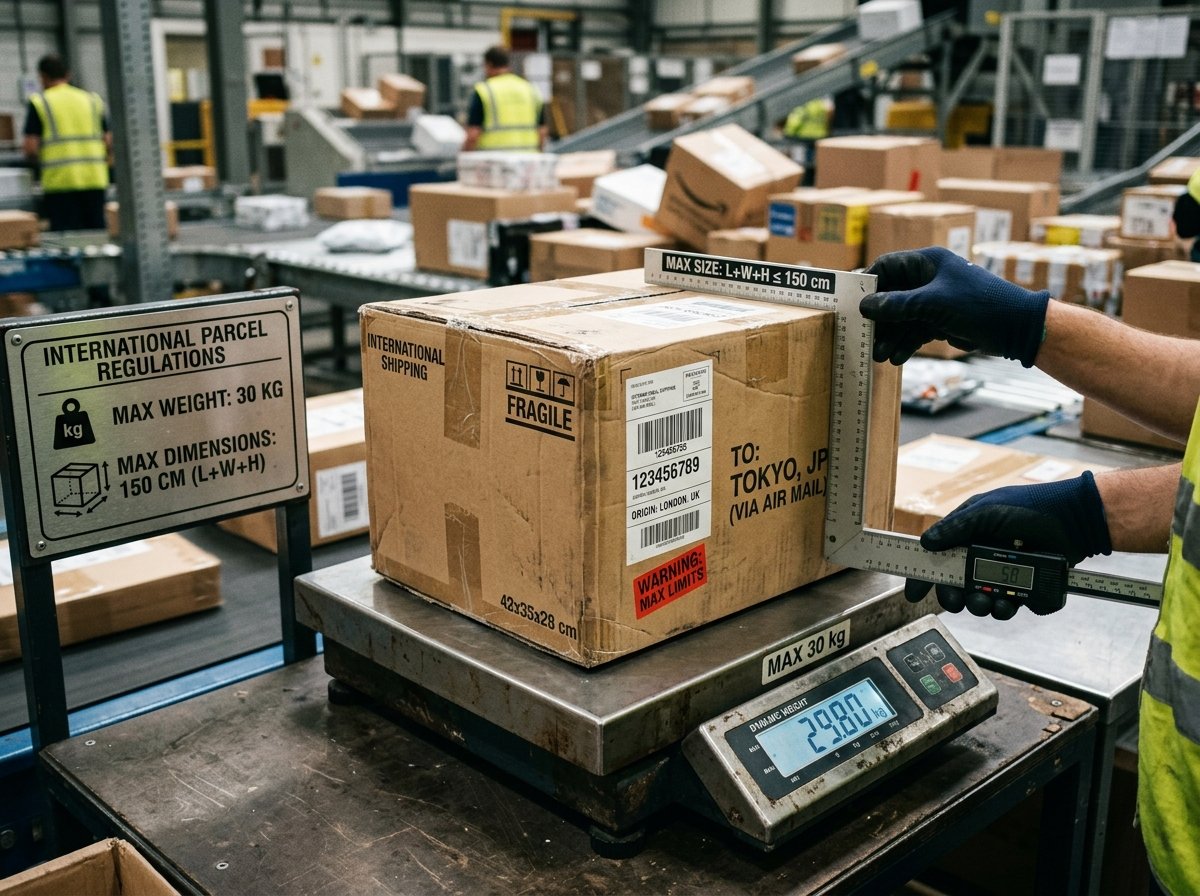
A friend of mine once packed a beautiful handmade wooden bookshelf into a massive box, drove to the courier office, and was told, “Sorry, we can’t ship this internationally.” The reason? The box exceeded the maximum length allowed by that carrier. He’d spent two hours wrapping, taping, and securing it — all wasted because he didn’t check the size limits beforehand.
This happens more often than you’d think. People focus on what’s inside the box, the customs paperwork, or the shipping cost — but completely overlook the weight and size restrictions. And here’s the thing: every courier has its own rules. What FedEx accepts, DHL might reject. What flies to the UK might not fly to Australia.
So before you pack that parcel and head to the nearest shipping counter, let’s break down exactly what the weight and size limits for international parcels look like across major carriers, postal services, and different countries. Whether you’re sending a gift, shipping products for your online store, or moving your belongings abroad, this guide covers everything you need to know — with real numbers, practical tips, and zero guesswork.
Why Do Weight and Size Limits Even Exist?
You might wonder — if I’m paying for shipping, why can’t I just send whatever size or weight I want? Fair question. But there are solid reasons behind these restrictions.
Aircraft cargo hold limitations are a big one. Commercial and cargo planes have strict load and space guidelines set by aviation authorities. A single oversized or overweight parcel can throw off the weight distribution of an entire cargo section. That’s a safety issue, not just a logistics one.
Then there’s the handling factor. Parcels go through conveyor belts, sorting machines, and multiple transfers between trucks, warehouses, and planes. If a box is too long, too heavy, or oddly shaped, it can jam equipment, slow down processing, and increase the risk of damage — not just to your parcel, but to others around it.
There’s also the cost and space efficiency angle. Carriers price their services based on predictable sizes. When a parcel falls outside those norms, it takes up disproportionate space, which is why oversized items often attract surcharges.
And finally, customs and destination country regulations play a role too. Some countries have their own import size restrictions, especially for postal services. You might meet your carrier’s limits but still get stopped at the destination country’s border.
Weight Limits by Major International Couriers
Let’s talk numbers. Here’s how the big-name carriers stack up when it comes to maximum weight for international shipments.
DHL Express allows international parcels up to 70 kg (154 lbs) per package. If your shipment is heavier, you’ll need to split it across multiple boxes or explore their freight services. DHL is known for being flexible with multi-piece shipments, so if you’re sending 5 boxes of 50 kg each, they’ll typically handle it as one shipment.
FedEx International also caps individual packages at 68 kg (150 lbs). There’s one important exception — FedEx International Economy can sometimes accept packages up to 68 kg, but certain routes might have lower limits depending on the destination.
UPS Worldwide matches FedEx with a 70 kg (150 lbs) per package limit for most international services. For anything heavier, UPS offers freight and cargo solutions, but those come with different pricing and timelines.
Aramex generally allows up to 50 kg per package for their express international services, though this varies by country pair. If you’re comparing, our Aramex vs DHL comparison breaks down how these two differ on pricing and service too.
Royal Mail (UK’s postal service) has much stricter limits. For international parcels, the max weight is 30 kg — and for some destinations, it drops to 20 kg. Parcelforce, Royal Mail’s parcel arm, offers slightly higher limits. You can check our Royal Mail vs Parcelforce comparison for a clearer picture.
USPS (United States Postal Service) caps international Priority Mail at 70 lbs (31.75 kg). First-Class Package International is limited to just 4 lbs (1.8 kg), which honestly works only for very small, lightweight items.
Australia Post allows international parcels up to 20 kg for standard international service. Some express options push this to 30 kg, but that depends on the destination.
India Post caps international parcels at 20 kg for most countries, though some destinations allow up to 30 kg for surface mail.
Pro Tip: These are per-package limits. Most carriers let you ship multiple packages under one tracking number or shipment reference. If your item weighs 90 kg, you don’t need a different carrier — you just need to split it across two boxes.
Size Limits by Major International Couriers
Weight is only half the equation. Your parcel could weigh just 5 kg but still get rejected if it’s too long or too large overall. Size limits are usually measured in two ways: maximum length of the longest side and maximum combined dimensions (length + girth, or length + width + height).
DHL Express allows a maximum length of 120 cm (47 inches) per side and a maximum combined dimension (L + 2W + 2H) of 300 cm (118 inches) for standard international shipments. Anything beyond that falls into their “non-conveyable” category and will likely attract a surcharge — or need to move via freight.
FedEx International accepts packages up to 274 cm (108 inches) in length and 330 cm (130 inches) in combined length and girth. These are among the most generous in the industry, which is one reason FedEx is popular for shipping bulky items. Our DHL vs FedEx international shipping comparison covers more differences beyond just size.
UPS Worldwide has limits of 274 cm (108 inches) in length and 400 cm (157 inches) in length plus girth. UPS is particularly accommodating for oversized parcels, though expect additional handling charges.
Royal Mail International restricts parcels to 1.5 meters in length and 3 meters in combined length and girth for most services. For small packets, dimensions are much tighter — typically 60 cm max length.
USPS caps most international parcels at 108 inches (274 cm) in combined length and girth. The longest side can’t exceed 79 inches (200 cm) for Priority Mail International. Some country-specific limits are even tighter.
Aramex typically allows up to 120 cm in any single dimension for standard international express, with combined dimensions capped around 300 cm.
Quick Fact: “Girth” confuses a lot of people. It’s calculated as 2 × width + 2 × height. So if your box is 100 cm long, 40 cm wide, and 30 cm tall, the combined length + girth = 100 + (2×40) + (2×30) = 240 cm.
What Is Dimensional Weight and Why It Matters Here
Here’s something that catches people off guard: your parcel might weigh 3 kg on a scale, but the carrier charges you for 12 kg. How? Because of something called dimensional weight (also called volumetric weight).
Carriers don’t just care about how heavy your box is. They care about how much space it takes up in their vehicle or aircraft. A large, lightweight box still occupies room that could be used for other shipments. So they calculate a “dimensional weight” based on the box’s size and compare it with the actual weight. Whichever is higher becomes the chargeable weight.
The formula varies slightly by carrier, but the standard is: Length × Width × Height (in cm) ÷ 5000 = Dimensional weight (in kg).
So a box measuring 60 × 40 × 40 cm has a dimensional weight of 19.2 kg — even if the actual contents weigh just 5 kg. You’ll pay for 19.2 kg. This is exactly why understanding how dimensional weight works can save you a lot of money on international shipments. It also ties directly into how shipping rates are calculated overall.
The practical takeaway? Use the smallest box that safely fits your item. Don’t throw a pair of earrings into a shoebox-sized parcel. That extra air space will cost you real money.
Country-Specific Restrictions You Should Know About
Beyond what your courier allows, the destination country can impose its own limits on incoming parcels. This is especially true for postal services, but even commercial couriers sometimes have to comply with local rules.
Shipping to the USA: USPS and most carriers accept parcels up to 70 lbs and 108 inches combined for inbound international mail. But certain items have additional shipping restrictions to the USA based on content — food products, plants, and certain chemicals have strict rules regardless of size.
Shipping to the UK: Post-Brexit, the UK has tightened its customs processes. Weight limits for Royal Mail inbound parcels are typically 30 kg, but certain product categories have separate shipping restrictions to the UK that you should check before packing.
Shipping to Australia: Australia is notoriously strict about biosecurity. Parcel size limits through Australia Post hover around 105 cm in length for inbound parcels. And the shipping restrictions to Australia go far beyond size — anything organic, wooden, or food-related undergoes extra scrutiny.
Shipping to Middle Eastern countries: Many Gulf states cap incoming parcels at 30–50 kg depending on the courier and customs agreement. Commercial shipments often need additional documentation if they exceed certain value or weight thresholds.
Shipping to African countries: Several African nations have lower weight limits for postal parcels — sometimes just 10–20 kg. Commercial couriers like DHL and FedEx tend to be more lenient, but costs rise sharply for heavier packages.
Warning: Always check destination-specific rules before packing. A parcel that meets your carrier’s limits might still be refused or held at the destination country’s customs if it exceeds their inbound regulations.
What Happens If Your Parcel Exceeds the Limits?
So you’ve measured wrong, or you just didn’t check. What actually happens when your parcel is over the weight or size limit?
At the origin facility: The courier will weigh and measure your parcel at drop-off or pickup. If it exceeds their published limits, they’ll simply refuse to accept it. Some carriers might offer to repackage it for a fee, but most will ask you to come back with a compliant package.
During transit: If the oversize or overweight issue is caught during transit (which happens when parcels are re-weighed at sorting hubs), the carrier might apply a surcharge to your account. You’ll see an unexpected charge on your invoice, and there’s not much you can negotiate after the fact.
At customs/destination: Some postal services at the destination country reject parcels that exceed their inbound limits. The parcel either gets returned to sender (at your cost) or sits in a warehouse until you arrange alternative delivery.
The surcharges can be brutal. FedEx charges an “Additional Handling” fee for packages exceeding 70 lbs or 48 inches on any side. UPS has a similar surcharge. DHL applies a “non-standard” or “oversize” fee. These surcharges typically range from $15–$100+ per package depending on how far over the limit you are.
The smarter approach? Measure and weigh before you seal the box. Keep a tape measure and a bathroom or kitchen scale handy. For heavier items, a luggage scale works great.
Practical Tips for Staying Within Limits
Choose the right box from the start. This sounds obvious, but people routinely grab whatever box they have lying around. A box that’s too large wastes space, increases dimensional weight, and costs more. Our guide on how to choose the right box size walks through this step by step.
Weigh the packed box, not just the item. Your product might weigh 4 kg, but after wrapping it in bubble wrap, adding padding, and using a sturdy box, the total could be 6 kg. Always weigh the final, sealed package. Similarly, if you’re wondering about protective materials, here’s a helpful read on how much bubble wrap you actually need.
Split heavy shipments into multiple boxes. If you’re shipping 80 kg of goods, don’t try to find one giant box. Use two or three packages, each within the carrier’s per-package weight limit. Most carriers offer multi-piece shipment options at reasonable rates, and bulk shipping discounts can help offset the cost of extra boxes.
Consider the item category. Some items, by nature, push against size limits. Shipping furniture internationally almost always requires freight rather than standard parcel services. Shipping a bicycle means dealing with awkward dimensions — partially disassembling it usually brings the box within limits. Even shipping musical instruments requires careful box selection to avoid surcharges.
Avoid common packaging mistakes. Overpacking is just as bad as underpacking. Too much filler makes the box bigger and heavier than needed. Too little leaves the item vulnerable. Our piece on common packaging mistakes that damage parcels covers this in detail.
Use a shipping calculator before booking. Every major courier has an online calculator where you enter dimensions and weight. Use it. Compare courier quotes from different carriers before committing. Sometimes switching from one service to another saves money simply because their size brackets work better for your specific parcel.
Standard vs. Express: Do Limits Change?
A common question: if you upgrade to express shipping, do you get higher weight or size limits? Generally, no. The per-package weight and size limits are usually the same across standard and express services from the same carrier. The difference lies in speed, priority handling, and tracking quality — not in how big or heavy your box can be.
That said, economy services sometimes have lower limits than express ones. For example, some postal economy services cap weight at 20 kg while their express tier goes up to 30 kg. If you’re weighing up economy vs express international shipping, keep this distinction in mind.
Similarly, the choice between ground and air shipping can affect limits. Ground freight carriers typically accept much heavier and larger items because they’re not constrained by aircraft cargo hold limitations. If your parcel exceeds air parcel limits, ground or sea freight might be the answer.
Special Item Considerations
Certain items create unique challenges when it comes to weight and size compliance.
Electronics like laptops and phones are usually well within weight limits, but their packaging needs — anti-static wrap, rigid boxes, foam inserts — can increase dimensions. If you’re shipping a mobile phone or laptop, focus on a snug-fitting box to avoid paying for empty air space.
Artwork and paintings can be tricky because they’re flat but wide. A large framed painting might exceed maximum length on one side even though it weighs almost nothing. Check out our guide to shipping artwork and paintings for dimension-smart packing techniques.
Auto parts and car accessories often push weight limits. A single brake disc or engine component can be surprisingly heavy. Our guide to shipping car parts covers how to handle these dense, heavy items within carrier limits.
Dangerous goods have their own weight restrictions entirely separate from standard parcel limits. Batteries, flammable liquids, and pressurized containers follow dangerous goods shipping rules that override normal carrier limits. Even a small package of lithium batteries has to meet specific weight-per-cell and total-weight-per-package regulations.
A Quick Reference: Weight & Size Limits at a Glance
Here’s a condensed comparison of major carriers’ international parcel limits for 2025:
DHL Express: Max weight 70 kg | Max length 120 cm | Max L+girth 300 cm
FedEx International: Max weight 68 kg | Max length 274 cm | Max L+girth 330 cm
UPS Worldwide: Max weight 70 kg | Max length 274 cm | Max L+girth 400 cm
USPS (Priority Mail Intl): Max weight 31.75 kg | Max length 200 cm | Max L+girth 274 cm
Royal Mail International: Max weight 30 kg | Max length 150 cm | Max L+girth 300 cm
Aramex International Express: Max weight 50 kg | Max length 120 cm | Max L+girth ~300 cm
Australia Post International: Max weight 20-30 kg | Max length 105 cm | Varies by service
These numbers are subject to route-specific adjustments. Always confirm directly with the carrier for your specific origin-destination pair.
FAQ Section
What is the maximum weight for an international parcel?
It depends on the carrier. Most major couriers like DHL, FedEx, and UPS allow up to 68–70 kg per package. Postal services like USPS, Royal Mail, and Australia Post have lower limits, typically between 20–31.75 kg. Always check with your specific carrier and confirm whether the destination country has its own inbound weight restrictions.
Do international size limits include the packaging?
Yes, absolutely. The weight and size limits apply to the total package — the item, all packing materials, and the box itself. If the carrier’s limit is 30 kg and your item weighs 29 kg, you need to account for the box, bubble wrap, and tape adding another 1–2 kg. Measure and weigh the fully sealed parcel, not just the contents.
What happens if my parcel is too heavy or too big for standard shipping?
You have a few options. You can split the contents across multiple smaller packages, each within the per-package limit. You can also look into freight shipping (air freight or sea freight) which handles much heavier and larger items — though delivery times are longer. Some carriers offer special “oversize” services at premium rates. Getting rejected at the counter is frustrating, so always measure before you head out.
Is dimensional weight the same across all carriers?
The concept is the same — carriers compare actual weight with volumetric weight and charge the higher one — but the divisor used in the formula can vary. Most international carriers use a divisor of 5000 (L × W × H in cm ÷ 5000), but some economy services use 6000, which is slightly more favorable. Always check your specific carrier’s dimensional weight formula before estimating costs.
Can I ship an item that exceeds standard parcel limits?
Yes, but it won’t go as a standard parcel. Carriers like DHL, FedEx, and UPS all have freight divisions that handle oversized and overweight items. Freight shipping has much higher limits — hundreds of kilograms and several meters in length. The trade-off is higher cost, longer transit times, and more complex documentation. For very large items like furniture, freight is usually the only realistic option.
Your Next Move
Knowing the weight and size limits for international parcels isn’t just a “nice to know” — it’s the difference between a smooth shipment and an expensive, frustrating experience. You’ve now got the specific numbers for every major carrier, you understand how dimensional weight can quietly inflate your costs, and you know that destination countries have their own inbound rules that can override your carrier’s limits.
Before you tape that box shut, grab a measuring tape and a scale. Take two minutes to verify that your parcel falls within your chosen carrier’s limits and the destination country’s rules. It’s a small step that saves you from surcharges, rejected shipments, and the headache of repacking at the counter.
And if you’re still comparing which carrier fits your needs best — whether it’s price, speed, or size flexibility — use online calculators, request quotes from multiple services, and factor in the real total cost, not just the base rate. Your shipment deserves to arrive smoothly, and a little preparation up front makes that happen every time.