
You put a package on the counter, the person behind it punches a few keys, and suddenly you owe ₹1,200 — or $45 — or £30. You stare at the screen thinking, “How did they even get that number?”
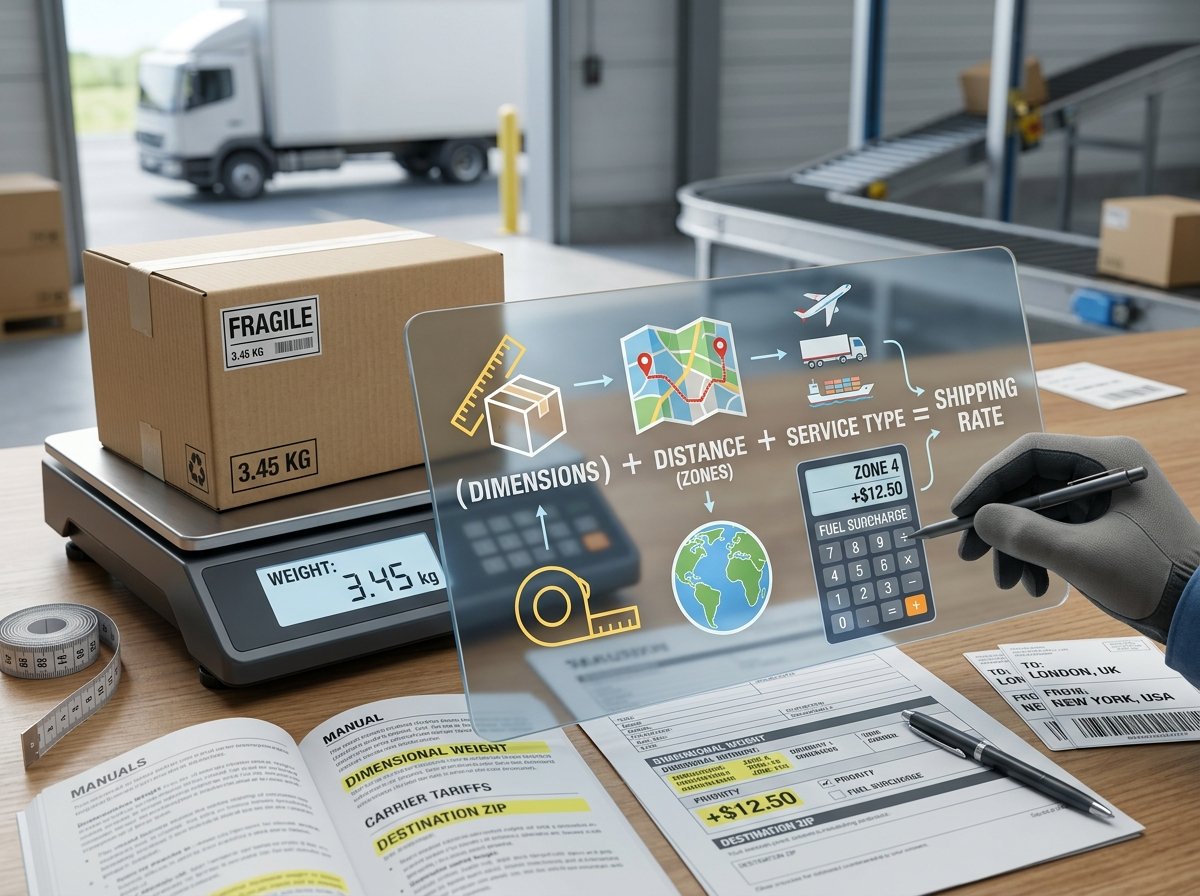
You’re not alone. Most people think shipping cost is just about weight. Put it on a scale, check a chart, done. But the reality? Your package goes through what’s almost a mini audit. Its weight, its size, where it’s going, how fast you want it there, what’s inside — every single detail affects the final price.
And here’s the kicker: two packages sitting side by side on the same counter, going to the same city, can have wildly different rates. Why? Because the calculation isn’t one formula. It’s several factors layered on top of each other.
Let me break it all down for you — no jargon, no fluff. Just clear explanations so the next time you see a shipping quote, you’ll know exactly why it costs what it costs.
The Two Big Players: Actual Weight vs. Dimensional Weight
This is where everything starts, and this is also where most confusion lives.
Every courier — whether it’s DHL, FedEx, UPS, or your local postal service — looks at your package in two ways.
Actual weight is straightforward. You place the box on a scale, and whatever number shows up is your actual weight. Simple.
Dimensional weight (also called volumetric weight) is trickier. It’s a formula that measures how much space your package takes up inside the delivery truck or airplane. Because here’s the thing: a courier’s vehicle has limited space. If your package is huge but light — like a box full of pillows — it takes up the room that three or four heavier packages could’ve used.
So carriers created dimensional weight to charge for that space.
The formula looks like this:
Dimensional Weight = (Length × Width × Height) ÷ DIM Factor
The DIM factor varies by carrier. For most international couriers, it’s 5000 (when you measure in centimeters and want the weight in kilograms). Some domestic carriers use 4000 or even 6000.
Here’s what actually happens at checkout: the carrier calculates both your actual weight and your dimensional weight, then charges you based on whichever is higher. This is called the billable weight.
So if your box actually weighs 3 kg but its dimensional weight comes out to 7 kg — you’re paying for 7 kg. That’s why packing smart matters so much.
If you’ve ever wondered why your “light” package cost more than expected, dimensional weight is almost always the answer. It catches people off guard constantly.
Pro Tip: Always measure your box after packing, not before. Tape, padding, and bulging sides can add 1-2 centimeters on each side — and that small difference can push you into a higher weight bracket.
Distance and Shipping Zones: Why “Where” Matters as Much as “What”
You already know intuitively that shipping something across town costs less than shipping it across the ocean. But how do carriers actually calculate this?
They use a zone system.
Most major couriers divide the world (or the country, for domestic shipping) into numbered zones based on distance from the origin point. Zone 1 might be your local area. Zone 8 might be the other side of the world. The higher the zone number, the more you pay.
Here’s what’s interesting: zones aren’t always based purely on geographic distance. They factor in logistics infrastructure, customs complexity, and even political relationships between countries. Shipping to a neighboring country with a smooth trade agreement might actually be cheaper than shipping to a country that’s geographically closer but has complicated customs processes.
For example, shipping from the UK to Germany (EU trade routes, excellent logistics) often costs less per kilo than shipping from the UK to certain parts of Africa, even though the physical distance difference might not be dramatic.
Carriers who use zone-based pricing include: FedEx, UPS, DHL, USPS, Royal Mail, India Post, Australia Post — basically all of them.
Did you know? Some couriers offer “flat rate” options for specific zones. If your package fits within certain weight and size limits, you pay one fixed price regardless of the exact destination within that zone. It’s worth asking about — especially if you ship regularly.
Speed of Delivery: You’re Literally Paying for Time
This one feels obvious, but the cost difference between shipping speeds is bigger than most people realize.
Let’s say you’re sending a 2 kg package from Mumbai to New York. Here’s a rough idea of how speed affects price:
Economy shipping (10-20 business days) might cost you ₹1,500-2,500. Express shipping (3-5 business days) could jump to ₹3,500-6,000. Priority/overnight shipping (1-2 business days) might land at ₹8,000-12,000 or more.
That’s a 3x to 5x price difference for the same package. The box doesn’t change. The weight doesn’t change. Only the speed changes.
Why such a huge gap? Faster shipping usually means your package gets air freight instead of ground or sea transport. It gets priority handling at sorting facilities. It skips the queue. All of that costs the carrier more — and they pass that cost straight to you.
You can see a detailed comparison of these speed tiers in our guide on economy vs. express international shipping. If you’re trying to decide between standard and expedited shipping, that breakdown will help too.
The honest advice? Unless your shipment is genuinely time-sensitive, standard or economy shipping saves serious money. Most people overestimate how fast they actually need something delivered.
Package Dimensions and How Packaging Choices Affect Cost
Here’s something that surprises a lot of first-time shippers: the box you choose can be just as important as what’s inside it.
Remember the dimensional weight formula from earlier? Your box dimensions feed directly into that calculation. So if you use a box that’s too big for your item, you’re literally paying for empty air.
Let me give you a real-world example. Say you’re shipping a pair of shoes. If you grab a random big box from your garage — let’s say 50cm × 40cm × 30cm — your dimensional weight comes out to 12 kg (using the 5000 DIM factor). But the shoes actually weigh 1.2 kg.
Now, if you use a proper shoe box — maybe 35cm × 25cm × 15cm — your dimensional weight drops to about 2.6 kg. Same shoes, same destination, but dramatically different cost.
This is exactly why choosing the right box size isn’t just about neat packing — it directly impacts your wallet.
And it’s not just box size. The packaging material itself adds weight. Heavy-duty cardboard, excessive bubble wrap, multiple layers of paper — it all adds up. A few hundred grams of packaging material might not seem like much, but if it pushes you from a 4.9 kg billable weight to 5.1 kg, you’ve just jumped into the next pricing tier.
There’s a useful guide on how much bubble wrap you actually need — it’ll help you protect your items without overdoing the padding.
Surcharges and Additional Fees: The “Hidden” Costs
This is the part that frustrates people the most. You see a base rate, you think that’s your total, and then extra charges show up. Let me walk you through the most common ones so nothing catches you by surprise.
Fuel Surcharges
Almost every major carrier adds a fuel surcharge on top of the base rate. This percentage fluctuates monthly based on global fuel prices. As of early 2025, fuel surcharges from major carriers like DHL and FedEx typically range between 5% and 15% of the base shipping cost. You won’t see this in the initial rate chart — it gets added during final billing.
Remote Area or Extended Delivery Surcharges
If your package is going to a rural address, a small island, or any location outside the carrier’s main service network, expect an extra fee. Carriers maintain lists of postal codes they consider “remote,” and deliveries to these areas cost more because they require special routing.
Residential Delivery Surcharge
This one’s mostly a US and European thing. Delivering to a home address often costs more than delivering to a commercial/business address. Why? Residential areas are harder for large delivery trucks to access, and there’s a higher chance nobody’s home — which means a second delivery attempt. If you’ve ever wondered what happens when no one’s home for delivery, that adds cost for the carrier too.
Oversized Package Surcharges
Every carrier has maximum size and weight limits. But even before you hit the limit, there are thresholds where extra fees kick in. For instance, FedEx charges an “oversize” fee when any single dimension of your package exceeds 120 cm (about 48 inches). You can check the weight and size limits for international parcels to avoid unexpected charges.
Special Handling Fees
Shipping something fragile? Irregularly shaped? Contains lithium batteries? Hazardous materials? Each of these triggers additional handling fees. Carriers charge more because these items need extra care, special labeling, or regulatory compliance during transit.
Insurance
Basic carrier liability coverage is usually minimal — often just $100 or less per package. If you’re shipping something valuable, you’ll want to add insurance for your shipped packages. This is a separate cost, typically calculated as a percentage of the declared value. It’s not technically a “surcharge,” but it adds to your total shipping cost.
Customs, Duties, and Taxes: The International Shipping Layer
If you’re shipping domestically, you can skip this section. But the moment your package crosses a border, a whole new set of costs enters the picture.
Customs duties are taxes that the destination country charges on imported goods. The amount depends on what you’re shipping, its declared value, and the specific trade rules of that country. Some countries have a de minimis threshold — a value below which no duties are charged. In the US, that threshold is $800. In the UK, it’s £135. In Australia, it’s AUD 1,000.
VAT or GST is another layer. Many countries charge value-added tax or goods and services tax on imported items. In the EU, VAT is charged on virtually all imports since the 2021 rule changes, regardless of value.
Brokerage fees are what the carrier (or a customs broker) charges for handling the paperwork to get your package through customs. DHL, FedEx, and UPS all include basic customs clearance in their international services, but complex shipments might incur additional brokerage charges.
Here’s the big question people ask: Who pays these charges — the sender or the receiver?
It depends on the shipping terms you choose. With DDU (Delivered Duty Unpaid), the receiver pays duties and taxes upon delivery. With DDP (Delivered Duty Paid), the sender pays everything upfront. DDP costs more initially but creates a better experience for the receiver — they don’t get surprised by an unexpected bill at their doorstep.
If you’re shipping to specific countries, knowing their rules in advance saves headaches. You can check out the shipping restrictions for the USA, the UK, or Australia to prepare properly.
Type of Goods: What You’re Shipping Changes the Price
Not all items are treated equally by carriers. Certain categories of goods automatically trigger higher rates or require special services.
Fragile items like artwork, glassware, or electronics need extra packaging and sometimes special handling labels. If you’re shipping something like a mobile phone or laptop, lithium battery regulations come into play, and some carriers charge a dangerous goods fee.
High-value items like jewelry push your insurance costs up significantly. The base shipping rate might be the same, but your total cost increases because you’re insuring a more expensive item. Our guide on shipping jewelry and valuables covers this in detail.
Perishable goods, live plants, alcohol — each has its own shipping requirements and restrictions. Carriers who accept these items charge more because of the specialized handling, temperature control, or legal compliance involved.
Irregular shapes also matter. A bicycle, for example, can’t be boxed into a standard rectangle easily. Its unusual shape means carriers may apply non-standard packaging surcharges or require you to use specific crating methods, as we explain in our bicycle shipping guide.
How to Actually Get the Best Rate
Knowing how rates work is one thing. Using that knowledge to pay less is where it gets practical.
Right-size your packaging. This is the single biggest money-saver for most people. Don’t use a box bigger than you need. Every extra centimeter of empty space inflates your dimensional weight. If you’re unsure about the best boxes for your specific item, there’s a helpful resource on best boxes for different types of shipments.
Compare quotes across carriers. Don’t just go with the first carrier you think of. The same package, same route, same speed can vary by 20-40% between carriers. Get at least three quotes. If you’re not sure how to do this effectively, our guide on how to compare courier quotes walks you through the process.
Choose the right speed. Be honest with yourself — does this package really need to arrive in 2 days, or would 7-10 days be perfectly fine? Dropping from express to standard can cut your cost in half.
Ship in bulk when possible. If you’re a business shipping multiple packages regularly, most carriers offer volume discounts. Even 10-15 packages a month can qualify you for better rates with some carriers.
Negotiate. Yes, you can negotiate shipping rates. This mostly applies to businesses, but if you’re shipping regularly — say you’re an eBay or Etsy seller — carriers are often willing to offer discounted rates to keep your business. Open a business account instead of shipping as a one-time customer.
Use carrier packaging. Some carriers offer free branded packaging (like FedEx and DHL express envelopes and boxes). These are optimized for their dimensional weight calculations, so you often get a better rate than using your own oversized box.
Real-World Calculation Example
Let me put everything together with a concrete example so this all clicks.
The package: You’re shipping a small decorative lamp from London to Toronto, Canada.
Step 1 — Weigh it. The packed lamp weighs 2.8 kg on the scale. That’s your actual weight.
Step 2 — Measure the box. The box is 35cm × 25cm × 30cm. Dimensional weight = (35 × 25 × 30) ÷ 5000 = 5.25 kg.
Step 3 — Determine billable weight. Actual weight is 2.8 kg, dimensional weight is 5.25 kg. The carrier charges based on the higher number: 5.25 kg.
Step 4 — Check the zone. UK to Canada might fall in Zone 6 or 7 for most carriers. Let’s say Zone 7.
Step 5 — Choose speed. You pick standard international (7-12 business days). The base rate for 5.25 kg to Zone 7 might be around £28.
Step 6 — Add surcharges. Fuel surcharge at 12% = £3.36. No remote area fee (Toronto is a major city). No special handling needed.
Step 7 — Customs considerations. The lamp is worth £60. Canada’s de minimis is CAD $20 for taxes and CAD $150 for duties. So the recipient might need to pay Canadian GST on arrival, plus a small brokerage fee.
Estimated total to the sender: roughly £31-32. The recipient might pay an additional CAD $10-20 in taxes and brokerage at delivery.
See how multiple factors stacked up? The actual weight was 2.8 kg, but you paid for 5.25 kg. The base rate was £28, but surcharges added a few more pounds. And there’s a customs cost the recipient bears too.
Now imagine you’d packed that same lamp in a bigger box — say 45cm × 35cm × 35cm. The dimensional weight jumps to 11 kg. Your base rate nearly doubles. Same lamp, same destination, just a different box.
That’s why understanding how shipping rates work isn’t just academic knowledge — it directly saves you money.
FAQ
Q: Why does my small, lightweight package cost so much to ship?
Most likely, it’s dimensional weight at work. If your package is physically large but doesn’t weigh much, the carrier uses its dimensional weight — based on its size — instead of its actual weight. The solution? Use the smallest box that safely fits your item. Even a few centimeters less on each side can bring down the cost significantly.
Q: Do all carriers calculate shipping rates the same way?
The core method — comparing actual weight vs. dimensional weight, then applying zone-based pricing — is standard across most major carriers like DHL, FedEx, UPS, and national postal services. But the specific rates, DIM factors, zone maps, and surcharges vary quite a bit. That’s why the same package can cost very different amounts depending on which carrier you choose.
Q: Can I reduce customs duties on international shipments?
You can’t avoid legitimate duties, but you can minimize them. Accurately declare the value (don’t over-declare). Check if the destination country has a free trade agreement with your country, which might reduce or eliminate certain duties. And stay below the de minimis threshold if possible — in the US, shipments valued under $800 are generally duty-free.
Q: Is shipping insurance included in the shipping rate?
Basic carrier liability is usually included, but it covers very little — often just $100 or less, and it only applies if the carrier was clearly at fault. If your item is worth more than that, you’ll need to add separate shipping insurance, which costs extra. For valuable shipments, this small additional cost is absolutely worth it.
Q: Why do shipping rates change throughout the year?
Carriers adjust rates based on fuel costs (fuel surcharges change monthly), demand (peak season surcharges during November-January), and annual rate increases (most carriers raise base rates 5-7% every January). Holiday seasons, global events, and supply chain disruptions all influence pricing too.
Your Next Move
You now understand the real mechanics behind every shipping quote you’ll ever receive. Weight, dimensions, distance, speed, surcharges, customs — these are the building blocks of every shipping rate on the planet.
The smartest thing you can do with this knowledge? Start with your packaging. Right-sizing your box is the fastest way to lower costs without changing anything else about your shipment. After that, compare quotes across carriers, pick the delivery speed you actually need (not the fastest one available), and always factor in potential customs charges for international shipments.
Shipping doesn’t have to feel like a guessing game. Once you see the formula, you’ll spot exactly where your money goes — and where you can keep more of it in your pocket.