
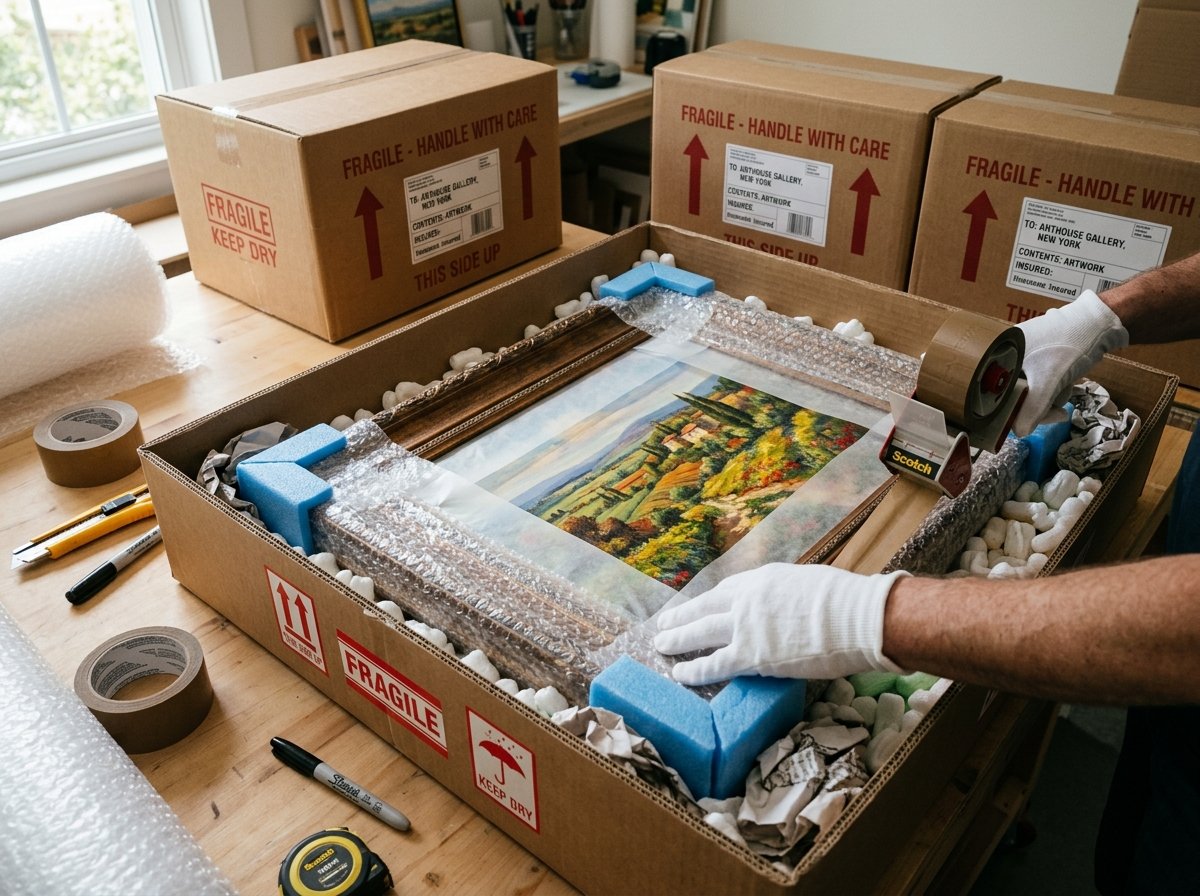
A small tear in the canvas corner. A crack running through the frame. Water stains on a print that took months to finish. That’s the nightmare every artist, collector, and gallery owner dreads when shipping artwork.
And it happens more often than you’d think. Artwork isn’t like shipping a pair of sneakers or a book. You’re dealing with fragile surfaces, odd shapes, moisture-sensitive materials, and sometimes pieces worth thousands — or even lakhs — of rupees. One wrong move during packing, one careless toss by a handler, and the damage is done.
Whether you’re an artist sending a commissioned piece to a client, an Etsy seller fulfilling orders, or someone relocating and moving your personal art collection — knowing how to ship artwork and paintings properly can save you from heartbreak and financial loss.
This guide walks you through the entire process. From choosing the right materials and packing techniques to picking the best carrier and handling insurance. Let’s get your art from Point A to Point B — safely.
Why Shipping Artwork Needs Special Attention
You might wonder — can’t I just wrap a painting in bubble wrap and throw it in a box? Technically, you can. But should you? Absolutely not.
Artwork faces a unique set of risks during transit that most other items don’t. Think about it: a canvas painting has a stretched surface that can puncture easily. An oil painting has texture that can smudge or crack under pressure. A framed piece with glass can shatter. Watercolors can bleed if exposed to moisture.
The main risks during shipping include:
- Impact damage — drops, bumps, rough handling
- Vibration — constant movement during long-distance transit can loosen frames and crack paint
- Moisture and humidity — especially during international or sea freight shipping
- Temperature extremes — heat can warp canvases, cold can make paint brittle
- Surface pressure — anything pressing against the painted surface can leave marks or cause sticking
These aren’t hypothetical scenarios. They’re the top reasons art gets damaged during shipping, according to claims data from major carriers and art shipping services. A 2023 report by the International Foundation for Art Research highlighted that transit damage accounts for nearly 40% of all physical damage claims on artwork globally.
So the extra 30 minutes you spend packing properly? That’s not wasted time — that’s protecting your investment.
Materials You’ll Need Before You Start Packing
Before you touch your painting, gather everything first. Running to grab tape mid-packing while your canvas sits half-wrapped is asking for trouble. Here’s what you’ll need:
Glassine paper or acid-free tissue paper — this goes directly against the painting’s surface. It’s smooth, non-stick, and pH-neutral, so it won’t react with paint or leave residue. Regular newspaper? Skip it. The ink can transfer onto your artwork.
Plastic wrap or polyethylene sheeting — goes over the glassine layer to create a moisture barrier. If your painting is an oil piece that’s still curing, don’t wrap plastic directly on the surface. It can cause the paint to stick.
Bubble wrap — your main cushioning layer. If you’re unsure about how much bubble wrap you actually need, the general rule for artwork is at least two layers around the entire piece, with bubbles facing outward (away from the art surface).
Cardboard corner protectors — these slip onto the corners of framed pieces and prevent the most vulnerable points from taking impact.
Sturdy cardboard or foam board — cut to size, these go on both sides of your painting to create a rigid “sandwich” that prevents bending and puncture.
A properly sized box or custom crate — the box should be at least 3–4 inches larger than your artwork on all sides to allow room for cushioning material.
Packing tape (not duct tape) — strong, clear packing tape for sealing. Duct tape leaves residue and doesn’t hold as well in temperature changes.
Foam peanuts or crumpled kraft paper — for filling void space inside the box.
“Fragile” and “This Side Up” stickers or markers — won’t guarantee gentle handling, but they help.
⚠️ Warning: Never use regular cling film, newspaper, or colored tissue paper directly on a painting’s surface. Chemical reactions, ink transfer, and sticking can cause irreversible damage.
How to Pack a Canvas Painting (Step by Step)
Alright, let’s get into the actual packing process. This method works for stretched canvas paintings — the most common type artists and sellers ship.
Step 1: Protect the Surface First
Lay your painting face-up on a clean, flat surface. Place a sheet of glassine paper over the entire painted surface. This creates a protective barrier between the paint and everything else. Tape the glassine to the back of the stretcher bars — never tape anything to the front or painted edges.
Step 2: Add the Moisture Barrier
Wrap the entire painting — glassine and all — in a layer of plastic sheeting or a large plastic bag. Seal it with tape. This keeps moisture and humidity out, which is especially critical if your painting is traveling internationally or through varying climate zones.
Step 3: Cardboard Sandwich
Cut two pieces of cardboard or foam board slightly larger than your painting. Place one on the front, one on the back. Tape them together around the edges. This creates a rigid protective shell around the canvas. If the painting is large, use double-wall corrugated cardboard for extra strength.
Step 4: Bubble Wrap Layer
Wrap the entire cardboard sandwich in at least two layers of bubble wrap. Make sure the corners get extra padding — that’s where most impact damage happens. Secure with tape, but don’t over-tighten. You want cushioning, not compression.
Step 5: Box It Up
Place the wrapped painting inside a box that’s 3–4 inches larger on every side. Fill the gaps with foam peanuts, crumpled kraft paper, or additional bubble wrap. The painting should not move at all when you shake the box. If it shifts, add more fill material.
Choosing the right box size matters a lot here. Too tight and there’s no cushioning space. Too large and the painting slides around. Both scenarios lead to damage.
Step 6: Seal and Label
Tape the box closed with at least two strips of packing tape on every seam. Add “Fragile,” “Handle With Care,” and “This Side Up” labels on multiple sides. Write “ARTWORK — DO NOT BEND” clearly on the box.
💡 Pro Tip: If you’re shipping multiple small paintings, don’t stack them face-to-face without protection between each piece. Treat each one as a separate packing job, then place them in the same box with dividers.
How to Ship Framed Paintings and Glass-Covered Art
Framed artwork adds another layer of complexity — literally. You’ve got the frame itself (which can crack or chip), the glass (which can shatter), and the artwork behind it (which gets destroyed if the glass breaks inward).
Tape the Glass
Before you wrap anything, apply painter’s tape in an “X” pattern across the glass surface. Then add horizontal and vertical strips to cover most of the glass. This won’t prevent the glass from breaking, but if it does break, the tape holds the shards together and stops them from slicing into your painting.
Don’t use regular masking tape or duct tape — painter’s tape removes cleanly without leaving residue on the glass.
Protect the Corners
Slide foam or cardboard corner protectors onto all four corners of the frame. If you don’t have commercial corner protectors, make your own by folding pieces of cardboard into L-shapes and taping them onto each corner.
Wrap the Whole Frame
Follow the same sequence: glassine or tissue over the glass face, then plastic sheeting, then bubble wrap. For heavy frames, use at least three layers of bubble wrap.
Use a Mirror Box or Telescopic Box
For framed pieces, a mirror box (also called a picture box) works perfectly. It’s designed for flat, fragile items. Two pieces telescope together to fit the exact size of your frame. Most moving supply stores carry these, and they’re surprisingly affordable.
If the framed piece is genuinely valuable — we’re talking original oil paintings, antiques, or anything irreplaceable — consider getting a custom wooden crate built. Art shipping companies like Craters & Freighters, Cadogan Tate, or even local crating services can build one to your painting’s exact dimensions.
Shipping Unframed Prints, Watercolors, and Works on Paper
Not every artwork is a stretched canvas. If you’re shipping prints, photographs, watercolors, or any flat art on paper, the approach is different.
For small to medium prints, a rigid cardboard mailer or a mailing tube works well. If using a tube, roll the print gently (with the printed side facing inward) around a core tube, then place it inside a larger shipping tube. Add tissue paper between layers to prevent surface contact.
For flat shipping (preferred for high-value prints), place the print between two pieces of acid-free mat board or foam core. Wrap the whole assembly in a plastic bag for moisture protection, then slide it into a flat cardboard mailer or box.
Did you know? Watercolors and pastels are the most sensitive artwork types to ship because the pigment sits on the surface and can smudge with the slightest friction. Always use a fixative spray before shipping pastels, and never let any material touch the painted surface directly.
If you’re selling prints on Etsy and shipping internationally, having an Etsy seller’s guide to international shipping handy can save you hours of confusion around customs forms and pricing.
Choosing the Right Shipping Carrier for Artwork
Your packing is only half the equation. The carrier you choose determines how your artwork is actually handled, how fast it arrives, and what happens if something goes wrong.
Major carriers like FedEx, UPS, and DHL all accept artwork, but none of them treat it differently from any other package unless you specifically pay for special handling services. That “Fragile” sticker? It’s a suggestion, not a command.
FedEx offers a Custom Critical service for high-value shipments, and UPS has UPS Pack & Ship locations where trained staff can pack artwork for you (for a fee). If you’re deciding between carriers for international shipments, comparing options like DHL vs FedEx for international shipping can help you make a smarter choice based on your specific route and budget.
Specialty art shipping companies are the gold standard if your piece is truly valuable. Companies like Ship Art, Pak Mail, Masterpak, or regional fine art transport services use climate-controlled vehicles, custom crating, white-glove handling, and door-to-door tracking. They cost more, but for a $5,000 painting, spending $200 on proper shipping is a no-brainer.
Speed matters too. Longer transit time means more handling, more warehouse transfers, and more opportunities for damage. If you’re weighing economy vs express international shipping, keep in mind that express options usually mean fewer touchpoints and faster delivery — both of which reduce risk for fragile items.
Here’s a reality check: if you’re shipping a painting worth less than $200, a major carrier with good packing will likely be fine. If the painting is worth $500+, seriously consider specialty shipping or at minimum, add full-value insurance.
Insurance: Don’t Ship Valuable Art Without It
This is the part people skip — and later regret.
Standard carrier liability for damaged or lost packages is laughably low. USPS offers up to $50 of free coverage for Priority Mail. FedEx and UPS declared value coverage is available but has a long list of exclusions for artwork. If your painting arrives damaged and you didn’t buy adequate coverage, you might get pennies on the dollar.
What you should do instead:
Get third-party shipping insurance from providers like Shipsurance, InsurePost, or specialty art insurance through companies like Hiscox or Berkley Asset Protection. These policies cover the actual appraised or market value of your artwork, including the frame.
Keep documentation ready: photos of the artwork before packing, photos of the packing process, receipts or appraisals showing value, and a detailed description of the piece. If you ever need to file a claim, this evidence makes the process dramatically smoother. Learn more about how insurance for shipped packages works to protect yourself properly.
💡 Pro Tip: Take timestamped photos during every stage of packing — surface close-ups, the wrapping process, the sealed box. If a claim dispute arises, these photos are your best defense.
Shipping Artwork Internationally — Extra Steps to Know
International art shipping adds a whole layer of customs, duties, and regulations that domestic shipping doesn’t.
Customs declarations are mandatory. You’ll need to describe the artwork accurately on customs forms — medium, dimensions, subject matter, and declared value. Some countries charge import duties on artwork, while others (like the EU for original art, and the US for works classified as “original”) may have lower or zero duty rates.
Certificates of authenticity and provenance documents might be requested at customs, especially for antiques or high-value original pieces. Having these ready in a clear plastic envelope attached to the outside of the crate speeds things up.
Certain countries have restrictions. Some nations restrict the import of items depicting specific cultural, religious, or political content. Antiques older than a certain age may need export permits from the origin country. Do your research before shipping.
If you’re sending art as part of a larger move abroad — say you’re an artist relocating — check out guidance on how to ship belongings when moving abroad for tips on combining personal items with fragile artwork in one shipment.
Temperature and climate consideration: If your artwork is traveling by sea freight (common for international moves), the container can experience extreme temperature swings. Silica gel packets inside the packaging absorb excess moisture. For very valuable pieces, climate-controlled air freight is worth the investment.
Cost Factors: How Much Does It Cost to Ship Artwork?
There’s no one-size-fits-all answer, but here’s what influences the price:
Size and weight are the biggest factors. Most carriers use dimensional weight pricing, which means if your painting is large but light (as most canvases are), you’ll be charged based on the box dimensions, not the actual weight. A 36×48-inch painting in a properly padded box can easily hit dimensional weights of 30–40 lbs even if it actually weighs 8 lbs.
Distance and destination obviously matter. Shipping a painting from New York to Los Angeles costs far less than New York to London.
Shipping speed plays a role too. Ground shipping is cheapest but slowest. Air freight is fast but pricier. For domestic shipments, understanding the pros and cons of ground vs air shipping helps you balance cost against transit time and handling risks.
Rough cost estimates for domestic US shipping (2025):
A small painting (under 24 inches) in a flat box via FedEx Ground typically runs $30–$70. Medium paintings (24–36 inches) cost $60–$150. Large paintings (36–48 inches) can range from $100–$300+. Custom crating and white-glove service for valuable pieces can easily run $300–$800 or more, depending on size and distance.
International shipments can double or triple these numbers.
Money-saving tips:
If you ship artwork regularly (as a gallery or online seller), ask carriers about volume discounts. Bulk shipping discounts can significantly reduce per-package costs when you’re sending multiple pieces per month.
Common Mistakes That Damage Artwork During Shipping
Let’s be honest — most art shipping damage isn’t caused by rough handlers (though that happens). It’s caused by bad packing choices. Here are the mistakes people make repeatedly:
Using the wrong box size. A box that’s too big lets the painting rattle around. A box that’s too tight doesn’t leave room for cushioning. Both result in damage.
Skipping the moisture barrier. Even domestic shipments can encounter rain, humidity in warehouses, or condensation in delivery trucks. That plastic layer takes 30 seconds to add and can save a painting.
Placing bubble wrap with bubbles touching the paint surface. The bubble texture can imprint onto wet or tacky paint. Always face bubbles outward, or place a smooth layer (glassine or tissue) between the bubbles and the surface.
Not reinforcing corners. Corners take the most impact in transit. Unprotected corners on a frame will chip or crack almost guaranteed.
Reusing old, weakened boxes. A box that’s been shipped before has compromised structural integrity. Use a new, sturdy box. Your artwork deserves it.
For a deeper look at packing errors that cause the most transit damage, check out this guide on common packaging mistakes that damage parcels.
FAQ
Can I ship a painting through regular mail like USPS or Royal Mail?
Yes, you can. USPS, Royal Mail, and other postal services accept paintings as long as they’re properly packed and within size/weight limits. For valuable or large pieces, though, courier services like FedEx, UPS, or DHL offer better tracking, handling options, and insurance coverage. Postal services work fine for smaller prints and lower-value artwork.
Do I need to remove glass from a frame before shipping?
It’s recommended for long-distance and international shipping. Glass adds weight, and if it breaks, it damages the art underneath. If you must ship with glass, tape the glass surface with painter’s tape in a cross-hatch pattern to contain any shards. For high-value pieces, consider replacing glass with plexiglass/acrylic before shipping — it’s lighter and shatter-resistant.
How do I ship a very large painting (over 48 inches)?
Paintings over 48 inches usually require a custom wooden crate. Most major carriers have size limits for standard packages (typically around 108 inches in combined length and girth). For oversized art, freight shipping services or specialty art transport companies are your best option. They’ll build a crate, handle the logistics, and offer full-value insurance.
Should I ship a painting flat or upright?
Upright (vertical) is almost always better, especially for framed pieces. Shipping flat increases the risk of something heavy being stacked on top of your box in a delivery truck or warehouse. Mark your box clearly with “THIS SIDE UP” arrows to encourage vertical handling.
How long does it take to ship artwork internationally?
It depends on the method. Air freight typically takes 3–7 business days for most international routes. Sea freight can take 4–8 weeks. Express courier services (DHL Express, FedEx International Priority) deliver in 2–5 business days to most countries but cost significantly more.
Your Art Deserves the Same Care in Transit as in Creation
An artist might spend weeks — sometimes months — creating a single painting. A collector might wait years to find the perfect piece. All of that effort and emotion shouldn’t be undone by a $2 box and some leftover newspaper.
The good news? Shipping artwork safely isn’t complicated. It just requires the right materials, a bit of patience, and attention to the details that actually matter — surface protection, moisture barriers, proper cushioning, and a carrier you can trust.
Take those extra 30 minutes to pack it right. Spend the extra $15 on a proper box and quality materials. Consider insurance for anything you’d be genuinely upset to lose.
Your next step? Grab the materials listed above, follow the packing steps for your specific art type, and ship with confidence. That painting will arrive exactly as it left — beautiful, intact, and ready to be admired.