
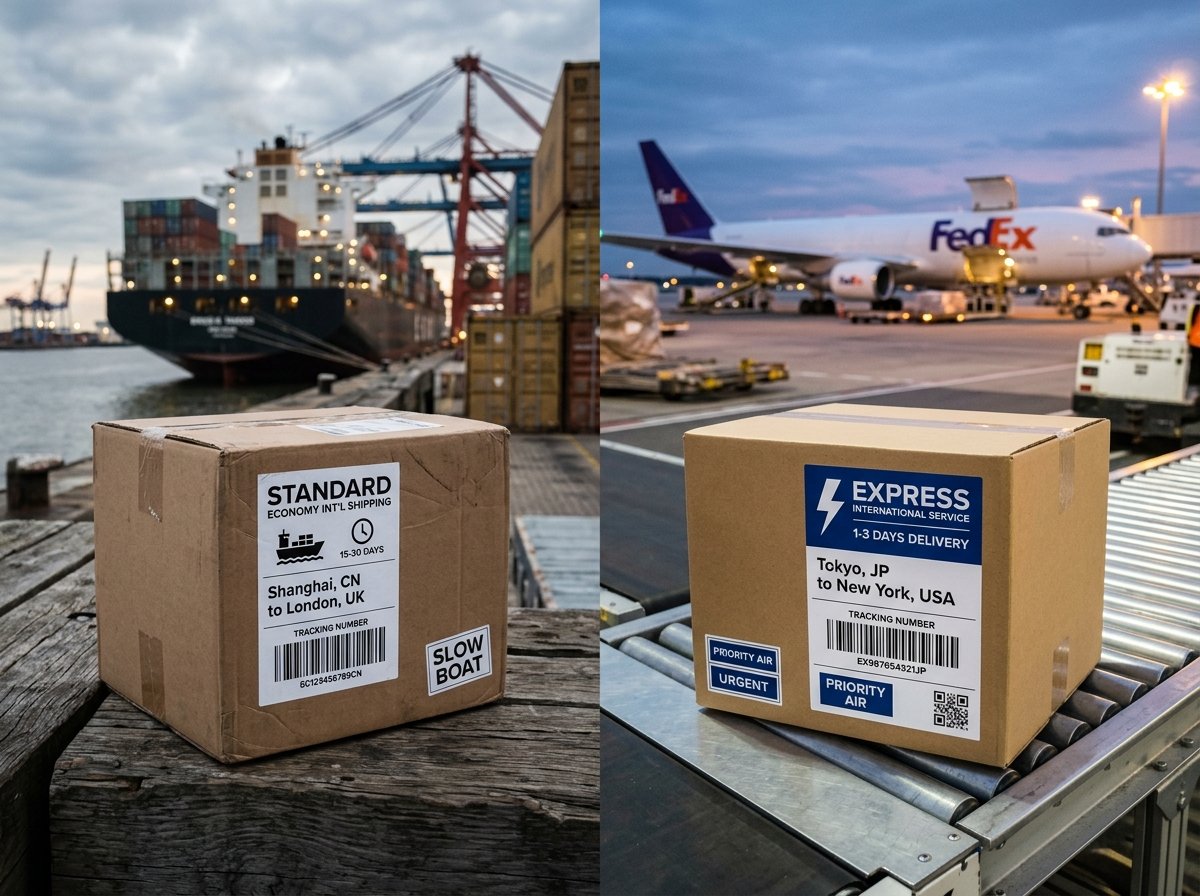
A package shipped economy from London to Mumbai can take 15–20 days. The same package, sent express, lands in 2–4 days. That’s a difference of nearly two weeks — and sometimes, those two weeks don’t really matter. Other times, they matter more than anything.
This is the exact decision millions of people face every time they ship something internationally. Economy or express? Cheap or fast? And the real question nobody asks out loud: am I wasting money by picking the wrong one?
You’re probably here because you’ve got a shipment to send — maybe a gift, a product for a customer, personal belongings, or something you sold online. You want to understand the actual difference between economy and express international shipping, not just a textbook definition, but what it means for your wallet, your timeline, and your peace of mind.
Let’s break it all down.
What Does Economy International Shipping Actually Mean?
Economy shipping is the slower, more affordable option that carriers offer for international deliveries. Think of it like taking a bus instead of a taxi — you’ll get there, but you’re sharing space, making stops, and it’s going to take longer.
With economy shipping, your parcel usually travels by ground transport, sea freight, or a combination of slower air routes. Carriers like DHL, FedEx, UPS, and national postal services all have their own economy options. DHL has “DHL eCommerce,” FedEx offers “FedEx International Economy,” and UPS has “UPS Worldwide Saver” and economy tiers too.
Typical delivery timeframes for economy international shipments range from 7 to 25 business days depending on the origin, destination, and carrier. A shipment from the US to Europe might take 7–12 days, while US to Southeast Asia could stretch to 15–20 days or even longer.
The main draw? Cost savings. Economy shipping can be 40–70% cheaper than express on the same route. If you’re shipping a 5 kg package from the UK to Canada, you might pay around £25–£40 for economy versus £60–£100+ for express. Those numbers add up, especially for businesses shipping in volume.
But here’s what most people don’t realize — economy shipping doesn’t always mean “no tracking.” Many economy services now offer basic tracking, though it might not update as frequently as express. You’ll usually see scans at major checkpoints, not every step of the way.
Quick Fact: Economy shipping parcels often sit in consolidation warehouses for a day or two before being dispatched with other shipments headed the same direction. That’s one of the reasons it’s slower — your package waits for company.
What Does Express International Shipping Really Offer?
Express shipping is the priority lane. Your package gets dedicated handling, faster transport (almost always by air), and usually a guaranteed or estimated delivery date.
With express services, parcels typically arrive within 1–5 business days internationally. DHL Express, FedEx International Priority, and UPS Express are the big players here. These services use their own dedicated air networks — DHL alone operates over 260 aircraft globally — which means your parcel doesn’t wait for commercial flight availability.
What you’re really paying for with express isn’t just speed. You’re paying for priority customs clearance (express carriers have dedicated customs teams that process shipments faster), real-time tracking with detailed updates, higher reliability in delivery windows, and usually better insurance or liability coverage included in the base price.
If you’ve ever compared DHL vs FedEx for international shipping, you’ve noticed both invest heavily in their express networks. That’s where their margins are, and that’s where the service quality is highest.
Pro Tip: Express shipping often includes automatic customs brokerage. With economy, you might have to handle customs paperwork yourself or pay a separate brokerage fee, which can eat into those savings you thought you were getting.
The Real Cost Difference — It’s Not Just About the Price Tag
Here’s where most comparison articles get lazy. They say “economy is cheaper” and move on. But the true cost picture is more layered than that.
The upfront price gap is real. On average, express international shipping costs 2x to 3x more than economy for the same package on the same route. For a 2 kg parcel from the US to Germany, you might see something like $18–$30 for economy and $45–$80 for express, depending on the carrier and service level.
But the sticker price doesn’t tell the whole story.
With economy, you might face additional customs handling fees that express carriers often bundle into their price. There’s also the cost of longer cash flow cycles for businesses — if you’re an online seller, your customer gets the product two weeks later, which delays reviews, repeat purchases, and satisfaction. There’s also the risk cost. Economy packages with limited tracking are slightly more prone to getting lost in transit, and filing a claim can be a longer process. Knowing how to file a claim for a lost package becomes important here.
For businesses, the calculation changes entirely at scale. Shipping 500 orders a month? That 2x–3x price difference becomes tens of thousands of dollars. That’s why many eCommerce sellers use a hybrid approach — economy for standard orders, express for premium or time-sensitive ones. If you’re running an online store, understanding how shipping rates are actually calculated helps you price your products properly.
Did You Know? Many carriers offer bulk shipping discounts that can bring express shipping costs down to near-economy levels if you’re shipping enough volume. It’s always worth asking.
Speed vs Savings: When Does Each Option Make Sense?
This is the part most people actually need. Not theory — practical guidance on when to choose what.
Choose economy international shipping when:
You’re sending gifts or personal items with no urgent deadline. Birthday present for a cousin three weeks away? Economy is perfect. You’re an online seller offering a “standard shipping” option to price-sensitive customers. The items aren’t perishable, fragile, or time-sensitive. You’re shipping personal effects or belongings for a move that’s planned weeks in advance — something covered well in this guide to shipping belongings when moving abroad. You’re a student sending non-urgent items to your university abroad.
Choose express international shipping when:
You’re sending documents needed for visa applications, legal matters, or business deals. Your customer paid for fast delivery and expects it. The item is perishable or has a time limit (event tickets, seasonal products, medication). You’re shipping something valuable that needs real-time tracking and faster customs processing — for example, if you’re figuring out how to ship jewelry and valuables, express is almost always the smarter pick. You’re sending last-minute gifts for occasions like Diwali or Mother’s Day. There’s a business-critical deadline attached.
The gray area is where most people get stuck. You’ve got a package that’s somewhat important, somewhat urgent, and you don’t want to overspend. Here’s my rule of thumb: if the delay would cause you stress, frustration, or a real-world consequence — go express. If you can genuinely forget about the package for two weeks and be fine — economy works.
Tracking and Visibility: A Bigger Deal Than You Think
Let’s talk about something most people underestimate until they’re refreshing a tracking page at 2 AM.
Express international shipments give you granular, real-time tracking. You’ll see when the package is picked up, when it arrives at the origin hub, when it clears export customs, when it’s on a flight, when it clears import customs, when it’s out for delivery. Some carriers even give you a delivery time window.
Economy shipments? The tracking experience is hit-or-miss. Some economy services offer tracking that updates at major transit points — maybe 3 or 4 scans total across the entire journey. Others offer almost no tracking at all, especially postal economy services. Your package enters a tracking black hole for days, and you just… wait.
This matters more than you’d think. If you’re selling products online, your customers will message you asking “where’s my package?” — and if you can’t give them a real answer, that’s a customer service headache. If you’re sending important personal items, the anxiety of not knowing where your package is for 10+ days gets real.
Understanding what different tracking statuses mean can help you decode those sparse economy tracking updates and reduce unnecessary panic.
Warning: Some economy tracking numbers stop working once the package crosses a border and gets handed off to the destination country’s local postal service. This is common with postal economy services and can make it very difficult to locate your parcel if something goes wrong.
Customs and Duties: The Hidden Variable
Here’s something that catches first-time international shippers off guard — customs clearance works differently for economy vs. express.
Express carriers like DHL Express, FedEx, and UPS have in-house customs brokerage teams at major international hubs. They pre-clear shipments electronically, often before the package even lands. This means fewer delays, fewer surprise holds, and a smoother process overall. If there’s a duty or tax to be paid, they’ll often collect it from the recipient or charge it to the shipper’s account — it’s streamlined.
Economy shipments, especially those going through national postal systems, often go through standard government customs processing. This process is slower because postal shipments are processed in bulk, and customs officials manually inspect or assess duties on a larger queue of items. It’s not unusual for an economy parcel to sit in customs for 3–7 extra days in some countries.
And there’s a practical risk here. If customs needs additional paperwork or has questions about your economy shipment’s contents, the notification process can be slow — sometimes a paper letter sent to the recipient’s address. With express, you’d get an email or a call from the carrier’s customs team within hours.
If you’re shipping to countries with stricter import rules, like the USA, UK, or Australia, express shipping’s faster customs process becomes a genuine advantage, not just a convenience.
Reliability and Risk: What Could Go Wrong?
No shipping method is 100% risk-free. But the risk profiles differ between economy and express.
Economy shipping risks: Packages spend more time in transit, which means more touchpoints, more handling, and more exposure to potential damage or loss. Economy parcels are also more likely to be stored in non-climate-controlled environments for longer periods. If your parcel does get lost, the claims process can be slower because tracking data is limited.
Express shipping risks: Express isn’t immune to problems either. Packages can still get delayed at customs, weather can disrupt flights, and occasionally items do get damaged. But the difference is that express carriers typically respond faster to issues. Their customer service teams are more accessible, tracking makes it easier to identify where a problem occurred, and claims processing is generally quicker.
The risk gap gets wider during peak shipping seasons — holidays, Black Friday, year-end rushes. Economy services slow down significantly during these periods because they’re already operating on tighter margins and thinner schedules. Express services slow down too, but usually by a day or two, not a week or two.
Pro Tip: No matter which option you choose, proper packaging is your first line of defense against damage. Avoiding common packaging mistakes and choosing the right box size can save you more headaches than any shipping upgrade.
A Side-by-Side Look: Economy vs Express at a Glance
Sometimes it helps to see everything in one place. Here’s a direct comparison across the factors that actually matter:
Delivery Speed: Economy takes 7–25 business days depending on route. Express delivers in 1–5 business days.
Cost: Economy runs 40–70% cheaper. Express is premium-priced, but includes more services in the base cost.
Tracking: Economy offers basic or limited tracking. Express provides real-time, detailed tracking with frequent updates.
Customs Handling: Economy goes through standard postal or government customs queues. Express uses dedicated, carrier-managed customs brokerage.
Reliability of Delivery Window: Economy gives estimates, not guarantees. Express often provides guaranteed or time-definite delivery dates.
Insurance/Liability: Economy typically includes minimal coverage (if any). Express includes higher base liability and offers easy add-on insurance.
Best For: Economy suits non-urgent, budget-conscious shipments. Express is ideal for time-sensitive, high-value, or business-critical items.
This comparison shifts a bit depending on the specific carrier. For instance, if you’re deciding between specific providers, checking a detailed Aramex vs DHL comparison or a standard vs expedited shipping breakdown can give you more targeted insights.
Smart Strategies: Getting the Best of Both Worlds
The savviest shippers — whether they’re individuals or businesses — don’t commit to just one option. They use a blended approach.
For online sellers: Offer both options at checkout. Let your customer decide. Some buyers are happy to wait 2–3 weeks if it saves them $15 on shipping. Others want their order by Friday and will gladly pay extra. Giving the choice improves conversion rates and customer satisfaction. If you’re selling on platforms like eBay or Etsy, this is practically standard practice. Guides like the Etsy seller’s international shipping guide cover this setup well.
For personal shippers: Plan ahead. If you know you need to send a birthday gift, anniversary package, or care package to someone abroad, start early and save money with economy. Rushed last-minute shipping almost always means paying express prices.
For business shipments: Categorize your shipments by urgency. Contracts, legal documents, prototypes, and samples? Express, always. Marketing materials, bulk product restocks, or non-urgent supplies? Economy makes financial sense.
For people relocating: If you’re moving abroad for work or studies, you’ll likely have some items you need right away (documents, essentials, a few changes of clothes) and a lot of items you can wait for (books, kitchen stuff, winter clothes). Send the essentials express and the rest economy. A shipping guide for work relocation can help you plan this split effectively.
How Dimensional Weight Affects Your Economy vs Express Decision
Here’s something that often gets overlooked. The cost difference between economy and express can shrink or widen based on your package’s dimensional weight.
Carriers don’t just charge by actual weight. They calculate dimensional weight (length × width × height, divided by a carrier-specific factor) and charge you for whichever is higher — actual weight or dimensional weight. This is how they account for large, lightweight packages that take up cargo space but don’t weigh much.
For economy shipping, the dimensional weight divisor is sometimes more generous (meaning you pay less for bulky items). For express, the divisor can be stricter, making oversized packages disproportionately expensive.
So if you’re shipping something big but light — like a box of clothes, a lampshade, or stuffed toys — the price gap between economy and express might be even larger than you’d expect. Understanding how dimensional weight works can genuinely help you make a smarter choice and potentially save money on packaging adjustments.
What Happens If Something Goes Wrong?
Nobody wants to think about this, but it matters. A lost, delayed, or damaged package is a completely different experience depending on whether you shipped economy or express.
With express: You have detailed tracking data that shows exactly where the package was last scanned. You can contact the carrier’s customer support (which is usually more responsive for express customers), initiate a trace or investigation quickly, and file a claim with supporting data. Most express carriers resolve claims within 5–15 business days.
With economy: If tracking is limited, pinpointing where the package went missing is harder. Customer support for economy services is often slower, and the investigation process can take 30–60 days. Claims payouts tend to be lower because economy services carry lower liability limits.
If your package shows as delivered but hasn’t actually arrived, the resolution process is also smoother with express because the tracking evidence is more detailed.
Warning: Always check the carrier’s liability limits before shipping something valuable via economy. Some economy services cap liability at $50–$100 regardless of the item’s actual value. If you’re shipping anything worth more than that, either upgrade to express or add shipping insurance.
FAQ
Is economy shipping safe for international packages?
Yes, economy shipping is generally safe for international parcels. Millions of economy packages are delivered worldwide every day without issues. The main trade-off is speed and tracking visibility, not safety. That said, proper packaging is critical — economy parcels go through more handling and sorting over a longer period, so they need to be packed well. For high-value or fragile items, express is a safer bet because of better tracking and handling.
How much slower is economy shipping compared to express?
On most international routes, economy shipping takes 7–25 business days, while express takes 1–5 business days. The exact difference depends on the origin country, destination, carrier, and even the time of year. During peak seasons like November–December, economy can slow down even further, while express mostly stays within its usual timeframe with only minor delays.
Can I upgrade from economy to express after I’ve already shipped?
In most cases, no. Once a parcel has been dispatched with an economy service, you can’t upgrade it mid-transit. Some carriers allow you to intercept or redirect a package, but changing the service level is typically not possible after the package enters the carrier’s network. If speed might become an issue, it’s better to choose express from the start rather than hoping for an upgrade later.
Does express shipping include customs clearance?
Most major express carriers — DHL Express, FedEx International Priority, UPS Express — include customs brokerage as part of their service. Their teams handle the customs paperwork, pre-clear shipments electronically, and manage duty/tax collection. Economy services, especially postal-based ones, usually don’t include this. Your package goes through standard government customs, which is slower and less predictable.
Which is better for eCommerce — economy or express?
It depends on your business model and customer expectations. Many successful online sellers offer both options and let the customer choose. Budget-friendly products with lower margins pair well with economy shipping. Premium, time-sensitive, or high-value products justify express. If you’re shipping in volume, negotiating bulk rates can make express more affordable than you’d expect.
Your Next Move
Choosing between economy and express international shipping isn’t really about which one is “better.” It’s about which one is right for this specific shipment, at this specific time, for this specific purpose.
Economy shipping is a smart, practical choice when you have time on your side and cost matters more than speed. Express is worth every extra penny when deadlines are tight, the item is valuable, or you need the peace of mind that comes with real-time tracking and priority handling.
The best approach? Know both options well, plan your shipments ahead of time, and match the service level to what’s actually at stake. Not every package needs to fly first class. But some absolutely do — and for those, don’t hesitate.
If you’re still figuring out the right carrier for your needs, comparing specific services like ground vs air shipping or understanding the difference between standard and expedited shipping can sharpen your decision even further. The more you know about how international shipping works, the less you’ll overspend — and the fewer surprises you’ll face along the way.