
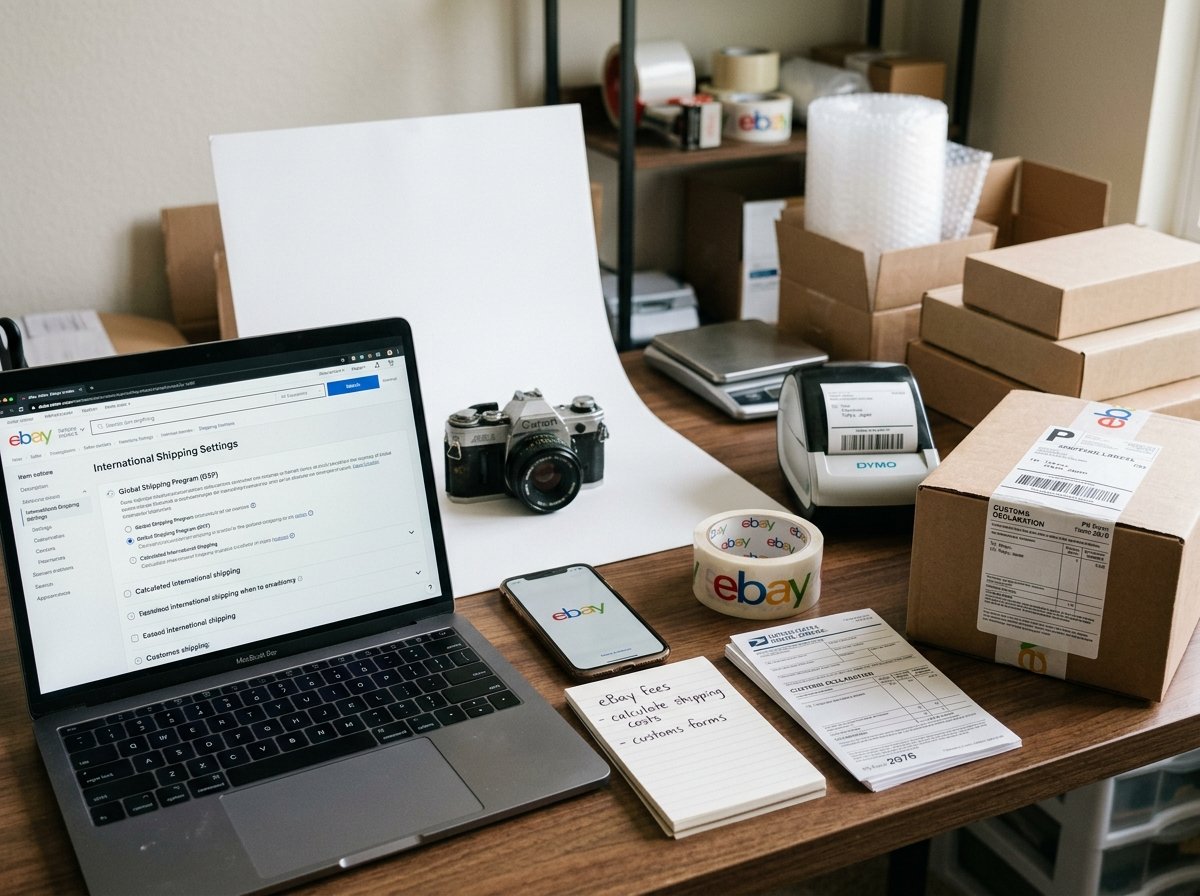
Here’s a number that should grab your attention — eBay has over 132 million active buyers spread across 190+ countries. That’s not just a marketplace. That’s practically half the planet waiting to buy something you might already have sitting in your closet, garage, or warehouse.
Yet most new sellers stick to domestic shipping because the idea of sending a package to Germany or Australia feels like solving a puzzle blindfolded. Customs forms, shipping labels, delivery timelines — it sounds overwhelming. But honestly? Once you understand the basics, selling internationally on eBay is just a few extra steps beyond what you’d do for a local sale.
Whether you’re clearing out your home or building a full-time e-commerce business, this guide walks you through everything — from setting up your eBay seller account to getting that first international package out the door without any headaches.
Why eBay Still Makes Sense for Sellers in 2025
You might wonder — with Amazon, Etsy, Shopify, and a hundred other platforms out there — why eBay? Fair question.
eBay has something most platforms don’t: auction-style flexibility combined with a massive global reach. You can sell a $5 phone case or a $5,000 vintage watch, and both have genuine buyers actively searching. The platform doesn’t force you into a specific product niche, and it doesn’t charge you monthly fees until you cross 250 free listings per month.
For international sellers specifically, eBay’s Global Shipping Program (GSP) and built-in tools make cross-border sales surprisingly manageable — even if you’ve never shipped anything beyond your own city before.
And here’s the thing most people overlook: certain products that seem ordinary in your country can be rare or highly desired overseas. A British vinyl record, an American vintage tool, Indian handicrafts — these items find passionate buyers internationally who’ll happily pay premium prices plus shipping.
Setting Up Your eBay Seller Account the Right Way
Before you list a single item, your account setup matters more than you think. A poorly configured account can lead to payment delays, listing restrictions, or even buyer distrust.
Personal vs. Business Account
eBay lets you register as an individual seller or a business seller. If you’re just testing the waters — selling personal items occasionally — a personal account works fine. But if you plan to sell regularly, buy inventory, or treat this as a side hustle, go with a business account from the start.
A business account gives you access to better analytics, bulk listing tools, and it looks more professional to buyers. You’ll need to provide your business name, address, and tax information. Don’t worry — you can always upgrade later, but starting right saves you time.
Getting Your Payment Setup Right
eBay now uses managed payments, which means they handle all transactions directly. You’ll link your bank account (not just PayPal like the old days), and eBay deposits your earnings on a regular schedule — typically within 2 business days after a sale.
Make sure your bank account details are accurate. One wrong digit, and your payouts get stuck in limbo. Also, set up your tax information early. If you’re in the US, that means your SSN or EIN. For UK sellers, it’s your National Insurance number or VAT details.
Pro Tip: Enable two-factor authentication on your account immediately. eBay seller accounts are prime targets for hackers, and losing access during active sales can be devastating.
Creating Listings That Actually Sell Internationally
Your listing is your salesperson. It works 24/7 across every time zone. So it better be good.
Writing Titles That Buyers Search For
eBay’s search engine works differently than Google. Buyers type specific terms — brand names, model numbers, sizes, colors, conditions. Your title should pack in as many relevant keywords as possible within the 80-character limit.
Bad title: “Nice leather bag for sale, great condition!”
Good title: “Coach Leather Crossbody Bag Brown Vintage Original Women’s Purse”
See the difference? The second title includes brand, material, style, color, era, and category. International buyers especially search by brand and specific product attributes because they often know exactly what they want.
Photos Make or Break Your Sale
You get up to 24 photos per listing — use at least 8-10. Photograph your item against a clean white or neutral background with natural lighting. Capture every angle: front, back, sides, bottom, close-ups of labels, serial numbers, and any flaws.
International buyers can’t touch or inspect your product. Your photos are their only window. A blurry, dark photo screams “don’t trust this seller,” even if your product is genuinely excellent.
Pricing Strategy for Global Buyers
Pricing for international sales needs a slightly different mindset. You’re not just competing with local sellers — you’re competing with sellers from countries where production costs might be lower.
Research completed listings (eBay lets you filter by “Sold” items) to see what similar products actually sold for, not just what people are asking. Factor in that international buyers will also pay shipping costs, so your item price plus shipping needs to feel reasonable compared to what they’d find locally.
Some sellers bake shipping costs into the item price and offer “free shipping.” This can boost visibility because eBay’s algorithm tends to favor free-shipping listings. But for international orders, truly free shipping can eat your margins fast — so calculate carefully.
Understanding eBay’s Global Shipping Program (GSP)
This is where things get interesting for new international sellers. eBay’s Global Shipping Program is basically training wheels for cross-border selling — and honestly, even experienced sellers keep using it because it’s that convenient.
How GSP Works
Here’s the simplified version: you ship your sold item to eBay’s domestic shipping center (in Erlanger, Kentucky for US sellers, or the UK hub for British sellers). That’s it. Your job is done.
From there, eBay handles everything — customs forms, international postage, import duties, and delivery to the buyer’s country. If anything goes wrong during the international leg of the journey, eBay covers it. You’re protected.
The buyer sees the total cost (item + domestic shipping + international shipping + import charges) before purchasing, so there are no surprise fees. This transparency actually increases conversion rates because buyers hate unexpected customs charges showing up at delivery.
GSP vs. Shipping Directly Yourself
GSP is fantastic for beginners, but it has trade-offs.
GSP advantages: You only deal with domestic shipping. No customs paperwork. Seller protection on international transit. Automatic duty/tax calculation for buyers.
GSP limitations: It’s available to limited countries (about 60+, but not all 190). Shipping costs can appear higher to buyers because eBay adds their handling margin. And you can’t offer expedited international shipping through GSP.
If you’re shipping lightweight, high-value items — like jewelry and valuables — the GSP markup might make your prices uncompetitive. In those cases, shipping directly through carriers like USPS, Royal Mail, or DHL gives you more control over costs.
Many experienced sellers use a hybrid approach: GSP for countries they’re unfamiliar with, and direct shipping to high-volume destinations like the UK, Canada, Australia, and Germany where they understand the customs process.
Shipping Internationally on Your Own: What You Need to Know
Once you’re comfortable (or if GSP doesn’t cover your target market), shipping directly opens up more countries, better rates, and faster delivery options.
Choosing the Right Carrier
Your carrier choice depends on package weight, dimensions, destination, and speed. Here’s a realistic breakdown:
USPS (for US-based sellers) remains the most affordable option for packages under 4 lbs through their First-Class International service. For heavier items, Priority Mail International offers tracking and insurance up to $200.
Royal Mail and Parcelforce serve UK-based sellers well. If you’re deciding between them, the differences in pricing and service levels matter — you can compare Royal Mail vs. Parcelforce to find which fits your product type.
DHL and FedEx are your best friends for time-sensitive or high-value shipments. They provide end-to-end tracking, faster customs clearance, and reliable delivery estimates. The costs are higher, but the reliability often justifies it — especially if you’re selling items worth $100+. If you’re weighing between the two, this DHL vs. FedEx comparison covers the important differences.
Understanding Shipping Costs and Dimensional Weight
Here’s something that catches new sellers off guard: carriers don’t always charge based on actual weight. They use something called dimensional weight (DIM weight), which calculates cost based on how much space your package occupies.
A large but lightweight box — say, shipping a lampshade — could cost far more than you’d expect because it takes up cargo space. Understanding how dimensional weight works can save you from accidentally pricing your shipping too low and losing money on every sale.
Always measure your packed item (not just the product — the product inside the box with padding) before setting shipping prices on your listing.
Packaging That Survives International Transit
International packages go through more handling points than domestic ones. Your item might pass through 3-4 sorting facilities, customs inspection, maybe even a rough truck ride in the destination country. If your packaging isn’t solid, your product arrives damaged — and that means refunds, negative feedback, and lost money.
Use double-walled corrugated boxes for anything fragile. Wrap items individually. Fill empty space with bubble wrap or packing paper — never newspaper (the ink transfers). And tape all seams with strong packing tape, not just the top.
Picking the right box size also matters because oversized boxes increase your DIM weight and cost you more. A box should be just large enough to hold your item with 2 inches of padding on each side.
If you’re shipping specific product categories — like electronics such as phones or laptops or cosmetics and skincare products — each category has its own packaging and regulatory requirements you should know before shipping.
Warning: Common packaging mistakes like using old, weakened boxes, under-wrapping fragile items, or skipping “FRAGILE” labels cause a shocking percentage of transit damage claims. Don’t cut corners here.
Customs, Duties, and Paperwork (It’s Simpler Than You Think)
The word “customs” scares most new sellers. But let’s be real — it’s basically just a form telling the destination country what’s inside the box, what it’s worth, and where it came from.
The Customs Declaration Form
Every international package needs a customs declaration (CN22 for small packets, CN23 for larger parcels, or a commercial invoice for business shipments). Most carriers — including USPS, Royal Mail, and all major couriers — let you fill this out electronically when you create your shipping label.
You’ll need to provide: a description of the item (be specific — “ceramic mug” not just “gift”), quantity, weight, value in your currency, and country of origin (where the item was manufactured, not where you’re shipping from).
Did you know? Under-declaring the value of your item to help your buyer avoid customs duties is technically customs fraud. If caught, the package gets seized, and both you and your buyer could face penalties. Always declare the actual sale price.
Who Pays Import Duties and Taxes?
This depends on how you’ve set up the sale. Under eBay’s standard international selling setup, the buyer is responsible for any import duties, taxes, or customs fees charged by their country. Your listing should clearly state this in the shipping terms.
Some countries have specific thresholds. For example, the UK charges VAT on goods above £135, and Australia applies GST on imports over AUD 1,000. The US has a relatively generous $800 de minimis threshold before duties kick in.
If you’re regularly shipping to specific countries, it helps to know their shipping restrictions and import rules. The UK and Australia have their own lists of restricted and prohibited items that can trip up sellers who don’t check in advance.
Handling Returns for International Orders
Let’s talk about the part nobody loves — returns.
International returns are trickier than domestic ones. Return shipping costs are high, transit takes longer, and the entire process can drag on for weeks. So having a clear, fair return policy upfront is essential.
You have three main options as an eBay seller:
Option 1: Accept returns, buyer pays return shipping. This is the most common approach for international sellers. The buyer gets their money back once the item arrives, but they cover the return postage. It’s fair and keeps your costs predictable.
Option 2: Offer partial refunds without requiring return. For low-cost items, it often makes more financial sense to refund part of the purchase price and let the buyer keep the item rather than paying $30+ for return international shipping on a $15 item.
Option 3: No returns. eBay allows this, but it can hurt your search ranking and buyer confidence. And even with a “no returns” policy, eBay may still force a return if the buyer claims the item wasn’t as described.
Having a solid understanding of how to handle returns for your online business can save you from reactive, emotional decisions when a return request lands in your inbox.
Scaling Up: From Casual Seller to International Business
Once you’ve made your first few international sales and the process feels comfortable, you’ll naturally want to sell more. Here’s where strategy starts mattering more than enthusiasm.
Identify Your Best-Selling Destinations
After 20-30 international sales, check your eBay analytics. You’ll probably notice patterns — maybe 40% of your international orders go to the UK, 20% to Germany, 15% to Australia. Focus your attention on these markets.
Consider offering calculated shipping rates to your top destinations so prices are accurate and competitive. You might even stock up on flat-rate boxes designed for those specific routes.
Optimize Your Shipping Costs
Volume gives you bargaining power. Services like eBay’s shipping discounts, Pirate Ship (for US sellers), or multi-carrier comparison tools can shave 15-30% off your shipping costs. Understanding how shipping rates are actually calculated helps you spot where you’re overpaying. And once your volume justifies it, look into bulk shipping discounts — they can seriously boost your profit margins.
Also, choose between economy and express international shipping based on what your product category and customer expectations demand. Expensive collectibles? Express with tracking and insurance. Budget accessories? Economy is perfectly fine.
Protect Yourself with Insurance and Tracking
For items valued over $50, always ship with tracking and consider adding insurance. eBay sides with the buyer in disputes where tracking doesn’t confirm delivery, so a $3 tracking charge protects a $100 sale. Shipping insurance is a small cost that prevents big losses, especially for fragile or high-value products crossing multiple borders.
Mistakes New eBay International Sellers Make
Let me save you some pain by sharing what trips up most people during their first few months.
Not researching prohibited items. Every country has restrictions. You can’t ship certain food items, aerosols, or lithium batteries to specific destinations. Check items banned from international shipping before listing products that might get seized at customs.
Ignoring handling time. eBay tracks how quickly you ship after a sale. If your stated handling time is 1 business day but you regularly ship on day 3, your seller metrics drop and your listings get buried. Be honest about your handling time — 2-3 business days is perfectly acceptable for most sellers.
Underestimating total shipping costs. You need to account for: the box, padding material, tape, label printing, fuel surcharges (carriers add these), and the actual postage. A sale isn’t profitable if your shipping expenses eat the margin.
Setting unrealistic delivery estimates. International delivery takes time. USPS First-Class International can take 2-4 weeks. Even express services take 3-7 business days. Set expectations correctly in your listing, and communicate proactively if you notice delays.
FAQ
Can I sell on eBay from any country?
eBay operates in over 20 country-specific marketplaces (eBay.com, eBay.co.uk, eBay.de, etc.), and sellers from most countries can register. You can sell on eBay.com even if you’re based outside the US. Just make sure your country is supported for managed payments, and that you can link a valid bank account for payouts. Some countries have restrictions on what you can list, so check eBay’s seller policies for your specific location.
How much does it cost to start selling on eBay?
Getting started is essentially free. eBay gives you 250 free listings per month. After that, each additional listing costs $0.35. When you sell, eBay takes a final value fee — typically around 13.25% of the total sale amount (item price + shipping), with a per-order cap of $350 for most categories. There’s no monthly subscription unless you choose an eBay Store plan, which starts at $4.95/month and offers more free listings plus reduced fees.
Is eBay’s Global Shipping Program available in all countries?
No. GSP currently ships to about 60+ countries, covering major markets like the UK, most of Europe, Australia, Japan, and several others. It’s not available for destinations like India, many African countries, and some parts of South America. For those destinations, you’ll need to ship directly using your own carrier. eBay regularly updates the GSP country list, so check their shipping page for the current coverage.
What happens if my international package gets lost?
If you shipped with tracking and the package shows no movement or delivery confirmation, you can file a claim with your carrier. If you used eBay’s GSP, eBay handles the claim for the international portion. If you shipped directly without tracking, eBay will likely side with the buyer if they open a case, and you’ll need to issue a refund. This is exactly why tracking and insurance are worth the extra cost on international orders.
Do I need a business license to sell internationally on eBay?
For casual selling — cleaning out your closet, selling personal items — no license is needed in most countries. But if you’re buying inventory specifically to resell, making consistent income, and operating as a business, you should check your local laws. In the US, many states require a sales tax permit for online selling. In the UK, you’ll need to register as a sole trader with HMRC if your sales exceed certain thresholds. When in doubt, consult a local tax professional.
Your Next Move
Starting an eBay business that ships internationally isn’t about having everything figured out on day one. It’s about listing your first item, making your first sale, learning from that experience, and gradually expanding your reach.
Start with eBay’s Global Shipping Program to keep things simple. Ship to a few countries. Learn what sells, what doesn’t, and what shipping methods work best for your products. Then, as your confidence grows, start shipping directly to your top markets for better margins and faster delivery.
The 132 million buyers on eBay aren’t going anywhere. Your only real risk is waiting too long to start. Pick one item, list it tonight, enable international shipping, and see what happens. You might be surprised how quickly that first international order notification pops up.