
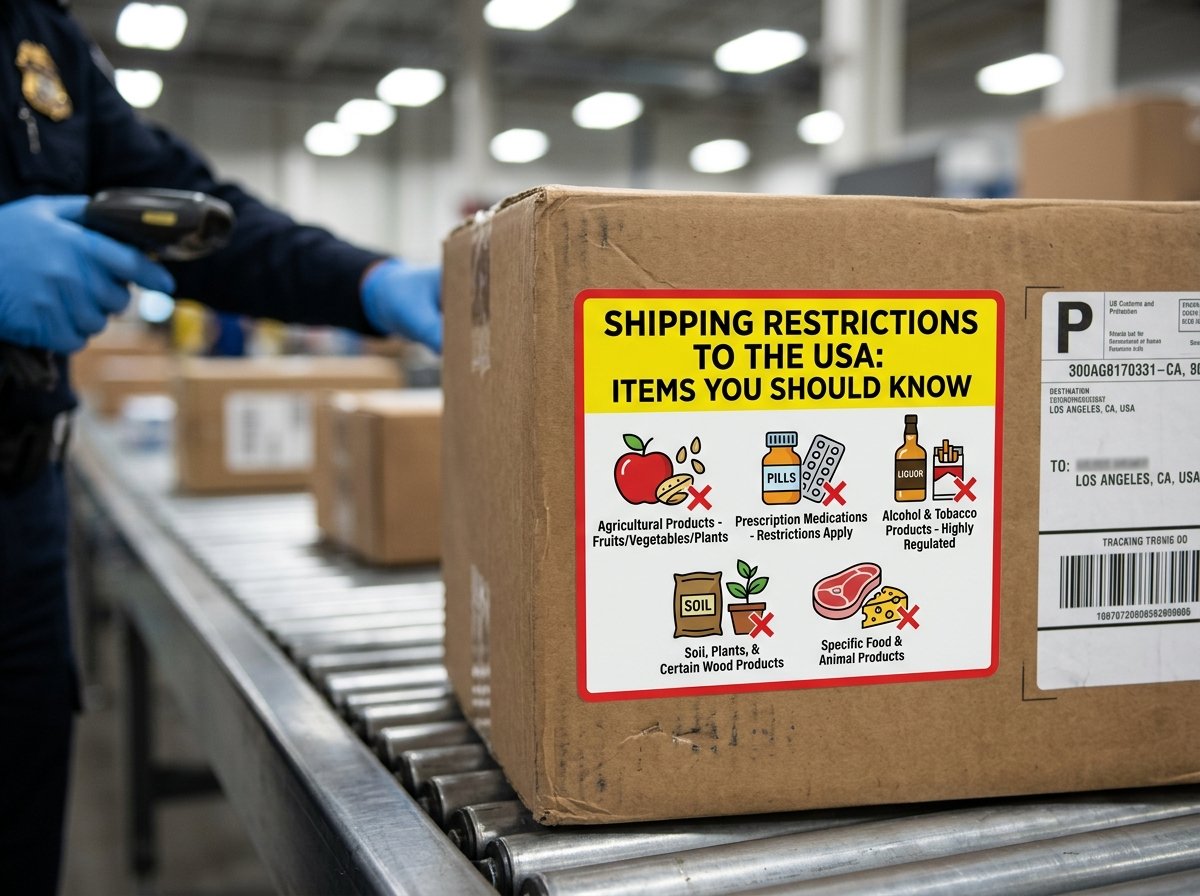
Every year, thousands of international packages get seized, returned, or destroyed at US borders — and most senders had no idea they were breaking any rule. Imagine spending money on shipping a thoughtful gift or important business order, only to get an email saying your package has been confiscated by US Customs and Border Protection (CBP).
The USA has one of the most detailed and strictly enforced import regulation systems in the world. Multiple federal agencies — from the FDA to the USDA to the ATF — have a say in what crosses the border. And here’s what catches most people off guard: it’s not just obviously dangerous stuff that’s restricted. Everyday items like certain foods, skincare products, wooden crafts, and even some medicines can land your shipment in trouble.
Whether you’re an online seller shipping products to American customers, a student sending personal belongings, or someone mailing a gift to family in the States, this guide breaks down exactly what you need to know. No legal jargon, no confusing government-speak — just clear, practical information you can actually use.
Why the USA Has Strict Shipping Restrictions
You might wonder — why does the US make it so complicated? The short answer is: safety, security, and economic protection.
The US government controls imports through several agencies, and each one has its own area of concern. The CBP (Customs and Border Protection) is the main gatekeeper. But behind them, you’ve got the FDA looking at food and medicines, the USDA protecting agriculture, the EPA monitoring environmental hazards, the ATF regulating firearms and alcohol, and even the FCC checking electronics.
Their goals overlap but boil down to three things. They want to keep harmful or unsafe products out, protect American agriculture from foreign pests and diseases, and enforce trade laws that prevent unfair competition or sanctions violations.
This layered system means your package might be perfectly legal in your home country but still violate US import rules. And ignorance isn’t a defense — US customs doesn’t care if you “didn’t know.” The package gets flagged, and you deal with the consequences.
⚠️ Quick Fact: CBP processes over 67 million import entries annually (as of 2024), and the volume of e-commerce parcels has only grown since then. With more shipments, enforcement tech has gotten sharper too — X-ray scanning, AI-assisted detection, and random inspections are all standard now.
Items Completely Banned From Shipping to the USA
Let’s start with the stuff that’s a flat-out “no.” These items cannot enter the US through any shipping method, period. If you’re caught sending them, the consequences range from confiscation to hefty fines and even criminal charges.
Illegal drugs and narcotics top the list, obviously. But people also get tripped up by items made from endangered species — think ivory jewelry, reptile skin bags, or products containing certain animal parts. The US enforces the CITES treaty aggressively, and even antique ivory pieces get seized.
Counterfeit goods are another big one. Fake branded clothing, watches, handbags, electronics — US customs actively seizes these, and the penalties are serious. You can’t ship a knockoff Rolex “as a gift” and expect it to slide through. CBP seized over $3 billion worth of counterfeit goods in fiscal year 2023 alone.
Other completely banned items include obscene materials, toxic substances, certain types of weapons and ammunition, and anything that violates US sanctions (for example, goods originating from sanctioned countries or entities). Even certain types of knives — like switchblades and ballistic knives — are federally banned from importation.
If you’re curious about what’s banned across international shipping generally, our detailed guide on items banned from international shipping covers the broader picture really well.
Food and Agricultural Products — Where Most People Get Caught
Here’s the category that surprises people the most. You’d think mailing some homemade sweets or fresh fruit to a relative in New York would be harmless. But the USDA’s APHIS (Animal and Plant Health Inspection Service) takes food and agricultural imports incredibly seriously.
Fresh fruits, vegetables, and plants are heavily restricted or outright banned from most countries. The reason? Foreign pests and diseases that could devastate American agriculture. A single piece of fruit carrying the wrong insect could cause millions of dollars in crop damage. That’s not an exaggeration — the Mediterranean fruit fly outbreaks in California have cost hundreds of millions in the past.
Meat and poultry products are another minefield. Unless they come from a country and facility approved by the USDA’s FSIS (Food Safety and Inspection Service), they’re not getting through. This includes cured meats, jerky, sausages, and even canned meat products from many countries. India, for example, isn’t on the USDA-approved list for meat exports, so sending homemade beef jerky from India to the US? Not happening.
Dairy products have their own set of rules. Certain cheeses are okay, but unpasteurized soft cheeses are restricted. The FDA requires specific pasteurization and aging standards.
Seeds and soil are also heavily regulated. You can’t just ship garden seeds or potting soil to the US without proper phytosanitary certificates. And even with paperwork, many seed varieties are prohibited because they could become invasive species.
🔖 Pro Tip: If you’re specifically trying to ship plants or seeds to the US, make sure you understand the legal requirements first. Our guide on how to ship plants and seeds legally walks you through the exact process, including what permits you need.
Medicines and Pharmaceutical Restrictions
This one hits close to home for a lot of people — especially immigrants who rely on specific medications from their home country. The FDA has strict rules about importing medicines into the US, and they catch more people than you’d expect.
As a general rule, the FDA doesn’t allow individuals to import prescription drugs into the US, even if the drug is for personal use and you have a valid prescription from your home country. There are very narrow exceptions — like if the drug treats a serious condition with no adequate US alternative, it’s not commercially available in the US, and you’re importing no more than a 90-day supply.
Over-the-counter medicines from other countries can also be problematic. If the drug contains ingredients that aren’t FDA-approved, or if it’s labeled in a foreign language without English labeling, customs can (and does) confiscate it. Some popular medications in countries like India, Mexico, or Southeast Asia contain formulations that the FDA hasn’t cleared.
Ayurvedic, herbal, and traditional medicines are a particularly tricky area. Many of these products have been found to contain heavy metals (lead, mercury, arsenic) or undeclared pharmaceutical ingredients. The FDA regularly seizes these at the border.
⚠️ Warning: Never ship controlled substances (even with a prescription) through international mail to the US. Substances classified under the DEA’s Controlled Substances Act — including many sleep aids, anxiety medications, and painkillers — require special import permits. Shipping them without authorization is a federal offense.
Alcohol, Tobacco, and Vaping Products
Sending a nice bottle of wine or a box of cigars to someone in the US? It’s not as simple as packing and posting.
Alcohol imports into the US are regulated at both the federal level (by the TTB — Alcohol and Tobacco Tax and Trade Bureau) and the state level. Every US state has its own alcohol import laws, and some are extremely restrictive. You generally can’t ship alcohol through regular postal services like USPS. Private carriers like FedEx and UPS do allow it in certain circumstances, but they require proper licensing, labeling, and the sender/receiver must meet specific requirements.
Even for personal quantities, you need to deal with federal excise taxes and state-specific permits. It’s one of those areas where “I’ll just send one bottle” mentality gets people in trouble.
If you’ve been thinking about shipping wine or spirits, check out our complete guide on how to ship alcohol and wine before you do anything. It covers carrier policies, legal requirements, and packaging tips.
Tobacco and vaping products have gotten even more restricted since the PACT Act (Prevent All Cigarette Trafficking Act) was amended in 2021. USPS now completely bans mailing most vaping products and e-cigarettes. Private carriers have followed with their own restrictions. The rules around importing foreign tobacco products are complicated, and duty rates are high.
Electronics, Batteries, and Tech Products
Shipping a phone or laptop to someone in the US? Totally doable — but with caveats.
Lithium batteries are the biggest concern here. Both lithium-ion (rechargeable, like in phones and laptops) and lithium-metal batteries (non-rechargeable, like in some cameras) are classified as dangerous goods for shipping. They can overheat, short-circuit, and in rare cases, catch fire during transit.
The IATA (International Air Transport Association) and DOT (Department of Transportation) have specific rules about how these batteries can be shipped. Batteries packed inside devices (like a phone with its battery) are generally allowed via air with proper packaging and labeling. Standalone or spare batteries face tighter restrictions, including quantity limits and special packaging requirements.
Electronics that don’t meet FCC standards can also be seized at customs. The FCC requires that electronic devices sold or used in the US meet specific emission and safety standards. If you’re shipping electronics for commercial sale that lack FCC certification, expect problems.
For those specifically looking to ship devices safely, our guide on how to ship a mobile phone or laptop covers the packaging and regulatory side in detail.
And while you’re at it, understanding dangerous goods shipping rules is worth your time if you’re shipping anything with batteries, chemicals, or pressurized contents.
Cosmetics, Skincare, and Personal Care Products
This category has grown massively with the K-beauty and J-beauty trends, plus the global popularity of products from brands in South Korea, Japan, France, and India. But shipping cosmetics and skincare to the US comes with real regulatory hurdles.
The FDA regulates cosmetics under the FD&C Act, and while cosmetics don’t need pre-market approval (unlike drugs), they must meet labeling and ingredient standards. If your product makes therapeutic claims — like “cures acne” or “reduces wrinkles” — the FDA may classify it as a drug, which triggers a completely different (and much stricter) set of import requirements.
Products containing certain ingredients banned in the US will be stopped at customs. For instance, some skin-lightening creams contain mercury or hydroquinone above permitted levels. Certain preservatives and colorants approved in the EU or Asia aren’t allowed in US cosmetics.
Labeling is crucial. Products must have English-language ingredient labels following the FDA’s format. Shipping unlabeled or foreign-language-only cosmetics commercially can result in detention at the port of entry.
If you’re an online seller or you’re sending beauty products to someone stateside, our guide on how to ship cosmetics and skincare products breaks down what you need to do right.
Customs Duties, Declarations, and the De Minimis Threshold
Even if your item isn’t restricted, you still need to deal with customs declarations and potentially pay duties. A lot of shippers — especially first-timers — underestimate this part.
The US has a de minimis threshold of $800. This means goods valued at $800 or less can generally enter the US duty-free and with simplified customs processing. This is one of the highest de minimis thresholds in the world (for comparison, the EU’s is only €150, and Australia’s is AUD 1,000).
For shipments over $800, formal customs entry is required, and duties/taxes apply based on the product category and country of origin. The Harmonized Tariff Schedule (HTS) determines the duty rate, and these rates vary wildly — from 0% on some goods to over 25% on others. Products from countries facing US trade tariffs (like certain Chinese goods subject to Section 301 tariffs) can carry even higher rates.
🔖 Pro Tip: Always fill out your customs declaration form accurately. Undervaluing your shipment to avoid duties is illegal — it’s called customs fraud, and it can result in penalties, seizure, and even being barred from future imports. Be honest about what’s in the package, its value, and its country of origin.
Understanding how shipping rates are calculated can also help you budget for the total cost, including duties and carrier surcharges.
How to Avoid Getting Your Shipment Seized or Delayed
Nobody wants their package stuck in a customs warehouse for weeks — or worse, destroyed. Here’s how you protect yourself.
Research before you ship. This sounds obvious, but most problems happen because people assume something is fine without checking. The CBP website, FDA import alerts database, and USDA APHIS resources are all freely available online. Spend 20 minutes checking before you spend money shipping.
Use the right customs documentation. At minimum, you need a commercial invoice (for commercial goods) or a detailed customs declaration (for personal shipments). Include the item description, quantity, value, country of origin, and HTS code if you know it. Vague descriptions like “gift” or “household items” are red flags for customs officers.
Choose your courier wisely. Different carriers have different policies on restricted items. Some are stricter than others, and some offer better customs brokerage support. If you’re comparing options, our DHL vs FedEx international shipping comparison might help you decide which service fits your needs. Both carriers, for instance, have dedicated customs teams that can pre-clear your shipment.
Package your items properly. This isn’t just about avoiding damage — it’s about compliance. Items like lithium batteries, liquids, and fragile goods all have specific packaging requirements for international shipping. Poor packaging can trigger inspection delays or rejection. If packaging is a concern, check out our tips on common packaging mistakes that damage parcels so you don’t make errors that cost you time and money.
Keep records of everything. Save your shipping receipts, tracking numbers, customs forms, and any correspondence with your courier. If something goes wrong, you’ll need this paper trail to file a claim or dispute a seizure.
Special Cases: Gifts, Personal Belongings, and E-Commerce
The reason for your shipment matters. US customs treats gifts, personal effects, and commercial goods differently, and mixing them up creates problems.
Gifts still need customs declarations, but they get a higher duty-free threshold — gifts valued at $100 or less to a single recipient are generally duty-free (not the standard $800 de minimis). But “gift” doesn’t mean you can just write “gift” on anything and avoid scrutiny. Customs officers can and do verify, and false declarations lead to penalties.
Personal belongings — like when you’re relocating to the US — can enter duty-free under specific conditions. If you’re a returning US resident or a new immigrant, your used household goods and personal effects typically qualify for free entry. But you need to prove they’re not for sale and that you’ve owned them for at least a year. Moving to the US and need to ship your stuff? Our guide on how to ship belongings when moving abroad covers the logistics and documentation you’ll need.
E-commerce shipments face the most scrutiny. If you’re running an online store and shipping to US customers, you need to comply with product safety standards (CPSC), labeling requirements, and possibly import permits depending on your product category. The US has been cracking down on non-compliant e-commerce imports, especially from third-party sellers on platforms like Amazon, eBay, and Etsy.
What Happens If Your Package Gets Flagged?
So your shipment got stopped at US customs. Now what?
First, don’t panic. Not every flagged package is seized. Sometimes, customs just needs additional information — a missing document, a clarification on the contents, or proof of value. Your courier will usually contact you, and you’ll have a window to provide the requested information.
If the package is detained, it’s being held for inspection or regulatory review. This can take anywhere from a few days to several weeks. You might receive a notice from CBP or the relevant agency (FDA, USDA, etc.) explaining why.
If the items are found to violate import laws, the package can be seized and forfeited. You’ll receive a seizure notice, and you typically have the right to petition for its return — though success depends on the violation. For outright banned items, you won’t get them back.
Penalties range from administrative fines to criminal prosecution for serious violations (like shipping counterfeit goods or controlled substances). Even innocent mistakes can result in fines if customs determines you should have known better.
If your package is genuinely lost or damaged during this process, knowing how to file a claim for a lost package can help you recover the financial loss through your courier’s claims process.
FAQ
Can I ship homemade food items to the USA?
It depends entirely on what the food is. Baked goods like cookies, cakes (without cream), and dry snacks are usually fine for personal shipments. But anything containing meat, fresh produce, dairy, or eggs is likely to be stopped by USDA inspectors. Commercially packaged and sealed foods with clear ingredient labels have a better chance of clearing customs, but always check the USDA’s specific country and product requirements before shipping.
What’s the penalty for shipping restricted items to the US without knowing they’re restricted?
Penalties vary based on the item and the circumstances. For unintentional violations involving non-dangerous goods, you might just lose the items — they get confiscated and destroyed. But for controlled substances, counterfeit goods, or sanctioned items, penalties can include fines starting from a few hundred dollars up to hundreds of thousands, and criminal charges are possible. The key takeaway: “I didn’t know” doesn’t protect you legally.
Do I need a special license to ship commercial goods to the USA?
For most consumer goods, you don’t need an import license per se, but you do need an Importer of Record (IOR) number, which could be your business’s EIN or an individual’s Social Security Number. Certain product categories — like alcohol, firearms, biological products, and certain electronics — do require specific permits or licenses from the relevant federal agency. If you’re selling on platforms like eBay, our guide on selling on eBay and shipping internationally explains the compliance basics for online sellers.
Are there different rules for shipping from different countries to the USA?
Yes. The US has country-specific trade agreements, tariff rates, and even bans. Goods from countries under US sanctions (like North Korea, Iran, Syria, and others on the OFAC list) face severe restrictions or outright bans. Products from countries with free trade agreements (like Canada, Mexico under USMCA, or Australia under AUSFTA) may enjoy reduced or zero duties. The country of origin also affects agricultural inspections — some countries have specific pest concerns that trigger extra scrutiny.
Your Next Step
Shipping to the USA isn’t impossible — millions of packages arrive there safely every single day. But the system has rules, and those rules exist for specific reasons. The people who run into trouble are almost always the ones who didn’t check before they shipped.
So here’s what I’d suggest: before your next US-bound shipment, take 15 minutes. Look up your specific item on the CBP or FDA website. Confirm your courier’s policies on that item. Fill out your customs forms with complete, honest information. That small effort upfront saves you from the headache of a seized package, a fine, or weeks of delays.
And if you’re shipping frequently or running a business that depends on reliable international delivery, investing time in understanding the difference between economy and express international shipping options can help you pick the right service that balances speed, cost, and customs handling.
Knowledge really is your best protection here. Ship smart, and your packages will get where they need to go. 📦