
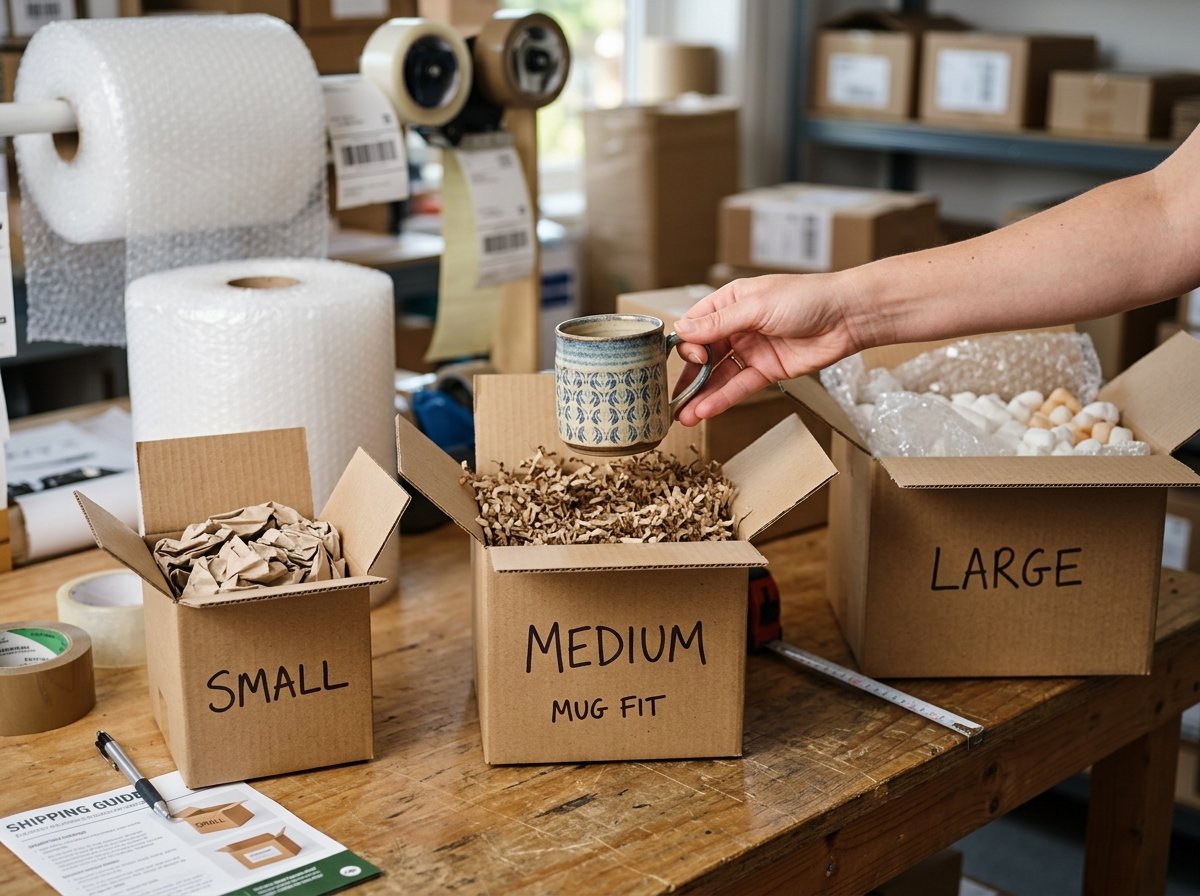
Nearly 30% of what travels inside a shipping box is just air. That’s not a fun fact — that’s your money going to waste. Every inch of unnecessary space inside your parcel means you’re paying more for shipping, using more packing material, and increasing the chance of your item getting damaged.
Here’s the thing most people don’t realize: choosing the right box size isn’t about finding the biggest box in your house and stuffing everything in. It’s about matching your item to a box that fits snugly, protects well, and doesn’t cost you a fortune in dimensional weight charges.
Whether you’re shipping a birthday gift to your cousin overseas, running an online store, or moving your belongings to a new country, the box you pick matters more than you think. Get it wrong, and you’ll either end up with a crushed item or a shipping bill that makes you wince.
This guide walks you through everything — from measuring your items correctly to understanding how couriers actually calculate your charges based on box dimensions. Let’s get into it.
Why Does Box Size Actually Matter?
You might wonder — what’s the big deal? A box is a box, right? Not really. The size of your box directly affects three things: cost, protection, and the planet.
It Hits Your Wallet
Most major couriers like DHL, FedEx, UPS, and Royal Mail don’t just charge by actual weight anymore. They use something called dimensional weight (also known as volumetric weight). This means if your box is too large for what’s inside, the courier treats it as if it’s heavier than it actually is. You end up paying for space, not weight.
Imagine shipping a pair of earrings in a shoe box. The earrings weigh almost nothing, but that shoe box takes up real space in a delivery truck. The courier charges you based on how much space you’re using — and suddenly, shipping tiny earrings costs as much as shipping a hardcover book. If you want to understand this pricing model better, check out our detailed breakdown of how dimensional weight works.
It Affects Product Safety
A box too big means your item rattles around during transit. A box too small means pressure on the item from all sides. Both situations lead to damage. The sweet spot? A box that leaves just enough room — about 2 inches on each side — for protective cushioning like bubble wrap or packing paper.
It Impacts the Environment
Oversized boxes need more filler material, more cardboard, and take up more space in delivery vehicles (which means more fuel). If sustainability matters to you, picking the right box size is one of the simplest things you can do. You might also want to explore eco-friendly packaging options that reduce waste without compromising protection.
How to Measure Your Item Before Picking a Box
Before you even look at boxes, grab a measuring tape. You need three numbers from your item: length, width, and height. Measure the longest side as your length, the shorter flat side as width, and the vertical side as height.
Here’s a tip most people miss: measure the item after you’ve wrapped it in protective material. If you’re wrapping a mug in bubble wrap, that adds about an inch on each side. Your “real” dimensions for box selection are the wrapped dimensions, not the bare item.
For items with irregular shapes — like a lamp or a figurine — measure the widest points. Think of an invisible rectangle around the item. That rectangle’s dimensions are what you use.
Quick Example:
You’re shipping a ceramic vase. The vase itself is 8″ tall, 4″ wide, and 4″ deep. After wrapping it in bubble wrap, it becomes roughly 10″ x 6″ x 6″. You need a box that’s around 12″ x 8″ x 8″ — giving you that 2-inch cushioning gap on all sides.
Not sure how much bubble wrap you actually need for different item types? That’s worth figuring out before you shop for boxes.
Standard Box Sizes and What They’re Best For
Boxes come in standard sizes for a reason — they fit the most common items people ship. Here’s a practical breakdown that should help you pick faster.
Small Boxes (Up to 12″ x 10″ x 8″)
These work great for books, small electronics, cosmetics, jewelry boxes, phone accessories, and similar compact items. If you’re running an Etsy shop selling handmade candles or shipping cosmetics and skincare products, you’ll probably live in this size range.
A small box also keeps your dimensional weight low, which directly saves money on shipping costs.
Medium Boxes (Up to 18″ x 14″ x 12″)
This is the workhorse size. It handles most clothing orders, kitchenware, toys, shoes, and mid-sized electronics. If you’re shipping shoes and footwear, a medium box with proper padding is usually the perfect fit.
Online sellers who deal with multiple product types often keep a stack of medium boxes handy because they cover the widest range of items.
Large Boxes (Up to 24″ x 18″ x 18″)
Think bigger items here — small appliances, multiple clothing items bundled together, toys and games, or larger home décor pieces. These boxes are also popular for people shipping personal belongings abroad — you can fit a good amount of clothes, books, and personal items in one large box.
⚠️ Warning: Large boxes get expensive fast because of dimensional weight. Only use them when your items genuinely need the space.
Extra-Large / Custom Boxes (24″+ in any dimension)
For artwork and paintings, musical instruments, car parts, or furniture pieces, you often need custom-sized boxes. Some couriers offer specialty packaging for these, or you can order custom boxes from packaging suppliers.
If you regularly ship items of unusual sizes, our guide on the best boxes for different types of shipments breaks down specific recommendations by product category.
Understanding Dimensional Weight (And Why It Changes Everything)
This is where most people get tripped up, so let’s make it crystal clear.
Couriers charge you based on whichever is greater — the actual weight of your package or its dimensional weight. Dimensional weight is calculated using a simple formula:
(Length × Width × Height) ÷ Dimensional Factor = Dimensional Weight
The dimensional factor varies by courier. For most international shipments, DHL, FedEx, and UPS use a factor of 5,000 (when measuring in centimeters and kilograms). For domestic shipments, it can be different.
Let’s Do the Math
Say you have a box that’s 40cm x 30cm x 30cm, and the item inside weighs 2 kg.
Dimensional weight = (40 × 30 × 30) ÷ 5,000 = 36,000 ÷ 5,000 = 7.2 kg
Your item weighs 2 kg, but the courier charges you for 7.2 kg. That’s a massive difference — and it happened simply because your box was too big.
Now imagine you’d used a 30cm x 20cm x 20cm box instead:
Dimensional weight = (30 × 20 × 20) ÷ 5,000 = 12,000 ÷ 5,000 = 2.4 kg
Almost the same as your actual weight. That smaller box just saved you a significant chunk of money.
This is exactly why choosing the right box size isn’t just about aesthetics or convenience — it directly determines how your shipping rates are calculated.
💡 Pro Tip: Before finalizing a box, quickly calculate the dimensional weight. If it’s significantly higher than the actual weight, you need a smaller box. Many courier websites have free dimensional weight calculators — use them.
Practical Steps to Choose the Right Box
Let me give you a straightforward process you can follow every single time you need to ship something.
Step 1: Wrap Your Item First
Don’t choose the box and then figure out packing. Do it the other way around. Wrap the item in bubble wrap, foam, or packing paper. Now measure the wrapped item.
Step 2: Add Cushioning Space
Add about 2 inches (5 cm) to each dimension. This gives you room for padding material inside the box — on all six sides. Your item should never touch the walls of the box directly.
Step 3: Check Standard Box Sizes
Look at what’s available. Most packaging suppliers and courier drop-off points sell standard-sized boxes. Find the one closest to your calculated dimensions. A slightly larger standard box with good cushioning beats a custom box that costs three times as much.
Step 4: Calculate Dimensional Weight
Run the numbers using the formula above. Compare it with your item’s actual weight. If the dimensional weight is way higher, see if there’s a smaller box option.
Step 5: Do the Shake Test
Once packed, gently shake the box. If you hear or feel movement inside, add more cushioning material. If nothing moves, you’ve nailed it.
Step 6: Check Courier Size Limits
Every courier has maximum size limits. If your box exceeds these, the shipment gets rejected or charged as oversized freight. For a detailed breakdown of what each courier allows, check out our guide on weight and size limits for international parcels.
Special Situations That Need Extra Thought
Not every shipment is a simple box-and-send job. Some items need you to think a bit differently about box selection.
Fragile Items
For anything breakable — ceramics, glassware, electronics — the rule of thumb is: box within a box. Place the item in a smaller box with tight cushioning, then put that box inside a larger box with padding between the two. This double-boxing technique absorbs shocks from multiple directions.
If you’re shipping something delicate like a mobile phone or laptop, the inner box should fit the device almost perfectly, while the outer box provides that extra buffer zone.
Multiple Items in One Box
Shipping multiple items together? Each one needs its own wrapping, and there should be dividers or padding between items so they don’t knock into each other. The box should be large enough to hold everything with individual cushioning, but not so large that items shift during transit.
Here’s a common mistake: people pile five different items into a huge box with some newspaper on top and call it done. That’s how things break. Treat each item like it’s traveling alone, even when it’s sharing a box.
Oddly Shaped Items
Round, curved, or irregular items are tricky. You can’t just find a round box (well, you can for tubes, but that’s specific). For most irregular shapes, find a rectangular box that fits the widest measurements and fill the odd gaps with crumpled packing paper or foam inserts.
For long, narrow items — think posters, fishing rods, or bicycle parts — triangular tubes or elongated boxes work better than trying to fit them into standard rectangles.
What Happens When You Pick the Wrong Size
Let’s talk about the real consequences, because understanding what goes wrong is just as useful as knowing what to do right.
Too Big a Box:
You pay more in dimensional weight charges. Your item bounces around and can get damaged even with some cushioning. The box itself is more likely to get crushed because the structural strength of a cardboard box depends partly on the contents supporting the walls from inside. An empty or half-empty box collapses more easily under the weight of other packages stacked on top during transit.
Too Small a Box:
You can’t fit enough protective material around the item. The box bulges at the seams, weakening the cardboard. Corners of your item press against the box walls and are vulnerable to impact damage. In extreme cases, the box bursts open during shipping — and now you have a lost or damaged parcel.
If you’ve experienced damaged deliveries before, there’s a good chance the root cause was a common packaging mistake that could have been avoided with the right box size.
Did You Know? According to packaging industry data, about 11% of products arrive damaged to customers, and poor box selection is cited as one of the top three causes. That’s real money lost — especially for online sellers dealing with returns and replacements. Speaking of which, if you run an e-commerce business, understanding how to handle returns efficiently can save you from a lot of headaches.
Tips for Online Sellers and Frequent Shippers
If you ship regularly — whether for business or personal reasons — a few smart habits can save you both time and money over the long run.
Keep 3–4 box sizes in stock. You don’t need 15 different sizes. Most sellers find that having a small, medium, large, and one flat/mailer size covers 90% of their orders.
Invest in a postal scale. A decent digital scale costs under $25 and pays for itself within a few shipments. Weigh your packed box before booking the shipment — this avoids surprise charges at the courier counter.
Use box resizers/score tools. These let you cut down a larger box to fit a smaller item. You literally score the cardboard at the right height, fold it down, and tape it. You turn a 12-inch tall box into an 8-inch tall box in under a minute. This is a hack that serious eBay and Etsy sellers swear by.
Compare quotes before shipping. Different couriers have different dimensional weight factors, size limits, and pricing structures. What seems expensive with one carrier might be reasonable with another. Our guide on how to compare courier quotes walks you through this process step by step.
Consider flat-rate boxes where available. Some postal services (like USPS in the US or Royal Mail in the UK) offer flat-rate boxes where the price is fixed regardless of weight — as long as it fits in their specific box. For heavy items that are relatively small, flat-rate shipping can be a steal.
A Quick Reference for Common Items
Sometimes you just want a fast answer. Here’s a practical reference that maps common items to ideal box size ranges:
A single book or small gadget ships well in a box around 10″ x 8″ x 4″. A pair of shoes fits nicely in 14″ x 10″ x 6″ with tissue paper stuffing inside the shoes. For a set of dishes or mugs, aim for 16″ x 12″ x 12″ with each piece individually wrapped. If you’re sending clothing (2–3 folded items), a 12″ x 10″ x 6″ box does the job perfectly.
For a laptop, you want the original box if you have it, or a 16″ x 12″ x 4″ box with snug foam padding. A small kitchen appliance like a blender usually fits in 14″ x 12″ x 14″ with the cord tucked in separately.
These aren’t hard rules — always measure your specific item. But they give you a starting point so you’re not standing in the shipping store staring at boxes like they’re a puzzle.
FAQ
Can I reuse old boxes for shipping?
Yes, you absolutely can — as long as the box is still structurally sound. Check for soft spots, tears, crushed corners, or water damage. Remove all old shipping labels and barcodes completely, because scanners can pick up old tracking numbers and cause routing errors. A reused box in good condition works just as well as a new one.
What if my item doesn’t fit any standard box size?
You have a couple of options. You can order custom-sized boxes from packaging suppliers online — companies like Uline, PackagingSupplies.com, or local packaging shops make boxes in virtually any dimension. Alternatively, you can modify a larger box using a box resizer tool or simply cutting and re-taping it. For very unusual items, some couriers offer custom crating services, though these cost significantly more.
Does the type of cardboard matter, or just the size?
Both matter. Cardboard comes in different strengths, measured by “burst strength” or “edge crush test” ratings. For items under 10 lbs, single-wall corrugated cardboard works fine. For heavier items (10–30 lbs), go with double-wall corrugated. Anything above 30 lbs really needs double-wall at minimum, and you should consider reinforcing the bottom with extra tape. The box size gets you the right fit, but the cardboard type ensures it survives the journey.
How do I avoid paying extra for dimensional weight?
The simplest way is to choose a box as close to your item’s wrapped dimensions as possible, leaving only enough room for cushioning. Avoid the temptation to “go bigger just in case.” Calculate the dimensional weight before you ship and compare it with actual weight. If dimensional weight is significantly higher, downsize the box. Also, compare carriers — some have more favorable dimensional factors than others.
Should I use the courier’s branded boxes or my own?
Either works. Courier-branded boxes (like FedEx or DHL boxes) are sometimes offered free for their express services, and they’re sized to match common shipping needs. But you’re usually locked into using that specific courier if you take their box. Your own boxes give you flexibility to compare prices across carriers. For business branding, custom boxes with your logo create a better unboxing experience for customers.
Your Next Step
Getting the right box size isn’t complicated once you build the habit of measuring first, calculating dimensional weight, and picking the closest standard size. It takes maybe three extra minutes per shipment — but those three minutes save you money, protect your items, and reduce waste.
So the next time you’re about to ship something, resist the urge to grab whatever box is lying around in your garage. Measure your item, check the math, and pick a box that actually makes sense. Your wallet and your recipient will both thank you for it.