
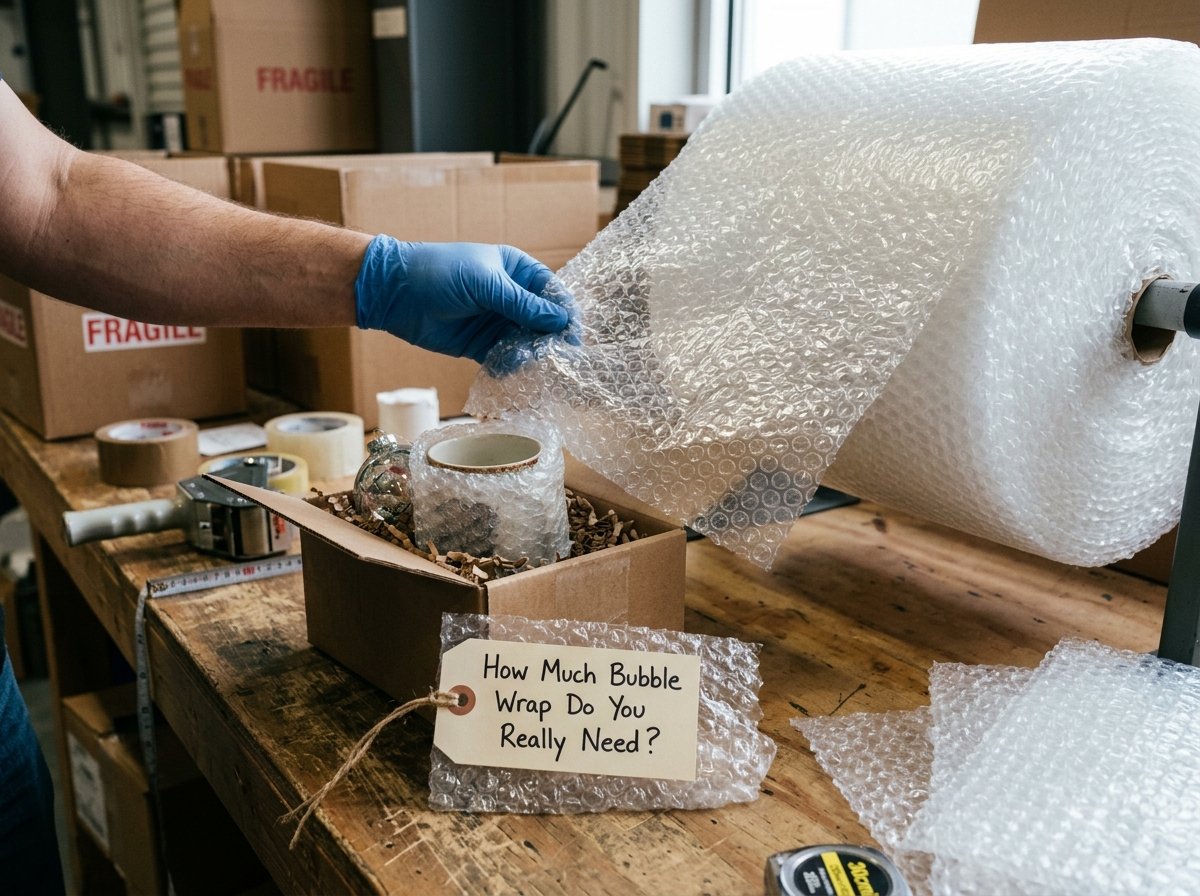
Here’s a scene that plays out in thousands of homes every single day. You’re standing over a fragile glass vase, a roll of bubble wrap in one hand, and scissors in the other. You wrap it once. Looks thin. Wrap it twice. Still doesn’t feel safe. Three times? Four? Before you know it, you’ve used half the roll on one item, and you’ve still got a kitchen full of plates to pack.
The truth? Most people either use way too much bubble wrap — wasting money and creating unnecessary bulk — or they use too little and end up with a shattered mess at the other end. Neither is a good look.
So let’s figure this out properly. How much bubble wrap does each type of item actually need? What bubble size should you pick? And where can you skip it altogether? You’ll walk away from this article knowing exactly what to do next time you’re packing something fragile.
Why Getting the Right Amount Matters More Than You Think
You might think bubble wrap is one of those “more is better” situations. It’s not. Using too much bubble wrap creates real problems.
Extra bulk means a bigger box. And a bigger box means higher shipping costs. Courier companies calculate charges based on either actual weight or dimensional weight — whichever is greater. So if you’ve over-wrapped every item and now need a box two sizes larger, you could be paying significantly more for shipping than you need to.
Too little wrap is obviously worse. A single thin layer around a porcelain figurine isn’t going to absorb the shock of being tossed around in a delivery truck. Items shift, boxes get stacked, and sometimes packages are dropped from waist height. That one flimsy layer won’t save anything.
There’s also an environmental angle here. Bubble wrap is mostly plastic. Using three times more than necessary means three times more waste ending up in landfills. If you care about being even slightly eco-conscious, right-sizing your wrap usage is a simple win. You might also want to explore eco-friendly packaging alternatives that can replace bubble wrap for certain items.
The goal is simple: use just enough to protect your item — and not a single inch more.
Understanding Bubble Wrap Sizes (Yes, It Matters)
Not all bubble wrap is created equal. Walk into any packaging supply store or browse online, and you’ll find at least two or three different types. The difference comes down to the size of the bubbles, and it directly affects how much protection each layer provides.
Small Bubble Wrap (3/16 inch or ~6mm bubbles)
These are the tiny, satisfying-to-pop bubbles. They’re best for surface protection — think preventing scratches, scuffs, and light impact damage. Small bubble wrap works perfectly for items like picture frames, books with delicate covers, or electronics screens. It wraps tightly around items and doesn’t add much bulk.
But here’s the thing — small bubbles don’t absorb heavy impacts. If you’re shipping something that could break from a drop, small bubble alone won’t cut it.
Medium Bubble Wrap (5/16 inch or ~8mm bubbles)
This is the most common type you’ll find at post offices and packaging stores. It’s the all-rounder. Medium bubbles offer decent cushioning while still conforming well to the shape of most items. Good for dishes, small appliances, and moderately fragile items.
Large Bubble Wrap (1/2 inch or ~12mm bubbles)
Those big, puffy bubbles you see in the wrap that comes inside appliance boxes. Large bubble wrap is designed for heavy-duty shock absorption. It’s what you want around truly fragile items — wine glasses, ceramic sculptures, glass vases, antique china. Each big bubble holds more air, which means more cushion between your item and whatever hits the box.
Pro Tip: You can actually combine sizes. Use a layer of small bubble wrap directly against the item’s surface (prevents scratches), then wrap larger bubble wrap over it (absorbs impacts). This two-layer approach is what professional packers use for high-value fragile items.
The Simple Rule: How Many Layers for Each Item Type
Alright, let’s get specific. Because “it depends” is the most unhelpful answer anyone can give you.
Here’s a practical framework that professional movers and experienced eBay sellers actually use. It’s based on two factors: how fragile is the item, and how far is it traveling?
Lightly Fragile Items (Low Risk)
Think books, shoes, clothing accessories, plastic items, wooden décor, or soft goods. These items can handle some bumping around.
You need: 1 layer of small or medium bubble wrap, or none at all. For something like shipping shoes and footwear, bubble wrap isn’t usually necessary — tissue paper or packing paper does the job fine. Same goes for toys and games unless they have fragile parts.
Moderately Fragile Items (Medium Risk)
This category includes things like framed photos, small electronics, cosmetics in glass containers, candles, and basic kitchenware. They won’t shatter from a light bump, but a decent impact could crack or damage them.
You need: 2–3 layers of medium bubble wrap. Make sure every surface is covered, especially corners and edges. If you’re shipping cosmetics and skincare products in glass bottles, pay extra attention to the caps and necks — these are the weak points.
For mobile phones or laptops, 2 layers of medium bubble wrap plus the original box (if you have it) is usually enough. The original packaging was designed for that specific device, so it does a lot of the heavy lifting.
Highly Fragile Items (High Risk)
Now we’re talking about wine glasses, crystal, porcelain, ceramic art, antique china, glass vases, mirrors, and anything that makes you nervous just picking it up.
You need: 3–4 layers of large bubble wrap, with small bubble wrap underneath if the surface scratches easily. Each item should be wrapped individually — never let two fragile items touch each other inside a box, even if both are wrapped. Glass-on-glass contact through bubble wrap can still cause cracks.
If you’re shipping artwork or paintings, the approach is slightly different — you’ll need corner protectors along with bubble wrap, and flat items need to be sandwiched between rigid cardboard sheets.
Extremely Fragile or High-Value Items
Think antique porcelain worth thousands, delicate musical instruments, or one-of-a-kind glass sculptures. These need the full treatment.
You need: 4–5 layers of large bubble wrap, plus internal box padding, plus potentially a double-box setup. The item gets wrapped, placed in a box with padding on all six sides, and that box goes inside a larger box with more padding between the two. Professional shippers call this “box-in-box” packing, and it’s the gold standard for extremely fragile shipments.
Quick Fact: According to packaging industry data, items packed with the double-box method experience roughly 75% fewer damage claims compared to single-box packing with the same amount of bubble wrap.
How to Calculate Bubble Wrap for a Full Shipment
Wrapping one item is straightforward. But what if you’re packing up an entire kitchen for a move? Or you sell products online and need to figure out your monthly bubble wrap budget?
Here’s a practical way to estimate.
Step 1: Measure Your Item
Take the length, width, and height of the item. Add these three numbers together and multiply by 2. That gives you a rough idea of how much wrap you need to go around the item once.
Example: A coffee mug that’s 4 inches tall, 3 inches wide, and 3 inches deep. That’s (4 + 3 + 3) × 2 = 20 inches of bubble wrap per single layer. For 3 layers, you’d need about 60 inches — or 5 feet of wrap for one mug.
Step 2: Account for Overlap
Always add about 15-20% extra for overlap. You want the edges of each wrap layer to overlap slightly so there are no exposed gaps. Gaps are where damage happens.
Step 3: Don’t Forget Void Fill
Bubble wrap around the item isn’t enough by itself. You also need padding inside the box — between the item and the box walls. This is called void fill. You can use crumpled bubble wrap, packing paper, foam peanuts, or air pillows for this. Every item should have at least 2 inches of cushioning between it and any box wall.
A Rough Quantity Guide for Common Scenarios
If you’re packing a set of 12 dinner plates, expect to use about 25–30 feet of medium bubble wrap. Each plate gets wrapped individually with 2 layers, and you’ll need extra for separating them inside the box.
For a small home move (kitchen items, some décor, a few electronics), a 175-foot roll of medium bubble wrap and a 75-foot roll of large bubble wrap should cover you. That’s roughly $25-40 worth of material.
For online sellers shipping 50 small to medium fragile items per month, a 350-foot roll of small/medium bubble wrap typically lasts the full month with some left over. Buying in bulk brings the per-foot cost down significantly — check into bulk shipping discounts if you’re running an eCommerce operation.
The “Shake Test” — Your Best Friend
Here’s a trick that professional packers swear by, and it takes exactly three seconds.
After you’ve wrapped your item and placed it in its box with all the padding, close the box and give it a firm shake. Not a gentle wiggle — a real shake, like it might experience on the back of a delivery truck hitting a pothole.
If you feel the item shifting or hear it moving: You don’t have enough padding. Add more bubble wrap or void fill until the item is completely immobile inside the box.
If nothing moves at all: You’re good. Seal it up.
This simple test prevents more shipping damage than any other technique. Most damaged packages arrive broken not because they lacked bubble wrap on the item itself, but because the item was free to move around inside the box. Movement creates impact. Impact causes breakage.
When Bubble Wrap Isn’t the Best Choice
Bubble wrap is versatile, but it’s not always the right call. There are situations where other materials work better.
Heavy items like car parts and auto accessories — Bubble wrap can compress under heavy weight and lose its cushioning. Foam inserts or custom-cut foam padding hold up better for items over 10-15 pounds.
Flat items like documents, prints, or thin artwork — Bubble wrap adds bulk that can actually cause bending pressure in the wrong spots. Rigid cardboard mailers or flat corrugated inserts are more appropriate.
Items that need breathability — If you’re shipping plants and seeds, wrapping them in bubble wrap can trap moisture and heat, causing rot or death. Perforated wrap or paper-based cushioning is a better option.
Temperature-sensitive products — Bubble wrap provides zero insulation against heat or cold. If you’re shipping alcohol and wine, you need specialized insulated packaging in addition to (or instead of) bubble wrap.
Did You Know? Sealed Air Corporation invented bubble wrap in 1957 — but originally designed it as textured wallpaper. It failed at that job, but the company quickly realized its potential as packaging material. By the 1960s, IBM became one of the first companies to use it for shipping fragile computer components.
Avoiding the Most Common Bubble Wrap Mistakes
Knowing how much to use is important, but using it correctly matters just as much. A few mistakes can completely cancel out your wrapping efforts.
Wrapping with bubbles facing outward. The bubbles should face inward, touching the item. That’s where the cushioning actually happens — the air pockets need to be between the impact and the item’s surface. Bubbles facing out pop more easily against box walls and other items.
Reusing old bubble wrap. Those popped and deflated sheets from your last Amazon delivery? They’ve lost most of their protective ability. If more than 20-30% of the bubbles are deflated, the wrap isn’t providing meaningful cushioning anymore. Fresh wrap is worth the small investment.
Not securing the wrap with tape. Bubble wrap naturally wants to unravel. If you don’t tape each wrapped item closed, the wrap will loosen during transit, leaving sections of the item exposed. Use packing tape — not scotch tape, which isn’t strong enough.
Using the wrong box size. Even perfectly wrapped items get damaged in the wrong box. Too big, and items rattle around. Too small, and there’s no room for adequate padding. Choosing the right box size is half the battle. If you’re unsure which box works for different products, this guide on best boxes for different shipments breaks it all down.
These aren’t small details. These are the common packaging mistakes that damage parcels every day, and each one is completely avoidable.
A Quick Reference for Bubble Wrap Amounts
To make your life easier, here’s a condensed reference. Think of it as your cheat sheet:
Coffee mugs / small ceramics: 2–3 layers of medium bubble wrap. About 4–5 feet per item.
Dinner plates (each): 2 layers of medium or large bubble wrap. About 3–4 feet per plate, plus cardboard dividers between them.
Wine glasses / stemware: 3–4 layers of large bubble wrap. About 6–8 feet per glass. Stuff the inside of each glass with crumpled paper first.
Laptops / tablets (without original box): 2–3 layers of medium bubble wrap on all sides. About 8–10 feet total.
Framed photos / mirrors: 2 layers of medium bubble wrap, plus corner protectors. Small frames need about 6 feet; large frames need 10–15 feet.
Jewelry and small valuables: 1–2 layers of small bubble wrap, placed inside a small rigid box. Maybe 1–2 feet per piece. For detailed instructions, check out this guide on shipping jewelry and valuables.
Does Shipping Distance Change How Much You Need?
Yes. Absolutely.
A package traveling across town on a 20-minute delivery route faces far less handling than one being shipped internationally across multiple transit hubs, customs inspections, and loading/unloading cycles.
For local or same-city shipments, you can usually get away with the lower end of the recommended wrapping range. For domestic long-distance shipping, stick to the standard recommendations. For international shipping, add one extra layer beyond what you’d normally use.
International packages go through more hands, more sorting facilities, and more opportunities for rough handling. If you’re comparing standard vs expedited shipping options, keep in mind that standard shipping generally means longer transit times and more handling touchpoints — which means your packaging needs to work harder.
Similarly, the method of transport matters. If your shipment is going via ground shipping rather than air, road vibrations over long distances can cause items to shift gradually even if they were snug when you packed them. A little extra bubble wrap adds a margin of safety.
FAQ
Can I use too much bubble wrap?
Yes, you can. Over-wrapping increases the size and weight of your package, which raises shipping costs — especially with carriers that charge based on dimensional weight. Excessive wrap can also make items harder to fit properly inside boxes, creating pressure points that can actually cause damage instead of preventing it. Aim for the right number of layers for your item’s fragility level, not the maximum possible.
Should bubble wrap bubbles face in or out?
Bubbles should always face inward, toward the item. The air-filled bubbles create a cushion that absorbs shock, and they work best when they’re in direct contact with the object’s surface. Facing them outward makes them more likely to pop against the box walls and reduces the cushioning effect right where it matters most.
How much bubble wrap do I need for a full kitchen move?
For an average kitchen with plates, glasses, mugs, bowls, and a few fragile appliances, plan on roughly 100–175 feet of medium to large bubble wrap. A standard 12-piece dinnerware set alone will use about 40–50 feet. Stock up on packing paper too — it’s great for filling gaps and wrapping non-fragile items that just need light surface protection.
Is bubble wrap better than packing paper?
They serve different purposes. Bubble wrap provides superior shock absorption for fragile items. Packing paper is better for surface protection (preventing scratches) and void fill. For most fragile items, the ideal setup is packing paper directly on the item, then bubble wrap over it. Paper is also cheaper, lighter, and more recyclable — so for items that aren’t truly fragile, packing paper alone is usually enough.
Can I reuse bubble wrap from packages I receive?
You can, but only if the bubbles are still mostly inflated. Check the sheet — if you see more than a quarter of the bubbles are flat or popped, the wrap has lost too much of its protective capacity. Lightly used bubble wrap with intact bubbles is perfectly fine for reuse, especially for moderately fragile items on short-distance shipments.
Your Next Step
You don’t need to overthink bubble wrap. The formula is pretty simple: match the fragility of the item to the right number of layers, pick the right bubble size, do the shake test, and you’re set.
Before your next packing session, take two minutes to measure your most commonly shipped items using the calculation method above. Write those numbers down somewhere — your phone notes, a sticky note on your packing station, wherever works. Once you know your standard amounts, you’ll stop guessing, stop wasting, and most importantly, stop getting messages from customers or family members about broken items arriving at their door.
Your items deserve to arrive the way they left — in one piece.