
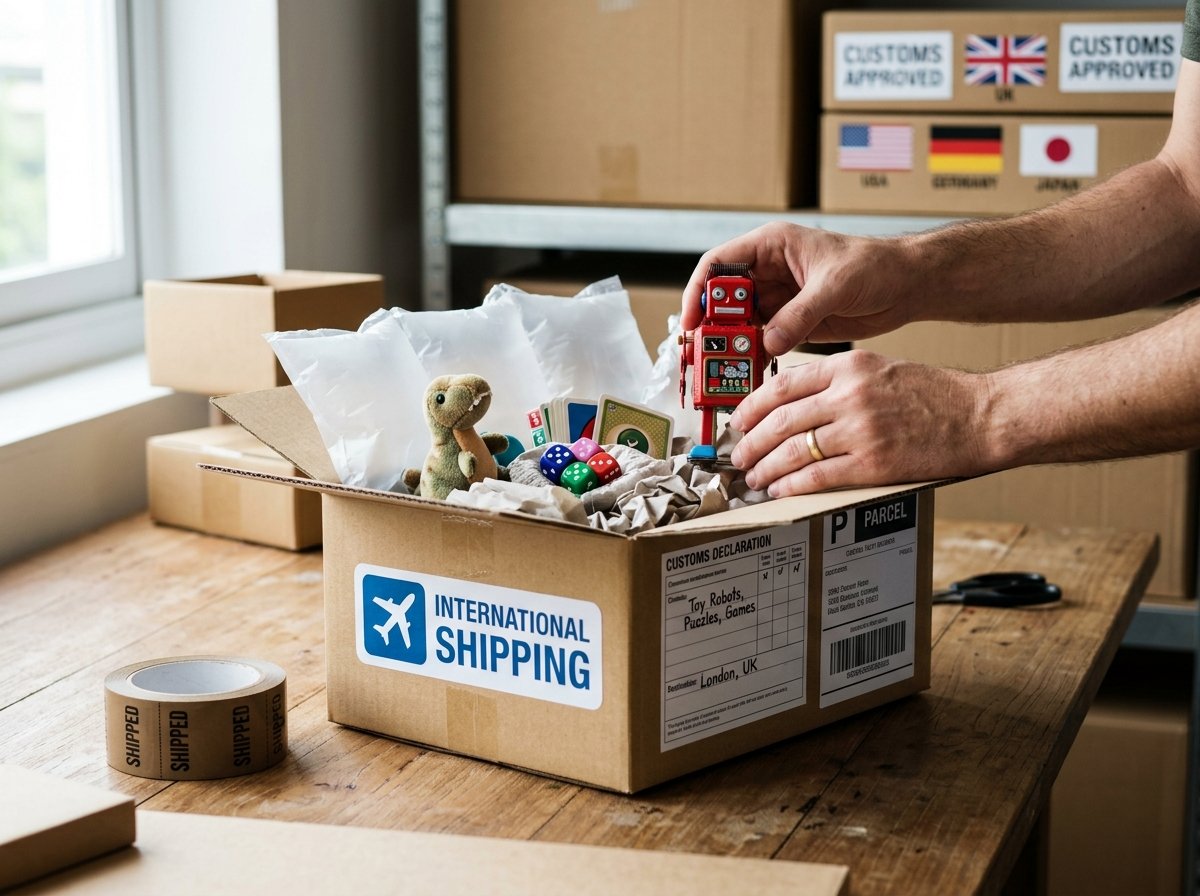
A single Lego set bought in Denmark can cost 40% less than the same box sold in Southeast Asia. That price gap alone has made international toy shipping a booming business — for parents hunting deals, sellers running cross-border stores, and grandparents sending birthday gifts halfway across the world. But here’s the thing most people don’t realize until it’s too late: toys are one of the trickiest product categories to ship internationally.
Between battery regulations, child safety certifications, customs paperwork, and the fact that toy packaging dents if you look at it wrong — there’s a lot that can go sideways. I’ve seen packages held at customs for weeks because a musical teddy bear had undeclared button-cell batteries. I’ve seen beautifully packed board games arrive with crushed corners because someone used a box two sizes too big.
You don’t want to be that person.
This guide walks you through everything — the rules you need to follow, how to pack toys so they actually survive the journey, what shipping options make sense for your budget, and the country-specific restrictions that catch people off guard. Whether you’re a parent shipping a gift, an eBay seller fulfilling international orders, or a small business scaling globally, you’ll find what you need right here.
Why Shipping Toys Internationally Isn’t as Simple as It Looks
You might think, “It’s just a toy — how complicated can it be?” Honestly? More complicated than shipping most other items. Here’s why toys sit in a uniquely tricky category.
Safety regulations vary by country. The US requires CPSIA (Consumer Product Safety Improvement Act) compliance. The EU enforces the CE marking under the Toy Safety Directive 2009/48/EC. Australia has its own mandatory standards under the ACCC. Japan follows the ST Mark system. And these aren’t just guidelines — customs officers actively check for these certifications, especially on commercial shipments.
Batteries change everything. A huge number of modern toys run on batteries — remote-controlled cars, talking dolls, electronic learning tablets, light-up action figures. The moment your toy has a battery inside, it falls under hazardous materials shipping regulations. Lithium batteries in particular have strict air transport rules governed by IATA (International Air Transport Association). Some couriers flat-out refuse to ship toys with lithium batteries via air freight.
Customs classification matters. Toys and games fall under HS Code Chapter 95 (specifically 9503 for most toys and 9504 for video games and board games). Getting the wrong code on your customs form can mean higher duties, delays, or your package getting flagged for inspection.
And then there’s the packaging challenge — toys come in all shapes and sizes, from tiny figurines to massive ride-on cars. Each needs a different packing approach.
Know the Rules Before You Ship
Let’s get the regulatory stuff out of the way first, because this is where most international toy shipments run into trouble.
Safety Certifications and Compliance
If you’re shipping toys commercially (selling them), the destination country will almost certainly require proof of safety compliance. Here’s what the major markets expect:
United States — All toys sold to children under 12 must comply with CPSIA standards. This includes lead content limits, phthalate restrictions, and mandatory third-party testing. You’ll need a Children’s Product Certificate (CPC) to clear customs for commercial quantities.
European Union — The CE marking is non-negotiable. Toys must meet EN 71 safety standards covering mechanical and physical properties, flammability, and chemical content. Since July 2021, the EU also requires an EU-based Authorized Representative for non-EU sellers.
United Kingdom — Post-Brexit, the UK introduced its own UKCA marking, though CE marks are still accepted until 2025. Always check the latest guidance from the UK’s Office for Product Safety & Standards.
Australia — The ACCC enforces mandatory standards for certain toy categories, especially projectile toys, toys for children under 3, and aquatic toys.
Pro Tip: If you’re shipping a personal gift (one or two toys for a family member), most countries won’t ask for safety certifications. These rules primarily target commercial imports. But you should still declare the item accurately on your customs form.
Battery Rules You Can’t Ignore
This is the part that trips up the most people. If your toy contains batteries, you need to know exactly what type they are.
Alkaline batteries (AA, AAA, C, D) — Generally accepted by most couriers for international shipping. Remove them from the toy and pack them separately. Tape the terminals to prevent short-circuiting.
Lithium-ion or lithium-metal batteries — Heavily regulated. IATA classifies these under Dangerous Goods. Many couriers ship them only via ground or sea freight, not air. DHL, FedEx, and UPS each have their own specific rules — and they update them frequently. If you’re debating between carriers, our DHL vs FedEx international shipping comparison breaks down what each one allows.
Button-cell batteries — Common in small toys, greeting cards with sound chips, and musical books. These are usually acceptable but must be properly declared. Some countries (like Australia) have extra rules around button batteries due to child safety concerns.
Quick Fact: In 2024, IATA updated its lithium battery shipping rules to require all packages containing lithium batteries to display the Class 9 hazard label if the battery exceeds 100 watt-hours. Even smaller batteries need proper documentation.
Customs Forms and Documentation
Every international shipment needs a customs declaration. For toys, you’ll typically need:
Your commercial invoice (for commercial shipments) or a customs declaration form (CN22 or CN23 for postal services). Include the toy’s description, material, value, country of origin, and HS code.
Most toys fall under HS Code 9503, which covers dolls, puzzles, construction sets, stuffed animals, and action figures. Board games and card games usually fall under 9504. Video game consoles go under 9504.50. Getting this right helps customs process your package faster and ensures you’re charged the correct duty rate.
If you’re shipping commercially, some countries also want a packing list, a certificate of origin, and safety test reports.
How to Pack Toys and Games So They Actually Arrive Intact
Packing is where you have the most control — and where most damage happens. Toys aren’t fragile like glassware, but they have their own vulnerabilities: flimsy retail packaging, small parts that can break loose, and awkward shapes that shift around inside a box.
Choosing the Right Box
The number one packing mistake? Using a box that’s too big. When there’s empty space inside, items slide and slam around during transit. International shipments go through more handling points than domestic ones — your package might get loaded, unloaded, and transferred six or seven times before it reaches the door.
Pick a box that fits snugly around the toy with just enough room for 2–3 inches of cushioning material on all sides. If you’re unsure about sizing, our guide on how to choose the right box size helps you figure out the math.
For board games and boxed toys, use a box that’s only slightly larger than the product box. For loose toys or irregularly shaped items, build a nest of cushioning inside a standard corrugated box.
Cushioning and Protection
Bubble wrap works well for individual toys, especially anything with protruding parts. Wrap each item separately. How much do you need? It depends on the item’s fragility and size — check out this breakdown on how much bubble wrap you actually need for different shipment types.
Crumpled kraft paper is great for filling gaps and preventing movement. It’s also more eco-friendly than foam peanuts. Speaking of which, if sustainability matters to you (and it should — customers increasingly care about it), explore some eco-friendly packaging options that protect just as well.
Foam inserts or molded pulp — If you’re shipping high-value collector toys or limited-edition board games, consider custom foam inserts. They cost more but virtually eliminate movement inside the box.
Special Packing Scenarios
Board games: The biggest risk is the box lid getting crushed or the corners denting. Wrap the entire game box in stretch wrap first to keep the lid sealed. Then wrap in bubble wrap, paying extra attention to corners. Place it in a shipping box that’s just slightly larger.
Action figures in retail packaging: If the recipient wants the packaging intact (common with collectors), don’t just throw the blister pack in a box. Use a figure shipping box or wrap the entire package in a layer of bubble wrap, then cushion it inside the outer box. Those plastic blisters crack easily under pressure.
Stuffed animals: These are forgiving because they’re soft, but they take up a lot of space. Compress them slightly and use vacuum bags if size is an issue — but warn the recipient that the toy might need some “fluffing” after arrival. The main concern here is keeping them dry, so use a plastic bag as an inner lining.
Building sets (Lego, Meccano, etc.): Seal the original box with tape so pieces don’t spill out if the box opens during transit. Then pack normally with cushioning.
Remote-controlled toys: Remove batteries (always). Pack the controller separately. Wrap any antennas or fragile parts individually. If the toy has a rechargeable lithium battery, you’ll need to follow the battery shipping rules above.
Picking the Right Shipping Method
Your shipping method depends on three things: how fast you need it there, how much you’re willing to spend, and what’s inside the package.
Express vs. Economy
Express shipping (DHL Express, FedEx International Priority, UPS Worldwide Express) gets toys delivered in 2–5 business days to most countries. You’ll pay more, but you get full tracking, faster customs clearance, and better insurance options. If you’re shipping a birthday gift and the party’s next Saturday, express is your only real option.
Economy shipping (postal services, FedEx Economy, DHL eCommerce) takes 7–21 days depending on the destination. It’s significantly cheaper — sometimes half the cost of express. If there’s no time pressure, this makes sense, especially for lower-value items. We’ve done a detailed economy vs express international shipping comparison if you want to see actual cost differences.
Air vs. Ground/Sea
For most toy shipments, air freight is the standard. Packages under 30 kg almost always go by air, whether express or economy.
If you’re shipping large quantities of toys (bulk orders, business inventory, trade show samples), sea freight becomes cost-effective. It’s slower — 4 to 8 weeks depending on the route — but the per-kilo cost drops dramatically. Our ground vs air shipping pros and cons guide explains when each option makes practical sense.
Warning: If your toy contains lithium batteries and your courier doesn’t allow them on air transport, sea freight might be your only option. Always confirm battery shipping policies with your carrier before booking.
Shipping Costs: What to Expect
Toy shipping costs depend on weight, dimensions, destination, and speed. Most couriers use dimensional weight pricing, which means they charge based on the size of the box, not just how heavy it is. Toys often get hit hard by dimensional weight because their packaging tends to be large relative to their actual weight.
A stuffed animal weighing 500 grams but packed in a 40×30×30 cm box might get billed as if it weighs 3+ kg. That’s dimensional weight in action, and it catches a lot of first-time shippers off guard. Understanding how dimensional weight works can save you real money — sometimes just switching to a smaller box drops the shipping cost by 30-40%.
Rough cost ranges for shipping a 2 kg toy package:
- USA to UK (Express): $40–$65
- USA to UK (Economy): $18–$30
- UK to Australia (Express): £45–£70
- UK to Australia (Economy): £20–£35
- USA to India (Express): $50–$80
These are ballpark figures for 2025. Actual rates vary by carrier, season, and whether you’re shipping from a business account (which usually gets discounts). If you ship regularly, you should learn how to compare courier quotes to find the best deal each time.
Country-Specific Restrictions That Catch People Off Guard
Not every country treats toy imports the same way. Here are some specific things to watch out for in popular shipping destinations.
United States
The US Customs and Border Protection (CBP) takes toy safety seriously. Commercial toy shipments valued over $2,500 require a formal entry. Toys with small parts must carry appropriate age-group warnings. Anything containing lead paint above 90 ppm will be seized. There are also specific shipping restrictions to the USA that apply broadly, not just to toys.
Toy guns and replica weapons are a gray area. Realistic-looking toy firearms can be seized at the border unless they have the required bright orange tip mandated by US federal law (15 USC §5001).
United Kingdom
Post-Brexit, the UK now has its own product safety framework separate from the EU. Toys entering the UK must meet the Toys (Safety) Regulations 2011. The duty rate on most toys is around 0-4.7%. VAT at 20% applies to the total value (product cost + shipping + insurance). For personal gifts under £39, VAT is waived. Check our UK shipping restrictions guide for a broader picture.
Australia
Australia’s Border Force is notoriously strict. Certain toy materials (particularly anything that could contain asbestos, which has been found in cheap imported toys) get flagged. Projectile toys, water toys, and toys for under-3s face mandatory safety standards. Duty is generally 5% on toys, and GST of 10% applies to goods valued over AUD 1,000. Our Australia shipping restrictions guide covers more details.
Middle East and Asia
Some Middle Eastern countries restrict toys that depict certain imagery or themes considered culturally inappropriate. Japan has strict quality standards but is generally smooth for personal shipments. India charges customs duty ranging from 20-60% on toys, and since 2020, has made BIS (Bureau of Indian Standards) certification mandatory for imported toys — a move that heavily impacts commercial sellers.
Tips for Sellers Shipping Toys as a Business
If you’re running an e-commerce store selling toys internationally — whether on eBay, Etsy, Amazon, or your own Shopify site — there are some extra things to think about.
Get your safety documentation in order before you list. Don’t wait until your first international order comes in. If you’re selling to the EU, have your EN 71 test reports ready. For the US, have your CPC prepared. Without these, customs can hold or return your shipments, and the buyer will blame you.
Offer clear shipping tiers. Give customers a choice between economy and express. Most toy buyers are price-sensitive (especially parents buying kids’ stuff), so economy shipping wins more sales. But always offer an express option for last-minute shoppers. If you’re selling on platforms like eBay, our guide to selling on eBay and shipping internationally walks through the logistics setup.
Automate where you can. If you’re processing more than 10 international orders a week, manual shipping label creation will eat your time alive. Look into setting up automated shipping for your online store — most platforms integrate with multi-carrier shipping tools.
Have a clear returns policy. International toy returns are painful because of the shipping cost. Some sellers offer refunds without requiring the item back (for lower-value toys) just because the return shipping would cost more than the toy. Whatever you decide, make your policy clear upfront. Here’s a practical guide on handling returns for online businesses that covers international scenarios.
Buy shipping insurance for valuable items. Collector toys, vintage board games, limited-edition figures — these can be worth hundreds or thousands of dollars. Standard carrier liability is usually capped at $100 or less. Shipping insurance costs a small percentage of the declared value and can save you from a nightmare if something goes wrong.
What to Do When Things Go Wrong
Even with perfect packing and the right paperwork, problems happen. Here’s how to handle the most common ones.
Package stuck at customs: Usually means missing or incorrect documentation. Contact your carrier’s customer service — they can often tell you exactly what customs needs. Provide the correct HS code, invoice, or safety certificate, and the package usually gets released within a few days.
Package shows delivered but buyer says it didn’t arrive: This is surprisingly common with international shipments, especially when a neighbor or building receptionist signs for the delivery. We’ve got a detailed troubleshooting guide for when a package is marked delivered but not received.
Toy arrives damaged: Take photos immediately. File a claim with the carrier — most have a 15-30 day window for damage claims. If you had shipping insurance, file through that as well. Our guide on how to file a claim for a lost or damaged package walks through the process step by step.
Seasonal Shipping: Plan Ahead for Holidays
Toys and holidays go together like chai and biscuits. But holiday shipping is when everything gets more chaotic — carriers are overloaded, customs processing slows down, and delays become the norm.
For Christmas and Hanukkah shipments, most carriers recommend shipping by early December for express and mid-November for economy. For Diwali, you’d want to ship 3-4 weeks ahead of the date if sending to India or other South Asian countries. We’ve put together a Diwali international shipping guide that covers timelines and tips specific to that season.
Did You Know? December is the peak month for international toy shipments. DHL and FedEx both add temporary surcharges during peak season (usually from late November through early January). In 2024, FedEx’s peak surcharge was an additional $2.50–$7.00 per package depending on size and destination. Plan your budget accordingly.
FAQ
Can I ship battery-operated toys internationally?
Yes, but it depends on the battery type. Toys with alkaline batteries (AA, AAA, etc.) are generally accepted by most carriers — just remove the batteries and pack them separately with taped terminals. Toys with lithium-ion or lithium-metal batteries face stricter rules. Many carriers restrict lithium battery shipments to ground or sea transport only. Always declare batteries on your customs form and check your carrier’s specific policy before shipping.
Do I need safety certifications to send toys as personal gifts?
For personal gifts (non-commercial, small quantities), most countries don’t require safety certifications. You’ll still need to fill out a customs declaration with an accurate description and value. But if customs suspects a commercial shipment disguised as a gift (multiple identical items, high quantities, or frequent shipments), they may ask for certification documents or charge commercial duty rates.
How much does it cost to ship toys internationally?
Costs vary widely based on package size, weight, destination, and speed. A 2 kg toy package shipped express from the US to Europe typically costs $40–$65, while economy shipping for the same package might run $18–$30. Dimensional weight pricing often affects toy shipments because toy packaging tends to be large relative to its weight. You can reduce costs by using a smaller box, comparing carrier quotes, and shipping economy when time isn’t critical.
Are toy guns and replica weapons allowed in international shipments?
This varies significantly by country. The US requires imitation firearms to have a bright orange tip. The UK bans realistic imitation firearms entirely under the Violent Crime Reduction Act 2006 — even toy guns that look too realistic can be seized. Australia also has strict rules around replica weapons. Always check the destination country’s specific regulations before shipping anything that resembles a weapon.
What happens if customs rejects my toy shipment?
If customs rejects your shipment, the package is either returned to you (at your expense) or destroyed, depending on the country and the reason for rejection. Common rejection reasons include missing safety certifications (for commercial shipments), undeclared batteries, incorrect HS codes, or prohibited materials. Contact your carrier immediately if your package is held — you may be able to provide additional documentation to get it released.
Your Next Step
Shipping toys internationally isn’t rocket science, but it does require a bit of homework. The rules around batteries, safety certifications, and customs paperwork exist for good reasons — mostly to protect kids and ensure product quality. Once you understand them, the actual process becomes pretty straightforward: pack well, declare accurately, choose the right carrier, and ship with enough lead time.
If this is your first time shipping a toy overseas, start with one package. Get the process down. Learn what your carrier requires, see how customs handles it at the destination, and note what worked and what didn’t. By your third or fourth shipment, it’ll feel routine.
And if you’re building a toy business around international sales? Invest the time upfront to get your safety certifications, automate your shipping workflow, and build relationships with reliable carriers. That groundwork pays for itself many times over as your orders grow.