
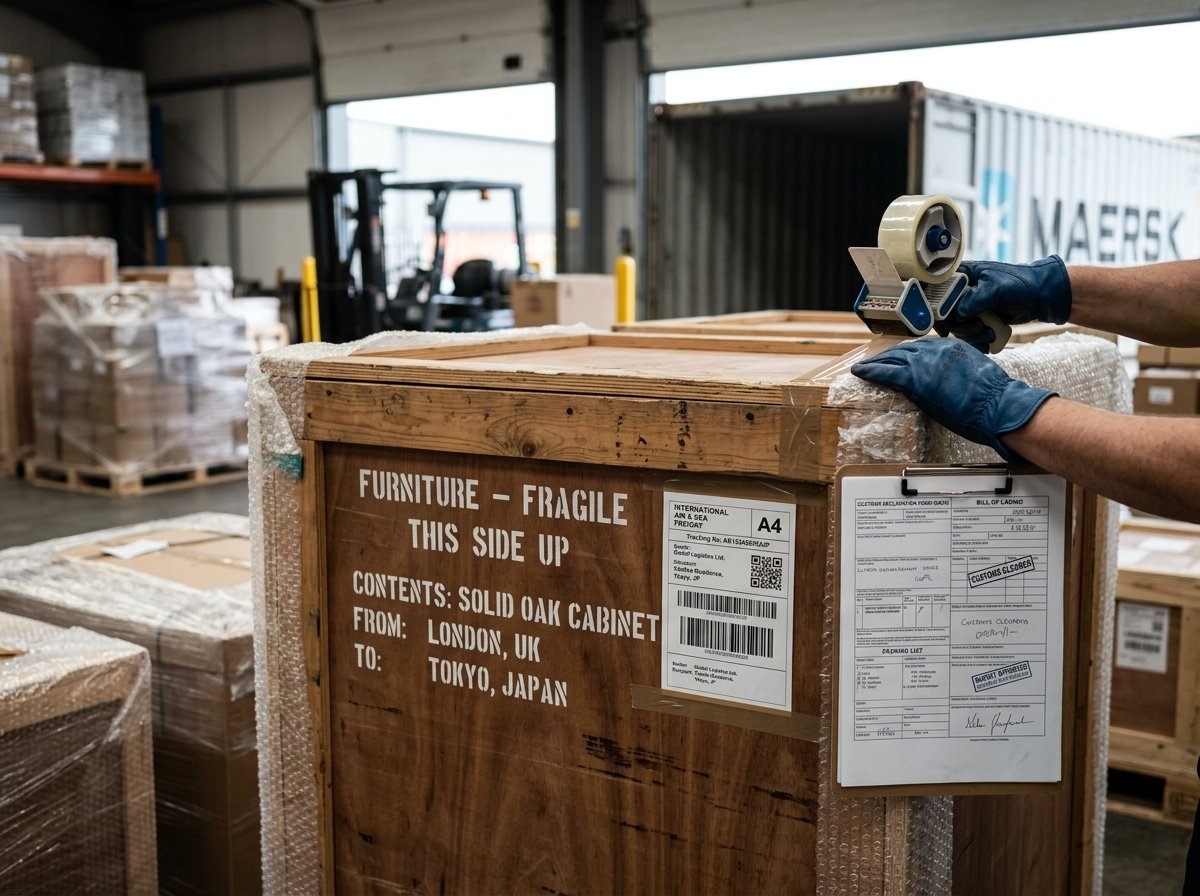
A hand-carved wooden bookshelf that your grandfather built. A mid-century dining table you found at a flea market in Paris. A sofa set you bought online from an Italian store. Now you need to get it across borders — and suddenly, you’re staring at a logistics puzzle that feels impossible to solve.
Shipping furniture internationally isn’t like sending a small parcel. You’re dealing with bulk, weight, fragile materials, customs paperwork, and costs that can spiral out of control if you don’t plan right. About 40% of international furniture shipments arrive with some form of damage, mostly because of poor packing or choosing the wrong shipping method.
But here’s the thing — thousands of people do this successfully every single day. Families relocating abroad, online sellers fulfilling orders, antique collectors importing rare finds. If they can do it, so can you. You just need to know the right steps.
This guide walks you through everything — from figuring out costs and picking the right shipping method, to packing your furniture like a pro and clearing customs without surprises.
Why Is Shipping Furniture Internationally So Tricky?
Let’s be honest. Furniture isn’t a pair of shoes you can toss in a box and slap a label on. (Even shipping shoes safely needs some thought, by the way.)
Furniture brings a unique set of challenges that most people underestimate.
Size and weight matter more than you think. International shipping costs are calculated based on either actual weight or dimensional weight — whichever is higher. A lightweight but bulky armchair can cost more to ship than a compact but heavy marble-top side table. If you’re not familiar with how this works, understanding how dimensional weight is calculated can save you from a nasty surprise on your invoice.
Fragility is another issue. Glass tabletops, wooden legs, upholstered fabric, leather surfaces — each material reacts differently to rough handling, temperature changes, and moisture during transit. A 3-week ocean journey from the US to Australia means your furniture will face humidity, stacking pressure, and vibrations the entire time.
Customs regulations vary wildly. Some countries have strict rules about importing wood products due to pest concerns. Australia, New Zealand, and several EU nations require fumigation certificates for wooden furniture. Ship without the right paperwork, and your stuff could get held at customs — or sent right back.
And then there’s the cost factor. International furniture shipping can run anywhere from $200 for a single small piece via courier to $5,000+ for a full container load. The range is enormous, and it depends on size, weight, distance, method, and insurance.
Step 1: Decide What’s Worth Shipping (And What Isn’t)
Before you start getting quotes and booking shipments, take a hard look at what you’re actually planning to send. Not every piece of furniture is worth the cost and hassle of international shipping.
Ask yourself a few practical questions. What’s the replacement value of this furniture? Could you buy something similar at the destination for less than the shipping cost? Does the item have sentimental value that makes it irreplaceable?
Here’s a real example. A standard IKEA bookshelf costs around $80–$150 to buy new. Shipping it internationally could cost $300–$600 depending on the destination. Doesn’t make sense, right? But your grandmother’s antique writing desk, which is valued at $3,000 and can’t be replaced? That’s absolutely worth shipping.
⚡ Pro Tip: Make a simple spreadsheet. List each piece, its approximate value, its dimensions, and its weight. This will help you get accurate shipping quotes and decide what makes the cut.
For people who are relocating abroad for work or studies, this step is even more critical because you’re likely shipping personal belongings too, not just furniture. Prioritizing smartly can save you hundreds of dollars.
Step 2: Understand Your Shipping Method Options
You’ve got three main options for shipping furniture internationally, and each one serves a different need. Let’s break them down honestly.
Courier Services (For Small Furniture Items)
If you’re shipping something compact — a small side table, a single chair, a desk lamp, or flat-pack furniture — courier services like DHL, FedEx, or UPS can work. They’re fast, usually delivering within 3–10 business days. Tracking is excellent. But costs are high per kilogram, and most couriers have size and weight limits (usually around 70 kg per piece and 300 cm in length + girth combined).
If you’re considering this route, it helps to compare DHL vs FedEx for international shipping to see which one offers better rates and coverage for your specific route.
Best for: Single small-to-medium furniture items, flat-pack furniture, urgent shipments.
Freight Shipping by Sea (Most Common for Furniture)
Ocean freight is the go-to method for most international furniture shipments. It’s affordable for heavy, bulky items — and you’ve got two sub-options:
LCL (Less than Container Load) — Your furniture shares container space with other people’s shipments. You only pay for the space you use. Good for a few pieces, but transit times are longer (4–8 weeks typically), and there’s a slightly higher risk of handling damage because items get loaded and unloaded at consolidation warehouses.
FCL (Full Container Load) — You rent an entire container. Standard sizes are 20-foot containers (about 33 cubic meters of space) and 40-foot containers (about 67 cubic meters). If you’re shipping a whole household’s worth of furniture, FCL is usually cheaper per item and safer because your stuff isn’t being shuffled around with strangers’ cargo.
Best for: Multiple large pieces, full household moves, heavy items.
Air Freight (When Speed Matters)
Air freight gets your furniture there in days, not weeks. Delivery typically takes 5–14 days including customs clearance. But it’s expensive — roughly 4 to 5 times the cost of sea freight for the same shipment. Most people only choose this for high-value items or time-sensitive situations.
Wondering about the real cost difference? Checking out the pros and cons of ground vs air shipping gives you a clearer picture. And if you’re torn between saving money and saving time, this economy vs express international shipping comparison is worth a read.
Best for: High-value or time-sensitive single pieces, antique furniture.
Step 3: Get Quotes and Compare Costs Realistically
Don’t just grab the first quote you find and run with it. Furniture shipping costs vary dramatically between providers, and hidden charges are more common than you’d like.
What Affects the Cost?
The price you’ll pay depends on several factors working together. The origin and destination play a huge role — shipping from the US to the UK is significantly cheaper than shipping from the US to New Zealand, simply because of route availability and distance. Weight and dimensions directly determine the base cost. Shipping method (courier, sea freight, or air freight) creates the biggest price difference. The type of furniture matters too — anything requiring special handling (glass, antique, oversized) costs more.
To give you a rough idea — shipping a standard 3-seater sofa from the United States to Europe via sea freight typically costs between $800 and $1,500 in 2025. The same sofa shipped by air freight could run $2,500 to $4,000.
Watch Out for Hidden Fees
Your shipping quote might look great until you realize it doesn’t include port handling charges, customs brokerage fees, fuel surcharges, or delivery from the destination port to your actual address (called “last mile delivery”). Always ask for an all-inclusive quote or at least a breakdown of every charge.
⚡ Pro Tip: Get quotes from at least 3–4 different companies. Use freight comparison platforms, and don’t forget to check if the quote includes insurance. Learning how to compare courier quotes properly can genuinely save you 20–30% on your total cost.
Step 4: Pack Your Furniture the Right Way
This is where most people mess up — and where most damage happens. Packing furniture for an international journey isn’t the same as wrapping it in a blanket for a local move. Your furniture will be stacked in a container, loaded onto a ship or plane, unloaded, possibly stored in a warehouse, loaded onto a truck, and finally delivered. That’s a lot of handling.
Disassemble Whatever You Can
Remove legs from tables and sofas. Take apart bed frames. Remove shelves from bookcases. Detach mirrors from dressers. Disassembling reduces the risk of protruding parts snapping off, and it also reduces dimensional size — which can lower your shipping cost.
Keep all screws, bolts, and small hardware in a labeled zip-lock bag and tape it to the corresponding furniture piece. Trust me, you don’t want to arrive at your new home and spend hours hunting for the right screws.
Wrap and Protect Like Your Furniture’s Life Depends on It
Start with a layer of clean packing paper or soft cloth directly on the surface. This prevents scratches. Then add bubble wrap — generously. For particularly fragile items, use two or three layers. If you’re wondering how much bubble wrap you actually need, there’s a good rule of thumb: you should be able to drop a wrapped item from waist height without worrying. If that thought scares you, add more wrap.
For glass surfaces (tabletops, cabinet doors), use cardboard corner protectors and consider getting custom-cut foam sheets. Mark these pieces clearly with “FRAGILE — GLASS” labels.
Use the Right Crating and Boxing
Soft wrapping alone won’t protect furniture in an international shipment. Large or valuable pieces should go into wooden crates. Yes, it adds cost ($50–$200 per piece depending on size), but it adds a rigid protective shell that bubble wrap simply can’t provide.
For medium items, heavy-duty double-walled cardboard boxes work well. Don’t use standard moving boxes — they’re not strong enough for overseas transit. If you need help figuring out what packaging to use, check out this guide on choosing the right box size for shipping.
⚠️ Warning: One of the most common packaging mistakes that damage parcels is leaving empty space inside boxes. Fill all gaps with packing peanuts, crumpled paper, or foam inserts. If an item can shift inside its packaging, it will get damaged.
Special Considerations for Wooden Furniture
If your furniture is made of solid wood, pay attention to the ISPM-15 regulation. Most countries require that wooden packaging materials (crates, pallets) be heat-treated or fumigated to prevent the spread of insects and diseases. Some countries — Australia, New Zealand, and South Africa especially — extend this requirement to the wooden furniture itself, not just the packaging.
You may need a fumigation certificate from an approved treatment provider. Ignoring this can lead to your shipment being quarantined, treated at the destination (at your cost), or even destroyed.
Step 5: Handle Customs Documentation Properly
Customs paperwork is the part most people dread, and for good reason. Get it wrong, and your furniture could sit in a warehouse for weeks, racking up storage fees while you scramble to fix the paperwork.
Documents You’ll Typically Need
The exact requirements vary by country, but here’s what you’ll almost always need. A commercial invoice (for purchased items) or a packing list with declared values (for personal belongings). A bill of lading (for sea freight) or air waybill (for air freight) — your shipping company provides these. Your passport copy and sometimes a visa or proof of residency in the destination country. For wooden items, a phytosanitary certificate or fumigation certificate if the destination country requires one.
If you’re moving abroad and shipping your personal furniture as household goods, many countries offer duty-free or reduced-duty import for personal effects. But you’ll usually need to prove that you’ve owned the items for at least 6–12 months before the move. Keep purchase receipts or photos with timestamps as proof.
Country-Specific Rules You Should Know
Not every country treats furniture imports the same way. The US charges customs duty on furniture imports ranging from 0% to 9.5% depending on the material and category. The UK applies VAT (currently 20%) on the declared value plus shipping costs for non-personal imports. Australia has some of the strictest biosecurity laws — all wooden furniture must be free of bark, insects, and soil. Fumigation is often required.
Before shipping, check the specific shipping restrictions to the USA, UK, or Australia depending on your destination. These guides cover what’s allowed, what’s restricted, and what documentation you need.
📌 Did You Know? Some countries also restrict the import of furniture containing certain materials. Items made with endangered wood species (like certain types of rosewood) fall under CITES regulations and may require special permits or could be prohibited entirely.
Step 6: Insure Your Shipment (Don’t Skip This)
Here’s a scenario nobody wants to think about. Your beautiful teak dining table arrives at the destination port. You open the crate. There’s a massive crack running through the middle. Without insurance, you’re absorbing that loss entirely.
Standard carrier liability — the basic coverage that comes with your shipping — is usually laughably low. For sea freight, it’s often limited to about $500 per shipping unit under standard terms, regardless of the item’s actual value. Your $4,000 antique cabinet and a $50 plastic chair get the same payout.
Get proper shipping insurance. It typically costs 2–3% of the declared value. So insuring $5,000 worth of furniture costs roughly $100–$150. That’s a small price for peace of mind. If you want to understand your options better, this guide on insurance for shipped packages explains what’s covered, what’s not, and how to file a claim if something goes wrong.
⚡ Pro Tip: Take detailed photos of every piece of furniture before packing — from multiple angles, with close-ups of any existing wear or marks. This serves as evidence of the item’s condition before shipping and makes insurance claims infinitely easier.
Step 7: Track Your Shipment and Prepare for Delivery
Once your furniture is on its way, you’re not completely out of the loop. Most freight companies and courier services offer tracking, though the level of detail varies.
Courier shipments (DHL, FedEx, UPS) provide real-time tracking updates, often down to the hour. Sea freight tracking is less granular — you’ll usually get updates at major milestones: picked up, loaded on vessel, in transit, arrived at destination port, cleared customs, out for delivery. If you’re unfamiliar with what all the statuses mean, this guide on understanding tracking statuses clears things up.
Preparing for Delivery at the Destination
Before your furniture arrives, make sure you’ve arranged a few things. Clear the pathway from your front door to wherever the furniture is going. Confirm whether the delivery service includes bringing furniture inside your home or just dropping it at the curb (curbside delivery is standard for freight shipments — indoor delivery costs extra). Have tools ready to reassemble disassembled pieces.
If nobody will be home on the delivery day, check the carrier’s policy. Some carriers attempt redelivery, others leave it at a depot. Knowing what happens if no one is home for delivery helps you avoid unnecessary storage fees or complications.
How to Reduce Your International Furniture Shipping Costs
Nobody wants to overpay. Here are some genuinely practical ways to bring costs down without cutting corners on safety.
Ship during off-peak seasons. January through March and September through early November tend to be cheaper for sea freight. Avoid shipping right before major holidays like Christmas, Chinese New Year, or Diwali — carrier capacity gets tight and prices spike. (If you’re shipping gifts during the festive season, the Diwali international shipping guide has useful timing advice.)
Consolidate your shipment. Shipping five items together in one crate or container is almost always cheaper per item than shipping them individually. If you’re moving abroad and shipping furniture alongside personal belongings, combining everything into a single shipment makes financial sense. Many people shipping belongings when moving abroad save significantly by consolidating.
Disassemble everything possible. We talked about this for protection, but it also reduces dimensional weight — and dimensional weight directly affects cost. A dining table with legs removed takes up far less space than one shipped fully assembled.
Consider selling and rebuying. I know this sounds counterintuitive in a guide about shipping furniture, but honesty matters. If your furniture is standard, mass-produced, and not sentimental, do the math. Sometimes selling locally and buying again at the destination is genuinely cheaper. Save international shipping for pieces that truly matter.
Negotiate with freight forwarders. Many freight companies are open to negotiation, especially if you’re flexible on timing. Asking for a better rate costs you nothing. And if you’re running a business, bulk shipping discounts can significantly cut per-unit costs on repeat shipments.
Shipping Furniture for Business: Extra Things to Keep in Mind
If you’re an online seller or a furniture business shipping internationally — whether through your own e-commerce store, Etsy, or eBay — the logistics get a bit more layered.
You need to think about return policies, because international furniture returns are expensive and complicated. Having a clear, realistic return policy saves you headaches. This guide on handling returns for online businesses offers solid strategies for managing this.
Customs duties become the customer’s problem in most cases (with DDP — Delivered Duty Paid — being the exception). Make sure your product listings clearly state whether the price includes duties and taxes at the destination. Surprising your customer with a $200 customs bill on arrival is a guaranteed way to earn a 1-star review.
Packaging consistency matters at scale. If you’re shipping furniture regularly, invest in standardized packaging solutions — custom foam inserts, branded crates, and a repeatable packing process. This reduces damage rates and speeds up your shipping workflow.
FAQ
How much does it cost to ship furniture internationally?
Costs vary widely depending on size, weight, destination, and shipping method. A single chair or small table shipped via courier might cost $200–$500. A sofa shipped by sea freight to another continent typically runs $800–$1,500. A full 20-foot container of household furniture can cost $2,000–$5,000 for major routes. Air freight is roughly 4–5 times more expensive than sea freight for the same items.
How long does international furniture shipping take?
Courier services deliver small furniture items in 3–10 business days. Sea freight takes 3–8 weeks depending on the route — US to Europe is around 3–4 weeks, US to Australia is 5–7 weeks. Air freight typically takes 5–14 days including customs clearance. Add 2–5 days for last-mile delivery from the destination port or airport to your address.
Can I ship used or antique furniture internationally?
Yes, but there are extra considerations. Antique furniture (typically defined as over 100 years old) may qualify for duty-free import in some countries, including the US and UK. You might need an appraisal certificate proving its age and value. For wooden antiques, fumigation and phytosanitary requirements still apply. Items made from endangered wood species may require CITES permits. Always check the destination country’s specific regulations before shipping.
Do I need to disassemble furniture before shipping?
It’s strongly recommended but not always required. Disassembling reduces the risk of damage to protruding parts like legs and handles, lowers the dimensional size (which can reduce cost), and makes items easier to crate and stack. Always keep hardware in labeled bags attached to the corresponding piece. If a piece can’t be disassembled — like a solid wood bench — make sure it’s crated in a sturdy custom-built wooden crate.
Should I hire a professional packing service or do it myself?
For standard, sturdy furniture that you’re comfortable handling, DIY packing works fine if you follow proper techniques — disassemble, wrap thoroughly, use quality materials, fill voids. For antique, high-value, glass-containing, or unusually shaped pieces, professional packing is worth the cost. Professional packers also provide documentation and photographs that support insurance claims if damage occurs during transit.
Your Next Step
Shipping furniture internationally feels overwhelming until you break it down — and now you’ve done exactly that. You know how to evaluate what’s worth shipping, which method fits your situation, how to pack properly, and what customs paperwork you need.
The single most important thing you can do right now? Measure and weigh your furniture pieces, write them down, and start requesting quotes from 3–4 freight forwarders or courier services. Real numbers in front of you make every decision easier — from choosing the shipping method to deciding if a piece is worth sending at all.
Your furniture has a story. Whether it’s a family heirloom, a business product, or a piece you just can’t leave behind — with the right planning, it’ll arrive at its new home in one piece. And honestly, that’s all that matters.