
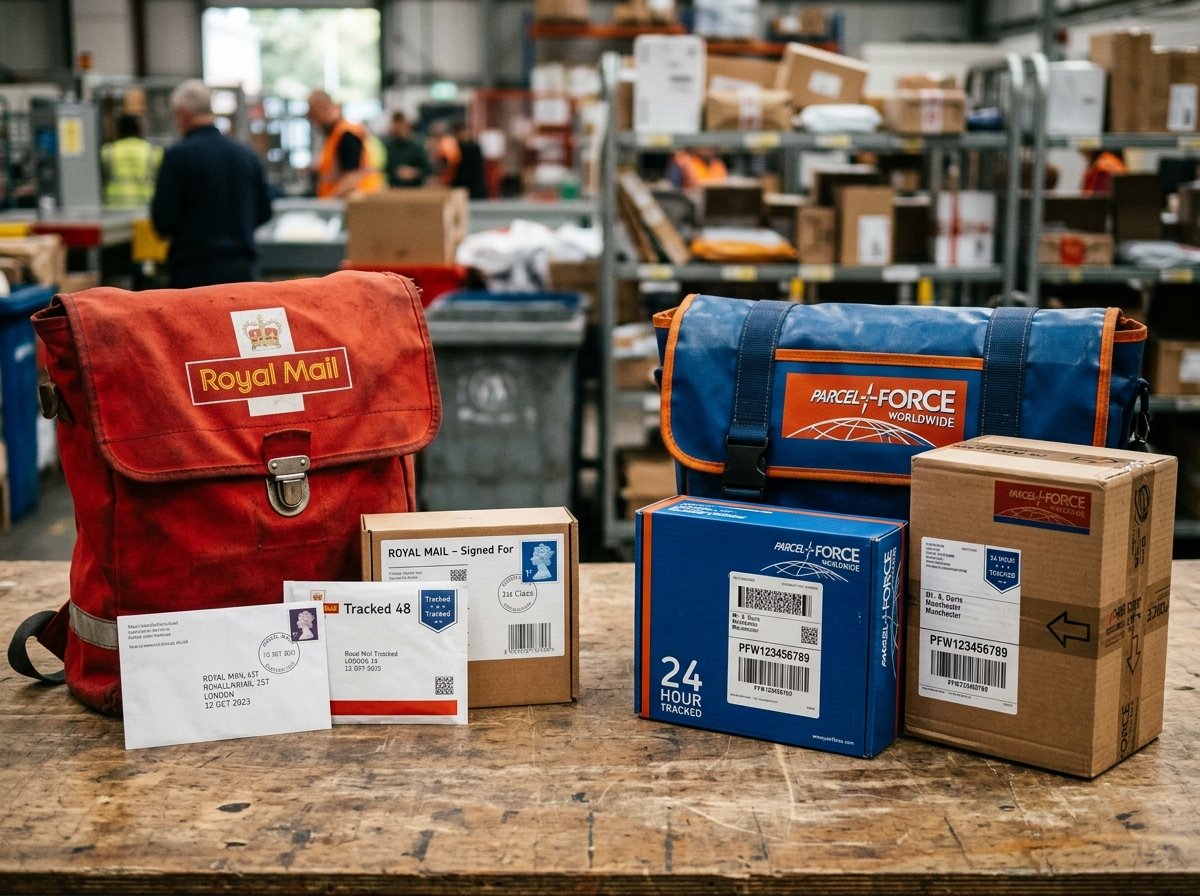
Here’s something that catches most people off guard — Royal Mail and Parcelforce are technically part of the same parent company, Royal Mail Group. Yet they operate almost like two separate worlds. Different pricing, different speeds, different strengths. And picking the wrong one? That can cost you real money, real time, or worse — a damaged parcel with no proper compensation.
Whether you’re an eBay seller shipping 50 packages a week, a student sending belongings home, or someone just trying to post a birthday gift to a cousin in Edinburgh, this choice matters more than you’d think. So let’s break it down properly — no fluff, no corporate jargon. Just the real differences that’ll actually help you decide.
What Exactly Are Royal Mail and Parcelforce?
Before we compare, let’s get the basics clear because a lot of people genuinely mix these two up.
Royal Mail is the UK’s universal postal service. It’s been around since 1516 — yes, over 500 years. It handles everything from letters and small packets to medium-sized parcels. Think of it as the everyday postal service that your local postman delivers. You drop your package at the post office, or your postman picks it up, and it goes through Royal Mail’s massive postal network.
Parcelforce Worldwide is the dedicated parcel delivery arm of Royal Mail Group. It was spun off specifically to handle larger, heavier, and time-sensitive parcels. Parcelforce operates more like a traditional courier — think along the lines of DPD, Hermes, or DHL for domestic and international shipments.
Here’s a simple way to think about it: Royal Mail is your reliable neighbourhood postman. Parcelforce is the delivery van that shows up when you’ve ordered something bigger or need it faster.
Quick Fact: Royal Mail delivers to approximately 31 million addresses across the UK, six days a week. Parcelforce handles around 68 million parcels per year through its dedicated depot network.
Price Comparison: Where Your Money Actually Goes
Let’s be honest — for most people, this is the deciding factor. And the pricing gap between these two can be surprisingly wide.
Royal Mail is almost always cheaper for smaller, lighter items. If your parcel weighs under 2kg, Royal Mail’s standard options (1st Class, 2nd Class, or Tracked services) are hard to beat on price. A small parcel under 1kg via Royal Mail 2nd Class costs around £3.00–£3.49, while 1st Class bumps it to roughly £4.00–£4.49 (2025 prices — Royal Mail updates pricing every April, so always double-check).
Parcelforce, on the other hand, starts at a higher price point. Their cheapest service (Express 48) typically begins around £15–£20 for domestic parcels. That’s a significant jump if you’re just sending a paperback book or a phone case.
But here’s where it gets interesting — once your parcel gets heavier (say, 10kg+), Parcelforce starts making a lot more sense. Royal Mail’s pricing climbs steeply for heavier items, and once you cross their 20kg limit, you can’t even use them anymore. Parcelforce handles parcels up to 30kg as standard, with some services going higher.
Pro Tip: If you’re running an online store and regularly ship items, understanding how shipping rates are actually calculated can save you hundreds over a year. Both Royal Mail and Parcelforce use weight thresholds, but Parcelforce also factors in dimensional weight more aggressively for large, lightweight packages.
So the pricing rule of thumb? Small and light — go Royal Mail. Big and heavy — Parcelforce earns its higher price tag.
Speed and Delivery Times: Who Gets There Faster?
Speed is where Parcelforce really pulls ahead, and it’s honestly not even close for urgent deliveries.
Royal Mail delivery options work on a tiered system. 2nd Class mail aims for delivery within 2–3 working days. 1st Class targets next working day, but it’s not guaranteed — it’s a “target,” not a promise. Royal Mail Tracked 24 and Tracked 48 offer better visibility but similar timeframes.
Their fastest guaranteed option, Special Delivery Guaranteed by 1pm, promises next-day delivery before 1pm with tracking and insurance up to £500. It works well, but it’s priced at around £7–£8 for lighter items, which starts closing the gap with Parcelforce.
Parcelforce delivery options are built around guaranteed timeframes. Express 48 delivers within two working days. Express 24 guarantees next-day delivery. Express AM promises delivery before noon. And their premium Global Express service gets international parcels to many destinations within 1–2 days.
The key difference? Parcelforce guarantees are contractual. If they miss the delivery window, you’re entitled to a refund on the postage. Royal Mail’s “targets” don’t carry the same weight.
If you’re weighing up speed tiers for a specific shipment, you might also want to look at the difference between standard and expedited shipping — the concepts apply directly to choosing between these two services.
Size and Weight Limits: This Could Be Your Dealbreaker
This is one area where the decision sometimes makes itself.
Royal Mail has strict size limitations. Their Small Parcel category covers items up to 2kg measuring no more than 61cm x 46cm x 46cm. Medium Parcels go up to 20kg with maximum dimensions of 61cm x 46cm x 46cm. And their Large Parcel (available via Parcel Post) handles items up to 30kg, but the pricing jumps considerably.
Got something that exceeds 61cm on any side? Royal Mail might reject it outright at the counter.
Parcelforce is far more flexible. Standard services accept parcels up to 30kg, with dimensions up to 1.5 metres in length and 3 metres combined (length + width + depth). Some contract services handle even larger items.
So if you’re shipping something like a guitar, a piece of artwork, or a flat-pack furniture component, Royal Mail often won’t be an option at all. For items like these, knowing how to ship musical instruments or artwork and paintings safely becomes just as important as picking the right carrier.
Tracking and Technology: Keeping an Eye on Your Parcel
We live in an age where people track their pizza delivery in real-time. So naturally, parcel tracking expectations have gone up massively.
Royal Mail offers tracking on selected services only. Their standard 1st and 2nd Class options have no tracking — your item goes into the system and, honestly, you just hope for the best. Tracked 24 and Tracked 48 add basic tracking with delivery confirmation. Special Delivery includes full tracking with signature on delivery.
The Royal Mail app and website do show tracking updates, but they’re often quite basic — “Item received,” “In transit,” “Delivered.” Don’t expect the GPS-level granularity you get with Amazon deliveries.
Parcelforce includes tracking on every single service. And their tracking is noticeably more detailed — you’ll typically see depot scans, out-for-delivery notifications, and estimated delivery windows. They also send proactive SMS and email updates without you having to opt in.
For anyone who’s ever had that sinking feeling of a package marked as delivered but not actually arrived, Parcelforce’s more detailed tracking gives you a much better starting point to investigate and resolve issues.
Did You Know? Parcelforce also offers a “Delivery Manager” style feature where recipients can request redelivery, redirect to a neighbour, or hold at depot — similar to what private couriers offer. Royal Mail has a redirection service too, but it’s less flexible for individual parcels. If you need to redirect a package to a different address, Parcelforce generally makes this easier.
International Shipping: Who Handles It Better?
Both services offer international shipping, but they target very different segments.
Royal Mail International is brilliant for smaller, non-urgent items. Their International Standard service (previously known as “Airmail”) delivers to most countries within 5–7 working days for Europe and 7–14 days for the rest of the world. Pricing starts low — you can send a small packet to Europe for under £5. International Tracked adds tracking capability for a few pounds more.
For lightweight ecommerce sellers shipping items like jewellery, cosmetics, or accessories internationally, Royal Mail is often the most cost-effective choice.
Parcelforce Worldwide caters to the international market with three main tiers: Global Express (1–2 days to major destinations), Global Priority (3–4 days), and Global Value (7–10 days). These are proper courier-level international services with full tracking, insurance options, and customs documentation support.
If you’re sending something valuable or time-sensitive internationally — say, a laptop, an expensive watch, or important documents — Parcelforce provides more peace of mind. The tracking is end-to-end, customs handling is smoother, and compensation limits are higher.
For anyone shipping to specific countries, be aware that both services must comply with destination country rules. If you’re sending goods to the UK from abroad (or within UK territories), check the shipping restrictions to the UK before booking anything.
Compensation and Insurance: What Happens When Things Go Wrong
Nobody likes thinking about lost or damaged parcels, but it happens. And the difference in protection between these two services is massive.
Royal Mail’s standard services come with very limited compensation. Standard 1st and 2nd Class parcels? You’re covered for up to £20 — barely enough to cover the contents of most parcels. Tracked services bump this to £50 for Tracked 48 and £100 for Tracked 24. Special Delivery includes cover up to £500 (with the option to extend to £2,500).
Parcelforce offers more robust standard compensation. Express 24 and Express 48 include cover up to £100 as standard, with the option to purchase enhanced cover up to £2,500. For high-value items, this makes a real difference.
Here’s the thing many people don’t realise — making a successful claim with either service requires proof of posting, proof of value, and evidence of damage. Take photos before you pack, keep your receipt, and always get proof of posting at the counter or online.
If you want extra peace of mind beyond what either service offers, consider third-party shipping insurance, especially for high-value goods.
Warning: Neither Royal Mail nor Parcelforce will compensate you adequately for poor packaging. If your item arrives damaged because you wrapped a ceramic vase in newspaper and prayer, they’ll likely deny the claim. Avoid the common packaging mistakes that damage parcels before you even think about which service to use.
Which Service Works Best for Online Sellers?
This deserves its own section because ecommerce sellers have very specific needs that casual senders don’t.
Royal Mail remains the backbone of UK ecommerce shipping for small to medium sellers. Their Click & Drop platform lets you print labels at home, schedule pickups, and manage bulk shipments. The pricing is competitive for lightweight items, and customers recognise and trust the Royal Mail brand. For eBay sellers especially, Royal Mail tracked services integrate smoothly with the platform.
Parcelforce targets larger-volume or premium ecommerce operations. They offer business accounts with discounted rates, dedicated account managers, and more reliable delivery windows. If you’re selling items that are bulky, fragile, or high-value — furniture components, electronics, premium fashion — Parcelforce’s service quality justifies the premium.
A practical example: if you sell handmade candles weighing 300g each on Etsy, Royal Mail 2nd Class Small Parcel is perfect — cheap, reliable, and your margins stay healthy. But if you sell custom-built PC components weighing 8kg, Parcelforce Express 48 gives your customers a better delivery experience with proper tracking and higher compensation.
The Collection and Drop-Off Experience
How you actually get your parcel into the system matters, especially if you’re sending regularly.
Royal Mail has the largest drop-off network in the UK — over 11,500 post offices, plus thousands of post boxes for letter-sized items. You can hand parcels over at any post office counter. They also offer daily collections from business addresses and home collections via the Royal Mail app (for a small fee).
Parcelforce has a much smaller depot network — around 54 depots across the UK. You can drop parcels at these depots or at selected Post Office branches. But their real strength is collections. Parcelforce will send a driver to your door to collect parcels, which is ideal for heavy items you don’t want to lug to the post office.
For occasional senders, Royal Mail’s accessibility wins hands down. For regular or heavy-item senders, Parcelforce’s collection service is a genuine convenience.
A Real-World Scenario Comparison
Let me paint two scenarios to make this concrete.
Scenario 1: Sarah sells handmade jewellery on Etsy. Her average order weighs about 150g and fits in a small padded envelope. She ships roughly 30 orders a week, mostly within the UK, with a few going to Europe.
Best choice? Royal Mail, without question. She can use Royal Mail Tracked 48 for domestic orders (under £4 each) and International Tracked for European ones. Her annual shipping costs stay manageable, and the Post Office is a five-minute walk from her house.
Scenario 2: Mike runs a small business selling refurbished monitors. Each monitor weighs about 7kg in packaging and needs careful handling. He ships 15 units a week across the UK.
Best choice? Parcelforce Express 48 with a business account. He gets daily collections from his workshop, proper tracking for every shipment, and compensation cover that actually reflects the value of his products. Royal Mail would be cheaper per parcel, but the size limitations, lower compensation, and lack of guaranteed delivery make it a risky choice for his products.
When to Use Royal Mail vs Parcelforce: The Quick Decision Framework
Rather than a long list, think about it through these three simple questions:
Is your parcel under 2kg and not time-critical? Go Royal Mail. You’ll pay less, and the service is perfectly reliable for everyday items.
Is your parcel heavy, large, valuable, or urgent? Go Parcelforce. You’re paying more, but you’re getting guaranteed delivery windows, better tracking, and higher compensation.
Are you shipping internationally on a budget? Royal Mail International is hard to beat for cost. But if the contents are valuable or you need it there fast, Parcelforce Worldwide is the safer bet.
FAQ
Is Parcelforce part of Royal Mail?
Yes, Parcelforce Worldwide is a subsidiary of Royal Mail Group Ltd. They share the same parent company, but they operate as separate services with different pricing, delivery networks, and service levels. Think of them as siblings — same family, very different personalities.
Can I use Royal Mail for heavy parcels over 20kg?
Royal Mail’s standard services cap out at 20kg for most parcel types, though some Parcel Post options extend to 30kg. If your parcel exceeds 20kg, Parcelforce is generally the better option as it handles parcels up to 30kg across all its domestic services. For very heavy items, you might even want to compare courier quotes from third-party services too.
Which is better for eBay and Etsy sellers?
It depends entirely on what you’re selling. For lightweight items (clothing, accessories, small homewares), Royal Mail’s Tracked services are more cost-effective and integrate well with both platforms. For heavier or higher-value items (electronics, collectibles, equipment), Parcelforce gives you and your buyers better protection and reliability.
Does Parcelforce deliver on Saturdays?
Parcelforce does offer Saturday delivery as a specific service, but it costs extra. Royal Mail delivers letters on Saturdays as part of its Universal Service Obligation, but parcel delivery on Saturdays depends on the service level. Both services don’t operate on Sundays or bank holidays for standard deliveries.
What happens if nobody’s home when Parcelforce delivers?
Parcelforce will typically leave a card with redelivery options. You can reschedule online, collect from your nearest depot, or request delivery to a neighbour. Royal Mail operates similarly but may leave the parcel with a neighbour or in a safe place if you’ve set preferences. For more detail on this, here’s a full guide on what happens if no one is home for delivery.
Making Your Choice
The Royal Mail vs Parcelforce debate doesn’t actually have a single winner — it has the right answer for your specific situation. They’re designed for different jobs, and the smart move is to use each one where it shines.
Royal Mail earns its place for everyday, affordable, lightweight shipping where speed isn’t your top priority. Parcelforce earns its higher price tag when you need guaranteed delivery, heavier parcel support, detailed tracking, and proper compensation coverage.
The best thing you can do right now? Look at the parcel sitting next to you (or the products you sell regularly), weigh it, measure it, and check both pricing calculators on the Royal Mail and Parcelforce websites. The numbers will make the decision pretty clear.
And whichever service you choose, don’t skip on proper packaging — because no carrier in the world can protect a poorly packed parcel.