
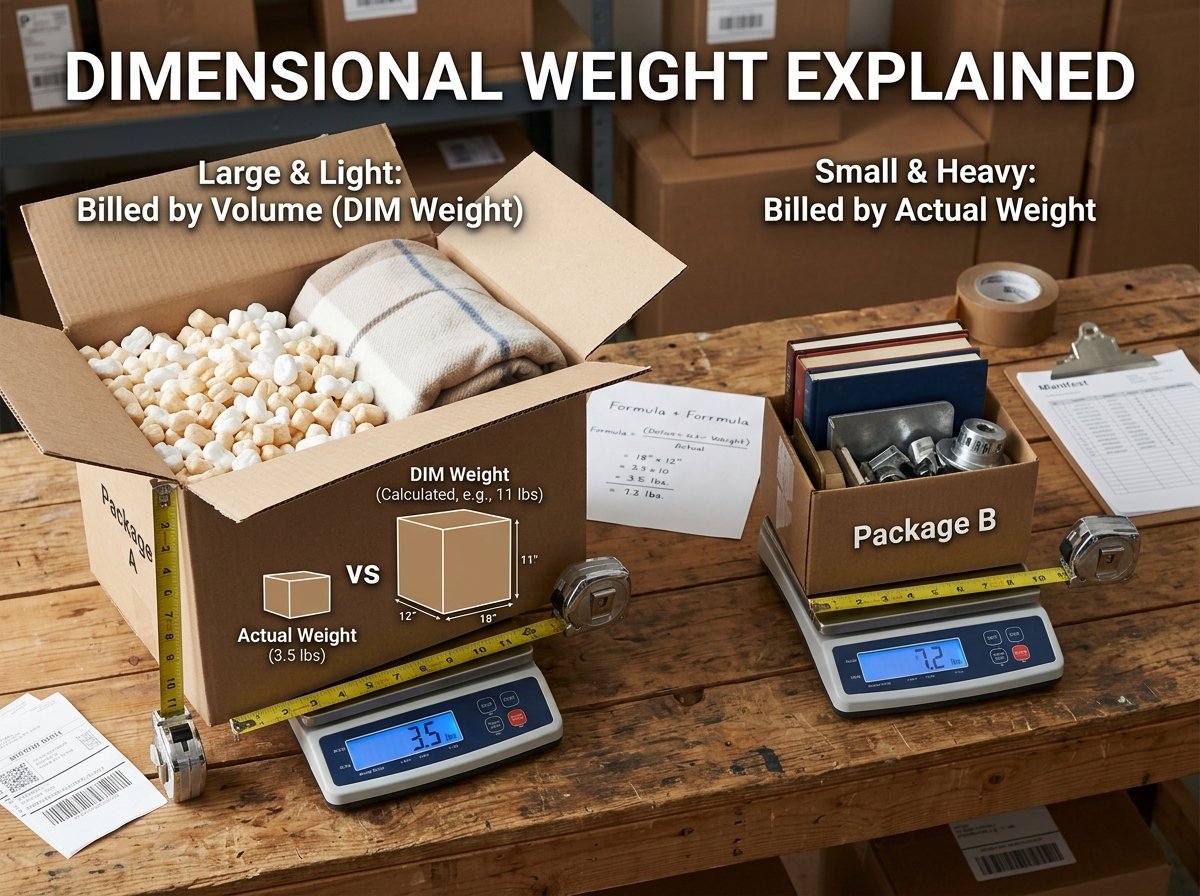
You packed a lightweight pillow into a big box, dropped it off at the courier office, and expected a tiny shipping bill. Then the agent told you a price that made your jaw drop. The box barely weighed a kilogram. So why did they charge you for 6 kilograms?
That’s dimensional weight doing its thing.
Most people only think about the actual weight of their package. But carriers like FedEx, DHL, UPS, and even postal services don’t just look at what the scale says. They also measure how much space your box takes up inside their truck or airplane. And if your package is big but light, they’ll charge you based on its size — not its weight.
This concept trips up first-time shippers, small business owners, and even experienced e-commerce sellers. If you’ve ever felt confused about why your shipping bill didn’t match your expectations, this article will clear everything up. You’ll learn exactly what dimensional weight is, how carriers calculate it, and — most importantly — how to use this knowledge to pay less.
Let’s get into it.
What Is Dimensional Weight, Exactly?
Dimensional weight (also called DIM weight or volumetric weight) is a pricing method that reflects the amount of space a package occupies relative to its actual weight.
Think of it this way. A courier’s delivery truck has limited space. If someone fills that truck with oversized boxes full of cotton balls, the truck runs out of room long before it reaches its weight capacity. The carrier still has to pay for fuel, the driver, and the route — but it’s hauling a truck full of air.
That’s bad business for the carrier. So they came up with dimensional weight to make sure they get fair compensation for the space your package uses — even if your box is feather-light.
Quick Fact: The concept of dimensional weight has been around since the 1950s in air freight. But it became mainstream for ground shipping in 2015, when UPS and FedEx started applying DIM weight pricing to ALL ground packages in the US — not just oversized ones.
The rule is simple: carriers compare your package’s actual weight to its dimensional weight, and they charge you whichever one is higher.
How Do Carriers Calculate Dimensional Weight?
The formula itself isn’t complicated. But every carrier uses a slightly different “divisor” number, so results vary depending on who you ship with.
Here’s the basic formula:
Dimensional Weight = (Length × Width × Height) ÷ DIM Divisor
All measurements are usually in centimeters (for international) or inches (for domestic US shipments). The DIM divisor changes based on the carrier and whether you’re shipping domestically or internationally.
Common DIM Divisors by Carrier (2025)
FedEx and UPS use a divisor of 5,000 for metric measurements (cm/kg) and 139 for imperial (inches/lbs) on most services. DHL Express also uses 5,000 for international shipments. Some economy or postal services use a more generous divisor like 6,000, which results in a lower dimensional weight.
If you’re curious about how shipping rates are actually calculated, it goes beyond just weight — distance, service type, fuel surcharges, and yes, dimensional weight all play a role.
A Real Example With Numbers
Let’s say you’re shipping a box that measures 50 cm × 40 cm × 30 cm, and the actual weight is 3 kg.
Step 1: Multiply the dimensions.
50 × 40 × 30 = 60,000 cubic centimeters
Step 2: Divide by the DIM divisor (let’s use 5,000).
60,000 ÷ 5,000 = 12 kg (dimensional weight)
Step 3: Compare.
Actual weight = 3 kg. Dimensional weight = 12 kg.
The carrier charges you for 12 kg — four times the actual weight of your package. That’s a massive difference, and this is exactly why so many people get surprised at the counter.
Another Quick Example
Now imagine a smaller, denser package: 20 cm × 15 cm × 10 cm, actual weight 4 kg.
20 × 15 × 10 = 3,000 cubic cm
3,000 ÷ 5,000 = 0.6 kg (dimensional weight)
Actual weight (4 kg) is higher, so the carrier charges you for 4 kg. In this case, dimensional weight doesn’t affect your price at all.
Pro Tip: Dimensional weight only hurts you when your package is large relative to its weight. Dense, compact packages almost always get charged by actual weight.
Why Do Carriers Use Dimensional Weight Pricing?
You might think this is just carriers being greedy. It’s not. There’s real logistics math behind it.
Every delivery vehicle — whether it’s a cargo plane, a delivery van, or a container ship — has two limits: how much weight it can carry and how much volume it can hold. These two limits rarely get maxed out at the same time.
If a plane fills up with giant, lightweight boxes, it runs out of space while it still has tons of weight capacity left. The airline is flying a half-loaded plane (by weight) but can’t fit a single extra box. That’s wasted potential revenue.
Dimensional weight pricing balances this out. It makes sure that whether your package is heavy or bulky, the carrier gets compensated fairly for the resources your shipment uses.
This also explains why air shipping costs more than ground shipping — space on an airplane is much more limited and expensive than space on a truck. So DIM weight hits even harder on air freight.
Which Shipments Get Hit Hardest by Dimensional Weight?
Not every package is equally affected. Some types of shipments almost always end up with a dimensional weight that’s way higher than their actual weight.
Clothing and textiles are classic examples. A box of t-shirts takes up a lot of room but doesn’t weigh much. Same goes for shoes and footwear — those shoeboxes create a lot of dead space. If you regularly ship shoes, understanding DIM weight can save you real money.
Home décor items like lampshades, cushions, and picture frames are another category. They need big boxes with lots of protective padding, which inflates the volume without adding much weight.
Electronics packaging is another culprit. A laptop or phone doesn’t weigh much, but once you add foam inserts, bubble wrap, and a sturdy outer box, the package dimensions grow significantly. If you’re shipping a mobile phone or laptop, this is definitely something to keep in mind.
Toys and games — especially those with unusual shapes — also tend to get hit hard. The box has to accommodate the awkward shape, leaving lots of empty space inside.
On the other hand, shipments that are heavy for their size — like books, metal parts, or bottles of wine — rarely get affected by dimensional weight. Their actual weight almost always exceeds the calculated DIM weight.
How to Reduce Dimensional Weight (And Pay Less)
This is the part you’ve been waiting for. You can’t change the carrier’s DIM divisor, but you absolutely can control how you pack your shipments. A few smart changes can make a noticeable difference in your shipping costs.
Choose the Right Box Size
This sounds obvious, but you’d be surprised how many people grab whatever box is nearby without thinking about fit. If your product is 20 cm tall, don’t put it in a 35 cm tall box and fill the rest with packing peanuts.
Use a box that fits your item snugly — with just enough room for protective padding. If you need help figuring out the ideal dimensions, there’s a solid guide on how to choose the right box size for different types of products.
Reduce Excess Packaging Material
Bubble wrap is your friend, but too much of it is your wallet’s enemy. Every extra layer of padding adds volume without adding protection beyond a point. Know how much bubble wrap you actually need — it’s less than most people think.
Consider Poly Mailers for Soft Goods
If you’re shipping clothing, scarves, or other soft items that don’t need rigid protection, skip the box entirely. Poly mailers or padded envelopes take up far less space, and many carriers calculate their dimensions differently (or don’t apply DIM weight at all for flat mailers).
Ship Multiple Items Together
Sometimes, combining two small shipments into one well-packed box is cheaper than sending them separately. The single box might have a higher dimensional weight than either individual package, but the total cost is often lower because you’re paying one shipping fee instead of two.
Vacuum Seal Where Possible
For items like clothing, bedding, or stuffed toys, vacuum-sealing can dramatically reduce the volume of your package. A vacuum-sealed bag of winter jackets takes up a fraction of the space compared to folding them loosely in a box.
Did You Know? Some e-commerce sellers have cut their shipping costs by 15–25% just by switching to better-fitting boxes and reducing unnecessary padding. That’s without negotiating rates or changing carriers.
Dimensional Weight for International Shipping
DIM weight becomes even more critical for international shipments. Why? Because international carriers — especially those using air freight — have tighter space constraints and higher per-kilogram rates.
Most international carriers (DHL, FedEx International, UPS Worldwide) use a 5,000 divisor for metric calculations. Some economy international services use 6,000, which is slightly more forgiving.
If you’re shipping personal belongings overseas — say, you’re moving abroad or relocating for work — DIM weight can significantly inflate your total cost. Packing efficiently becomes even more important.
One thing to watch out for with international shipping: some countries have specific weight and size limits for parcels. Even if you’re willing to pay the DIM weight charges, your package might get rejected if it exceeds maximum dimensions.
Dimensional Weight for E-Commerce Sellers
If you sell products online — whether on your own store, Amazon, eBay, or Etsy — dimensional weight directly affects your profit margins.
Let’s say you sell decorative throw pillows for $25 each. The pillow weighs 500 grams, but the shipping box measures 45 × 45 × 20 cm. That’s a dimensional weight of over 8 kg. If you’re offering free shipping (which most buyers now expect), that inflated shipping cost eats straight into your profit.
Smart sellers factor DIM weight into their product pricing from day one. Some even redesign their packaging to minimize dimensions. A few practical things that help:
Use branded poly mailers for soft products instead of boxes. Offer product bundles that justify a larger box while spreading the shipping cost across multiple items. Negotiate DIM divisors with your carrier — yes, this is possible. High-volume shippers can often get a more favorable divisor (like 6,000 or even 7,000 instead of 5,000) as part of their contract.
If you’re an Etsy seller figuring out your shipping strategy, this guide for Etsy sellers covers international shipping specifics that tie directly into DIM weight planning.
How Different Carriers Handle DIM Weight
Not all carriers calculate dimensional weight the same way, and knowing the differences can help you pick the cheapest option for a specific package.
FedEx
FedEx applies dimensional weight to all shipments — domestic and international — across all service levels (Express, Ground, Home Delivery). They use a divisor of 139 for inches/lbs and 5,000 for cm/kg. There’s no minimum package size threshold; even small packages get evaluated for DIM weight.
UPS
UPS follows almost the exact same rules as FedEx. Since 2015, they’ve applied DIM pricing to all ground packages. Their divisor matches FedEx at 139 (imperial) and 5,000 (metric).
DHL Express
DHL uses 5,000 as the standard divisor for international express shipments. For some DHL eCommerce solutions and economy products, the divisor can be more generous.
USPS (United States Postal Service)
Here’s where it gets interesting. USPS only applies dimensional weight pricing to Priority Mail packages that exceed 1 cubic foot (1,728 cubic inches). Packages smaller than that get charged by actual weight only. This makes USPS a great option for larger lightweight packages that fall under the threshold. They use a divisor of 166 — much more favorable than FedEx or UPS.
Royal Mail and Parcelforce
If you’re shipping from the UK, Royal Mail uses volumetric weight for international parcels and some domestic services. The divisor is 5,000 for metric measurements. Parcelforce follows a similar approach. If you’re deciding between these two, comparing Royal Mail and Parcelforce might be helpful.
Pro Tip: Always calculate dimensional weight for your package across multiple carriers before choosing one. A package that’s expensive with FedEx might be much cheaper with USPS or a regional carrier — just because of DIM weight differences.
How to Calculate DIM Weight Before You Ship
Don’t wait until you’re at the shipping counter to find out your dimensional weight. You can calculate it at home in under a minute.
What you need: A measuring tape and a calculator (or your phone).
Step 1: Measure the length, width, and height of your package in centimeters. Always measure the longest point on each side — including any bulges or irregular shapes.
Step 2: Multiply all three numbers together.
Step 3: Divide by the carrier’s DIM divisor (usually 5,000 for international, 6,000 for some economy services).
Step 4: Compare the result to your package’s actual weight. The bigger number is what you’ll be charged for.
Most carrier websites also have DIM weight calculators built into their rate estimation tools. FedEx, UPS, and DHL all offer free online calculators. If you’re comparing courier quotes from different providers, make sure the quoted rate reflects the DIM weight — not just the actual weight you entered.
Warning: Some online rate calculators default to actual weight only. If you don’t input your box dimensions, the quoted price might be lower than what you’ll actually pay. Always enter accurate dimensions.
The Business Impact: Why DIM Weight Matters Beyond One Shipment
If you ship one or two packages a year, DIM weight is a mild annoyance at most. But if you’re a business shipping dozens or hundreds of packages weekly, even a small improvement in dimensional efficiency adds up fast.
Consider this: if you reduce each package’s dimensional weight by just 2 kg on average, and you ship 200 packages a month, and the per-kg rate is $1.50 — that’s $300 saved every month. That’s $3,600 a year, just from better packaging.
Businesses that ship in bulk often negotiate custom DIM divisors with carriers. A divisor of 6,000 instead of 5,000 reduces your dimensional weight by about 17%. On large volumes, that translates to thousands of dollars in annual savings.
Some companies go further and hire packaging engineers to design custom boxes that minimize wasted space for each product SKU. That might sound extreme, but for high-volume shippers, the ROI is significant.
FAQ
What’s the difference between dimensional weight and actual weight?
Actual weight is what your package weighs on a scale. Dimensional weight is a calculated number based on your package’s length, width, and height divided by a standard divisor. Carriers compare both and charge you for whichever is higher. If your package is large but light, dimensional weight will usually be the billable weight.
Can I avoid dimensional weight charges?
You can’t avoid them completely — it’s standard practice across all major carriers now. But you can minimize the impact by using right-sized boxes, reducing excess packaging, and choosing carriers with more favorable DIM divisors (like USPS for eligible packages). Poly mailers and flat-rate options can also help you sidestep DIM weight on certain shipments.
Do all carriers use the same DIM divisor?
No. The divisor varies by carrier and service type. FedEx and UPS both use 5,000 (metric) for most services. USPS uses 166 (imperial), which is more generous. DHL uses 5,000 for express but may offer different divisors for economy services. Always check the specific carrier’s current DIM divisor before calculating — they can change these numbers, and contract customers often get custom divisors.
Does dimensional weight apply to flat-rate shipping?
No. If you use a flat-rate box or envelope (like USPS Flat Rate or some carrier-specific flat-rate products), the price is fixed regardless of weight or dimensions — as long as the item fits inside the designated box and doesn’t exceed the weight limit. Flat-rate options can be a smart workaround for heavy items that fit into smaller packaging.
How is dimensional weight different for air freight vs. ground shipping?
The DIM divisor for air freight is often lower (meaning the calculated dimensional weight is higher), because airplane cargo space is much more expensive than truck space. Historically, ground shipments used a higher divisor or didn’t have DIM pricing at all. Since 2015, most major carriers apply DIM weight to ground shipping too, but some services remain more lenient than air express.
Your Next Step
Dimensional weight isn’t going away. If anything, carriers are getting stricter about it as shipping volumes grow and cargo space becomes more competitive. The good news? Now that you understand how it works, you’re already ahead of most shippers.
Before your next shipment, take 60 seconds to measure your box, run the DIM weight calculation, and see if a smaller box could save you money. For business shippers, audit your top 10 most-shipped products and check whether your current packaging is costing you more than it should.
A little math upfront saves a lot of money over time. And honestly, once you start thinking in terms of dimensional weight, you’ll never look at an oversized box the same way again.