
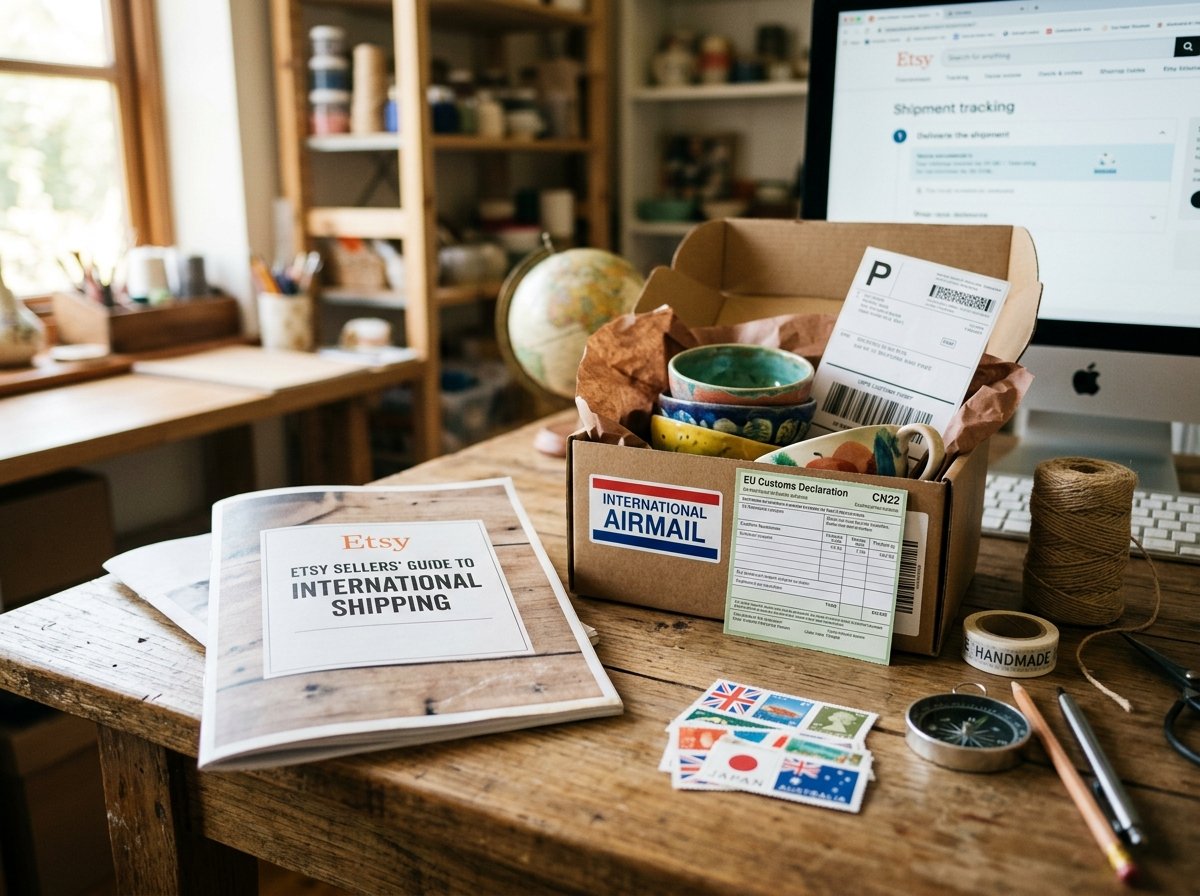
You made a sale. Someone in Germany just bought your handmade ceramic mug. Exciting, right? Then the panic sets in — How do I ship this? What about customs? Will it even arrive in one piece?
This is exactly where most Etsy sellers freeze. International shipping sounds complicated, and honestly, it can be — if you go in without a plan. But once you understand how it actually works, shipping globally stops feeling like a gamble and starts feeling like just another part of running your shop.
Whether you’re shipping handmade jewelry to Canada or vintage decor to Australia, this guide will walk you through everything — carriers, customs, pricing, packaging, and the little things that make the difference between a happy international customer and a nightmare refund request.
Setting Up International Shipping on Etsy: The Basics First
Before you print a single label, you need to get your Etsy shop settings right. This is where a lot of sellers lose money without realizing it.
Shipping Profiles — Don’t Skip This Step
Etsy lets you create shipping profiles that you can attach to multiple listings at once. Instead of entering shipping details for every single product, you set up a profile once and reuse it. If you’re selling 50 items and want to offer international shipping on all of them, a profile saves you hours.
Go to Shop Manager → Settings → Shipping Settings and create profiles by region — one for North America, one for Europe, one for the rest of the world. Each region has different rates, delivery times, and risk levels, so keeping them separate makes your pricing much cleaner.
Calculated Shipping vs. Fixed Prices
Etsy gives you two options: calculated shipping (where the cost is auto-calculated based on the buyer’s location and your package weight) or fixed prices (where you set a flat rate).
Calculated shipping is almost always better for international orders. Flat rates are tricky — charge too little and you eat the loss, charge too much and buyers abandon their cart. If you’re unsure how shipping rates actually get determined, it helps to understand how shipping rates are calculated before you set anything in stone.
For calculated shipping to work accurately, you must enter the correct weight and dimensions of your packaged item — not just the product itself. A ring weighs almost nothing, but the box, tissue paper, and padding add up.
Choosing the Right Carrier for International Etsy Orders
This is probably the question sellers ask most: Which carrier should I use?
There’s no single right answer. It depends on your product, destination country, budget, and how fast your buyer expects delivery.
USPS (For US-Based Sellers)
For sellers in the United States, USPS First Class Package International is often the most affordable option for small, lightweight items under 4 lbs. It’s slow — typically 2 to 6 weeks depending on the destination — but the cost is hard to beat for handmade goods where margins are tight.
USPS Priority Mail International is faster (6–10 business days) and includes up to $200 in insurance, which matters if you’re shipping anything valuable.
The downside? USPS tracking internationally is spotty. Once a package leaves the US, tracking updates can disappear for weeks. This leads to anxious buyers sending you “where’s my order?” messages constantly.
UPS and FedEx
These carriers are faster and have more reliable international tracking, but they cost significantly more. They also charge brokerage fees for customs clearance in some countries — fees that can surprise your buyer and leave them with a bad taste in their mouth.
If you’re choosing between the two for a specific route, a proper DHL vs FedEx international shipping comparison can help you figure out which one actually makes sense for your shipment.
DHL Express
For Etsy sellers shipping higher-value items or time-sensitive orders, DHL Express is worth the extra cost. They have excellent tracking, fast delivery (typically 2–5 business days internationally), and a strong customs clearance network. If a buyer is paying $80+ for a handmade item, they probably expect something better than a 6-week mystery journey.
Royal Mail (For UK-Based Sellers)
UK sellers have a solid option with Royal Mail International Tracked. It’s reasonably priced, offers decent tracking to major destinations, and integrates well with Etsy’s shipping tools. For bulkier items, comparing Royal Mail vs Parcelforce is worth your time — Parcelforce often wins on reliability for heavier packages.
Understanding Customs: The Part Everyone Avoids
Let’s be honest — customs is where most Etsy sellers feel completely lost. It’s also where most international shipping problems actually start.
What Is a Customs Declaration?
Every international package needs a customs declaration form — a document that tells the destination country what’s inside, what it’s made of, and what it’s worth. If you ship through Etsy’s postage purchase system, you’ll fill this out as part of buying the label.
You’ll need to provide:
- A clear description of the item (not “gift” or “handmade goods” — be specific, like “ceramic coffee mug, handmade”)
- The HS code (Harmonized System code) — a standardized number that classifies your product for customs purposes
- The declared value (what the buyer paid)
- Country of origin
Pro Tip: Never undervalue packages to help buyers avoid import taxes. It’s customs fraud, and if caught, your package gets seized and your shop’s reputation takes a hit. It’s not worth it.
HS Codes — What They Are and Why They Matter
HS codes sound technical, but they’re just categories. Handmade soap is different from jewelry, which is different from printed art — and customs authorities use these codes to know what duties to apply.
You can find the right HS code using the World Customs Organization database or your carrier’s online tool. Etsy’s label purchase flow will ask for this when shipping to certain countries.
Who Pays Import Duties and Taxes?
Your buyer does — unless you’ve explicitly offered Delivery Duty Paid (DDP) shipping, which means you collect duties upfront. Most Etsy sellers don’t do this, and that’s fine. But you must mention in your shop policies that the buyer is responsible for any import fees in their country.
This matters especially for EU buyers. Since July 2021, the EU removed the duty-free threshold for packages under €22. Every package entering the EU now potentially has VAT applied. Etsy collects and remits VAT for orders going to many EU countries, but not all — check Etsy’s tax page for the current list.
Pricing Your International Shipping Without Losing Money
Underpriced shipping is one of the biggest reasons Etsy sellers struggle with profitability on international orders. It’s almost always a silent killer — you’re so excited about a sale that you don’t realize you just lost $4 on it.
The Real Cost of International Shipping
The price on the label isn’t the only cost. You also have:
- Packaging materials (boxes, bubble wrap, tissue paper, tape)
- Time spent packing and queuing at the post office
- Insurance (if you add it)
- Currency conversion fees if you’re paid in a foreign currency
Add these up before you set your shipping price. Understanding dimensional weight pricing is also crucial — carriers often charge based on the size of your box, not just its actual weight. A large lightweight item (like a handmade wall hanging) can cost far more to ship than you’d expect.
Should You Offer Free International Shipping?
Free shipping can boost your Etsy search ranking, but for international orders, it’s usually a bad idea unless you’ve baked the cost into your product price. A $30 ceramic mug with $18 international shipping doesn’t sell well, but a $45 mug with “free shipping” might — as long as your margins still work.
The cleaner approach: charge accurate shipping separately, and make sure your shop policies explain why international rates differ. Most buyers understand this.
Economy vs. Express — Giving Buyers a Choice
One smart thing many successful Etsy sellers do is offer two shipping tiers — a slower, affordable option and a faster premium one. This works especially well during gifting seasons when someone needs something by a specific date.
If you want to understand the trade-offs clearly before building your pricing, reading about economy vs express international shipping will give you a solid foundation.
Packaging for International Shipments: Don’t Cut Corners
International packages go through more handling than domestic ones. They get scanned, sorted, loaded onto aircraft, transferred between facilities, and sometimes sit in customs warehouses for days. Your packaging needs to survive all of that.
What “Good Enough” Packaging Actually Looks Like
For fragile items — ceramics, glass, enamelware — double-boxing is not overkill, it’s standard. The inner box holds the item, padded on all sides. The outer box gives a buffer against impacts. If you’re new to this, understanding how much bubble wrap you actually need is more useful than you’d think.
For flat items like prints, artwork, or cards — use rigid mailers or sandwich the item between two pieces of corrugated cardboard. “Do not bend” stickers help, but they don’t guarantee anything.
Jewelry and small valuables need special attention — not just for protection but for customs scrutiny. See how to ship jewelry and valuables for a proper breakdown.
Labeling Your Package Correctly
Your shipping label must be clearly visible and securely attached — ideally in a clear pouch, not taped over directly (ink smears, tape peels in humidity). Write the full address including the country name in English, the ZIP/postal code, and your return address.
If you’re shipping to a country with a different script (Japan, Korea, UAE), include both the local-language address provided by the buyer and a transliterated English version. Carriers and customs agents need to read it.
Warning: Never put customs declaration documents inside the package. They go in a clear pouch on the outside, or they’re attached electronically when you use carrier-provided labels.
Managing Customer Expectations and Communication
International shipping delays happen. Packages sit in customs. Weather disrupts flights. Buyers who understand this upfront are far more patient than buyers who were promised 7-day delivery and are now at day 19.
Set Realistic Processing and Delivery Times
In your Etsy listings, be honest about your processing time (how long it takes you to make and pack the item) and your estimated delivery window for each region. Add buffer days — especially for countries with slower postal services like Brazil, Mexico, or parts of Southeast Asia.
What to Do When a Package Goes Missing
If tracking shows no movement for 2+ weeks, first check if it’s stuck in customs — this is the most common reason. Ask the buyer to check with their local post office or customs facility. Sometimes packages are held there for duties without any notification being sent.
If it’s genuinely lost, you’ll need to file a claim with the carrier. Knowing how to file a claim for a lost package before it happens saves you a lot of panic in the moment.
For packages marked delivered but not actually received — this is a different issue, and it’s more common than sellers expect. There’s a clear process to follow when a package is marked delivered but hasn’t arrived.
Should You Offer Insurance?
For orders over $50, yes — absolutely. Carrier-included insurance has limits (USPS First Class International, for example, offers no insurance at all). Third-party insurance through services like InsureShip or ShipSurance is affordable and gives you actual protection. For Etsy sellers shipping handmade or vintage items, this isn’t a luxury — it’s basic risk management.
Etsy’s Global Shipping Program (and Whether It’s Worth It)
Etsy offers something called the Etsy Purchase Protection Program, and they’ve expanded their tools to make international selling easier — but their Global Shipping Program (now evolved into Etsy’s managed shipping features) isn’t available in all regions and doesn’t cover all scenarios.
The idea is that Etsy handles the customs paperwork and international leg of the shipping on your behalf. You ship to a domestic hub, and they take it from there. It simplifies things but also reduces your control over the customer experience.
For sellers just starting with international orders, it’s a reasonable stepping stone. For sellers with established international volume and specific carrier preferences, doing it yourself with calculated shipping profiles gives you more flexibility and often better rates.
Countries and Restrictions to Know
Some countries have strict import rules, and some items are simply not shippable everywhere. Before accepting orders from a new country, spend two minutes checking their restrictions.
Common problem areas:
- Australia has very tight biosecurity laws — no wooden products without treatment, no seeds, no organic materials that could carry pests. Check shipping restrictions to Australia before you ship anything that could fall into a grey area.
- Brazil has high customs duties and slow clearance — delays of 4–8 weeks are common.
- Russia and Belarus — many carriers have suspended or severely restricted services since 2022.
- Saudi Arabia and other Gulf countries — certain items (alcohol-themed decor, some art) may be refused on cultural/religious grounds.
Also, certain product categories have restrictions regardless of destination — things like items with lithium batteries, certain dyes, or plant-based materials. A quick check on items banned from international shipping can save you a returned or seized shipment.
FAQ
Q: Do I need to charge sales tax on international Etsy orders?
Generally, no — international orders aren’t subject to US state sales tax. However, destination-country VAT or GST may apply, and in many cases Etsy collects and remits this automatically. For countries where Etsy doesn’t handle this, the tax responsibility falls on the buyer, not you. Always state this clearly in your shop policies.
Q: What happens if a buyer refuses to pay customs duties and the package is returned to me?
This happens more than sellers expect. If a package is returned due to refused customs fees, you’re typically responsible for the return shipping cost (if the carrier charges it) and the original postage is not refunded. To protect yourself, state clearly in your listings and shop policies that buyers are responsible for all import fees. You can then decide whether to offer a partial refund (minus shipping) or require the buyer to pay shipping again for a reship.
Q: Can I use Etsy’s built-in postage for international shipments?
Yes, for US sellers, Etsy integrates with USPS and some partner carriers to let you purchase international postage directly from Shop Manager. You’ll get a discounted rate compared to walking into the post office. However, Etsy’s carrier options are limited — for DHL, FedEx, or other carriers, you’ll need to use a third-party platform like Pirateship, ShipStation, or the carrier’s own website, and then mark the order as shipped manually in Etsy.
Q: How do I handle returns from international buyers?
International returns are expensive and complicated. Most experienced Etsy sellers have a “returns not accepted for international orders” policy, instead offering store credit or refunds for genuine issues. If you do accept returns, clarify who pays return shipping upfront. For a fuller picture on managing this, the guide on how to handle returns for an online business covers the options clearly.
Ready to Ship Globally?
International shipping has a learning curve — but it’s not steep. The sellers who do it well aren’t necessarily the most experienced; they’re just the ones who took the time to set things up properly before their first order shipped.
Get your shipping profiles right. Know your carrier options. Be transparent about customs fees. Pack like your item is going to survive a rough journey — because it is. And communicate with your buyers like a human being, not a policy document.
The global market is massive. Someone in Denmark, Japan, or New Zealand is already looking for exactly what you make. The only thing standing between you and that sale is knowing how to get it there safely.
That part, you’ve got covered now.