
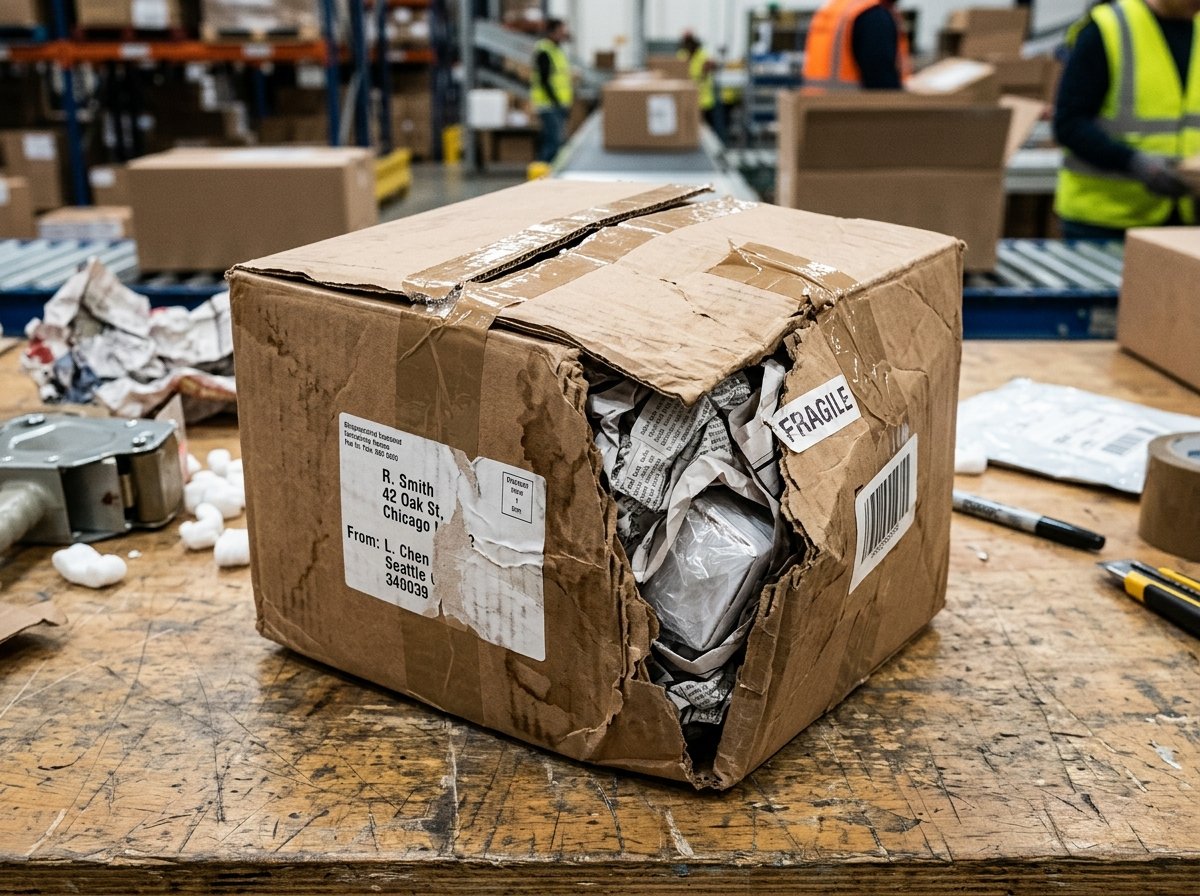
Almost one in ten packages shipped globally arrives with some form of damage. That’s not just an unlucky courier toss or a rough customs check — most of the time, the real problem started before the box even left your hands.
Think about it. You’ve carefully picked the right product, maybe it’s a gift for someone special, a product you sold on your online store, or personal belongings you’re moving overseas. You pack it up, drop it off, and expect it to arrive perfectly. But when the recipient opens it? Cracked edges. Dented corners. A shattered screen. Something that was perfectly fine when you sealed it is now ruined.
The frustrating part? Almost all of this damage is preventable. The culprit isn’t always the courier — it’s the packaging itself. Small mistakes, the kind you don’t think twice about, can turn a smooth delivery into a disaster.
This article breaks down the most common packaging mistakes people make, explains exactly why each one causes damage, and gives you straightforward fixes. Whether you’re shipping a single birthday gift or running an e-commerce business with hundreds of daily orders, these mistakes apply to you.
Choosing the Wrong Box Size
This is the single most common packaging mistake, and honestly, most people don’t even realize they’re making it. They grab whatever box is lying around — maybe the Amazon box from last week’s delivery — stuff the item in, and call it a day.
Here’s why this wrecks your parcel: if the box is too big, your item has room to slide, bounce, and slam into the walls during transit. Every bump the delivery truck hits, every conveyor belt transition at the sorting facility, your product is essentially rattling around like a marble in a shoebox.
On the flip side, a box that’s too small creates outward pressure on the walls. The cardboard is already strained before the package even moves. Stack a few heavy parcels on top during transit, and the box collapses, crushes, or splits open at the seams.
The fix is simple: your item should have roughly 2–3 inches of clearance on all sides inside the box. That space is for cushioning material, not air. If you’re unsure about sizing, check out this guide on how to choose the right box size — it covers dimensions for different types of items.
Pro Tip: If you ship regularly, keep 3–4 standard box sizes on hand. It saves you from the “grab whatever fits” habit that leads to most sizing mistakes.
Skimping on Cushioning Material
You could have the perfect box, but if there’s nothing protecting your item inside it, damage is almost guaranteed. A lot of people use a single layer of newspaper or a few handfuls of packing peanuts and assume that’s enough. It’s not.
Here’s what happens during shipping that most people don’t picture: your parcel doesn’t just sit on a shelf. It’s loaded, stacked, moved across conveyor belts, loaded again into a different vehicle, possibly tossed short distances, and sometimes dropped from waist height. That’s a lot of impact events for one journey.
What good cushioning actually does is absorb shock. It creates a “suspension” system inside the box so the item doesn’t take the direct hit — the cushioning material does.
The most effective approach involves wrapping the item individually first, then filling the remaining space so nothing shifts when you shake the box. Yes, the shake test is real — pick up the sealed box and give it a firm shake. If you hear or feel movement inside, you need more fill.
Bubble wrap works great for fragile items. Crumpled kraft paper is surprisingly effective for medium-weight goods. Foam inserts are ideal if you’re shipping the same product repeatedly, like in an e-commerce setting.
Not sure how much wrapping material you actually need? This piece on how much bubble wrap you need for shipping gives you practical measurements based on item type and fragility.
Did You Know? According to packaging industry data, proper cushioning alone can reduce transit damage by up to 40%. That’s a huge number for something that takes two extra minutes.
Using Old, Worn-Out, or Recycled Boxes Incorrectly
Look, there’s nothing wrong with reusing boxes. It’s environmentally responsible, and it saves money. But there’s a right way and a very wrong way to do it.
A box that’s already been shipped once has already absorbed humidity, handled compression stress, and been through the structural beating of transit. Its corrugated walls are weaker. The flaps don’t seal as tightly. The corners may have soft spots you can’t see from outside.
If you’re going to reuse a box, inspect it carefully. Press the walls — do they feel firm, or do they bend easily? Check the corners and edges for tears, creases, or moisture damage. Look at the flaps — do they close flat, or are they warped?
Here’s a rule of thumb: if the box has more than one previous shipping label on it, it’s probably been through too many journeys. Use it for storage at home, not for shipping something valuable.
Also, remove all old labels, barcodes, and stickers. Leftover shipping labels confuse automated sorting machines at courier facilities. Your package could end up routed to the wrong destination or flagged for manual inspection, adding handling time and increasing damage risk.
If you’re looking for alternatives to reusing old boxes, there are some excellent eco-friendly packaging options that are both sturdy and sustainable.
Ignoring How Weight Is Distributed Inside the Box
This one flies under the radar constantly. People put heavy items on one side and light items on the other, or they place a dense object on top of a fragile one inside the same box.
Weight distribution matters because of how packages are handled in transit. They get flipped, tilted, stacked, and repositioned multiple times. If the heavy stuff is all on one side, the box becomes unbalanced. An unbalanced box tips over more easily, and it puts uneven stress on the cardboard walls — which means one side is far more likely to cave in or tear.
For multiple items in one box:
Always place the heaviest item at the bottom, centered. Lighter items go on top. Each item should be individually wrapped and separated from the others. Don’t let two hard surfaces touch directly — even two books can scuff each other’s covers if they rub together over a long journey.
If you’re packing irregularly shaped things — like car parts and auto accessories or electronics — pay extra attention here. Odd shapes shift unpredictably unless firmly secured with cushioning on all sides.
Sealing the Box Poorly
You’d be surprised how many damaged parcels trace back to bad taping. People use a single strip of packing tape across the top, or worse, they use masking tape, duct tape, or cellophane tape — none of which are designed for shipping.
Regular masking tape doesn’t stick well to cardboard under humidity or temperature changes. Duct tape, despite its reputation, can peel off during extended transit, especially in warm weather. Cellophane tape is too narrow and too weak to hold box flaps under any real stress.
The right tape is pressure-sensitive packing tape (the clear or brown kind, at least 2 inches wide) or reinforced gummed tape for heavier shipments. And taping technique matters just as much as tape type.
Use the H-taping method: one strip along the center seam of the flaps, then one strip along each edge seam where the flaps meet the box sides. This distributes stress across three tape lines instead of one, dramatically reducing the chance of the box popping open.
Pay equal attention to the bottom of the box. In fact, the bottom seam takes more stress than the top because it supports all the weight. If you only tape the top well and ignore the bottom, don’t be surprised when your parcel arrives with the bottom blown out and items missing.
Warning: Never rely on staples or string to seal a shipping box. Staples tear through corrugated cardboard under pressure, and string can catch on conveyor belts at sorting facilities, causing your package to get jammed, torn, or rerouted.
Overlooking Fragile Item Protection
Saying “handle with care” on a box is not a packaging strategy. Sorry, but it’s true. Those labels and stickers can help, but carriers handle thousands of parcels daily. Your box will be treated like every other box in the system — stacked, sorted by machines, loaded by workers with time pressure. A fragile sticker might earn a gentle hand during the last mile delivery, but it won’t protect your item during the other 95% of the journey.
Real protection for fragile items means structural defense inside the box. That means:
Wrapping each fragile piece individually with bubble wrap or foam sheets. Using dividers or cardboard inserts between items (think about how wine bottles are shipped — each one gets its own slot). Filling every gap so the item literally cannot move.
If you’re shipping something like electronics — say, a mobile phone or laptop — the item needs to be suspended away from the box walls. One direct impact to a box corner shouldn’t transfer to your device. That’s what corner protectors and double-boxing achieve.
Double-boxing is exactly what it sounds like: place your wrapped item in a smaller inner box, cushion that inner box, then place it inside a larger outer box with more cushioning around it. This creates two layers of protection and is the gold standard for anything truly fragile or valuable.
For high-value items like jewelry and valuables, double-boxing plus insurance is really the only responsible approach.
Not Considering the Shipping Environment
Here’s something most people never think about: your parcel doesn’t travel in a climate-controlled environment. Delivery trucks get hot in summer. Cargo holds in aircraft can get extremely cold. Warehouses and sorting centers vary in temperature and humidity. And if you’re shipping internationally, your package might go from a tropical climate to a cold one — or vice versa — within 48 hours.
Moisture is the sneaky destroyer. Cardboard absorbs humidity. When it does, it loses structural strength. A box that felt rock-solid when you packed it in your dry, air-conditioned room might turn soft and saggy after sitting in a humid warehouse for a day.
For moisture-sensitive items, use a plastic liner inside the box. You can wrap the item in a simple plastic bag before cushioning it. This adds a waterproof barrier that costs almost nothing but prevents a huge percentage of moisture-related damage.
Temperature-sensitive products like cosmetics and skincare or even chocolates and candles need special consideration. Insulated liners, gel packs, and thermal bubble wrap exist specifically for this. If you’re shipping something that melts, freezes, or degrades with temperature swings, standard packing isn’t enough.
Quick Fact: International shipments typically go through 8–15 handling points between pickup and delivery. Each one is a potential exposure to different environmental conditions.
Getting the Label and Documentation Wrong
This isn’t a “packaging” mistake in the traditional sense, but it causes just as much damage — sometimes more. A wrong address, a missing customs form, or an unreadable label can send your parcel on a detour that adds days or weeks to transit time. And every extra day in the shipping system is another day of handling, stacking, and environmental exposure.
Smudged labels are a common problem. Inkjet-printed labels can bleed when exposed to rain or humidity. If the barcode becomes unreadable, your parcel gets pulled for manual sorting — meaning more human handling and a higher chance of misrouting.
Practical fixes:
Use a laser printer for labels when possible, or cover inkjet labels with clear tape. Place the label on the largest flat surface of the box, away from seams and edges. Include a duplicate label or address card inside the box. For international shipments, make sure customs declarations are accurate and complete — incorrect declarations can get your parcel held, opened for inspection, or returned.
If you’re shipping internationally for the first time, understanding how shipping rates are calculated helps you fill out documentation correctly, especially weight and dimension declarations that affect customs processing.
Underestimating Dimensional Weight
You packed your parcel beautifully. Perfect box, great cushioning, sealed like a pro. But you used a box that’s way bigger than necessary because you “wanted extra protection.” Now you’re paying for size, not just weight — and worse, that oversized box becomes a target for damage.
Carriers use dimensional weight pricing, which means they charge based on the size of your box if it takes up more space than its actual weight justifies. A large, lightweight box gets stacked under heavier parcels because handlers and machines see it as a light package. But the oversized cardboard walls aren’t built to support the heavy box sitting on top.
So you end up paying more AND increasing the chance of crushing damage. It’s a lose-lose situation.
Learn how dimensional weight works so you can pick boxes that keep costs down while maintaining structural integrity.
Forgetting to Match the Box to What’s Inside
Not all boxes are created equal. There’s single-wall corrugated, double-wall corrugated, and even triple-wall for extremely heavy items. Using a thin single-wall box for a 15-kilogram item is asking for trouble.
Similarly, the type of product dictates the type of packaging. Liquids need leak-proof containers inside the box. Items with sharp edges need extra cardboard reinforcement so they don’t poke through. Long or oddly shaped objects — like musical instruments or artwork and paintings — need specialty packaging or custom solutions.
A helpful guide on the best boxes for different shipments breaks down exactly which box type matches which product category. It’s worth a read if you’re shipping anything beyond basic clothing or books.
What to Do When Damage Happens Despite Good Packaging
Even with perfect packaging, there’s always a small chance of damage. Maybe your parcel was in a truck accident. Maybe it sat in a flooded warehouse. Things happen that are genuinely beyond your control.
That’s why shipping insurance exists. For anything worth more than a trivial amount, adding insurance for your shipped packages is smart. Most carriers offer basic coverage, but it’s usually limited. Third-party insurance or declared-value coverage gives you actual financial protection.
If your parcel does arrive damaged, document everything immediately — photos of the box exterior, the interior packing, and the damaged item. If it’s a carrier issue, you’ll need to file a claim for a lost or damaged package, and having clear photos speeds up the process enormously.
FAQ Section
Q: Does writing “FRAGILE” on the box actually help prevent damage?
A: It can remind the delivery person to handle your box gently during the final delivery, but it won’t protect your parcel during automated sorting or warehouse stacking. Machines don’t read fragile stickers. Your real protection always comes from what’s inside the box — proper cushioning, a right-sized box, and secure sealing.
Q: Can I use any tape to seal my shipping box?
A: No. Masking tape, cellophane tape, and even standard duct tape aren’t reliable for shipping. Use pressure-sensitive packing tape that’s at least 2 inches wide, or reinforced gummed paper tape for heavy boxes. Apply it using the H-taping method — center seam plus both side seams — on both top and bottom.
Q: Is double-boxing really necessary, or is it overkill?
A: For everyday items like clothing, books, or non-fragile goods, single boxing with proper cushioning is fine. But for electronics, glassware, ceramics, jewelry, or anything that costs more than you’d want to replace, double-boxing is absolutely worth the small extra effort and cost. It creates a cushioned air gap that absorbs impacts before they reach your item.
Q: How do I know if my recycled box is still strong enough for shipping?
A: Do the squeeze test — press firmly on each wall and corner. If the cardboard compresses easily or feels soft, it’s too weak. Check for moisture stains, rips at the seams, and warped flaps. If the box has been shipped more than once already, it’s safer to use a fresh one, especially for anything fragile or heavy.
Q: What’s the biggest packaging mistake for e-commerce sellers specifically?
A: Using one box size for every product. E-commerce sellers who buy boxes in bulk often force-fit different products into the same size, leading to either over-packing (wasted space, higher costs, crushing risk) or under-packing (items shifting, no cushioning room). Stocking 3–4 box sizes based on your product range solves this instantly.
Your Next Step
Every parcel you send represents something — your money, someone’s gift, a customer’s order, maybe your entire business reputation. The gap between a parcel that arrives perfectly and one that arrives destroyed usually comes down to five or ten minutes of careful packing.
You don’t need expensive equipment or professional training. You need the right-sized box, enough cushioning so nothing shifts, proper tape applied in the right places, and a weatherproof label. That’s genuinely it for 90% of shipments.
Next time you’re about to seal a box, try the shake test. Pick it up, give it a good shake. If anything moves inside, open it back up and add more fill. That one simple habit will save you more headaches than you’d believe. Your parcels — and the people receiving them — deserve that extra minute of attention.