
A cracked guitar neck. A dented saxophone bell. A piano with busted hammers. Every year, thousands of musicians receive their beloved instruments in pieces — not because the courier was careless, but because the sender didn’t pack them right.
Musical instruments aren’t just “things.” For many people, they’re an extension of who they are. A grandfather’s violin, a touring musician’s keyboard, a student’s first cello — these carry emotional and financial weight that a standard cardboard box simply can’t protect on its own.
So if you’re about to ship a musical instrument — whether you sold it online, you’re moving to another city, or you’re sending a gift — you need to do it properly. Not “hope for the best” properly. Actually properly.
This guide walks you through every step: from choosing the right packaging materials to picking the best shipping method, handling customs for international shipments, and insuring your instrument against damage. Let’s get into it.
Why Shipping Musical Instruments Is Trickier Than Most Items
You might think, “It’s just a box and some bubble wrap, right?” Not quite.
Musical instruments are uniquely challenging to ship for a few reasons. They’re often irregularly shaped — think about the curves of a violin, the length of a trombone, or the sheer size of a cello. Standard boxes don’t fit them well, and empty space inside a box is the enemy during transit.
They’re also sensitive to temperature and humidity changes. Wood expands and contracts. Strings lose tension. Brass can tarnish. A guitar that leaves your house perfectly tuned can arrive with a warped neck if it sits in a hot delivery truck for too long.
And then there’s the fragility factor. Thin wood panels, delicate keys, exposed tuning pegs, reeds, bridges — instruments have dozens of vulnerable parts that can snap, crack, or bend with one rough toss during sorting.
This is exactly why you can’t treat instrument shipping like shipping a pair of sneakers. If you want to understand how fragile item shipping differs from everyday parcels, the guide on common packaging mistakes that damage parcels is worth a read.
Step-by-Step: How to Pack Musical Instruments for Shipping
Packing is where 90% of the protection happens. Get this right, and your instrument will survive almost anything the courier throws at it — literally.
Start With the Case (If You Have One)
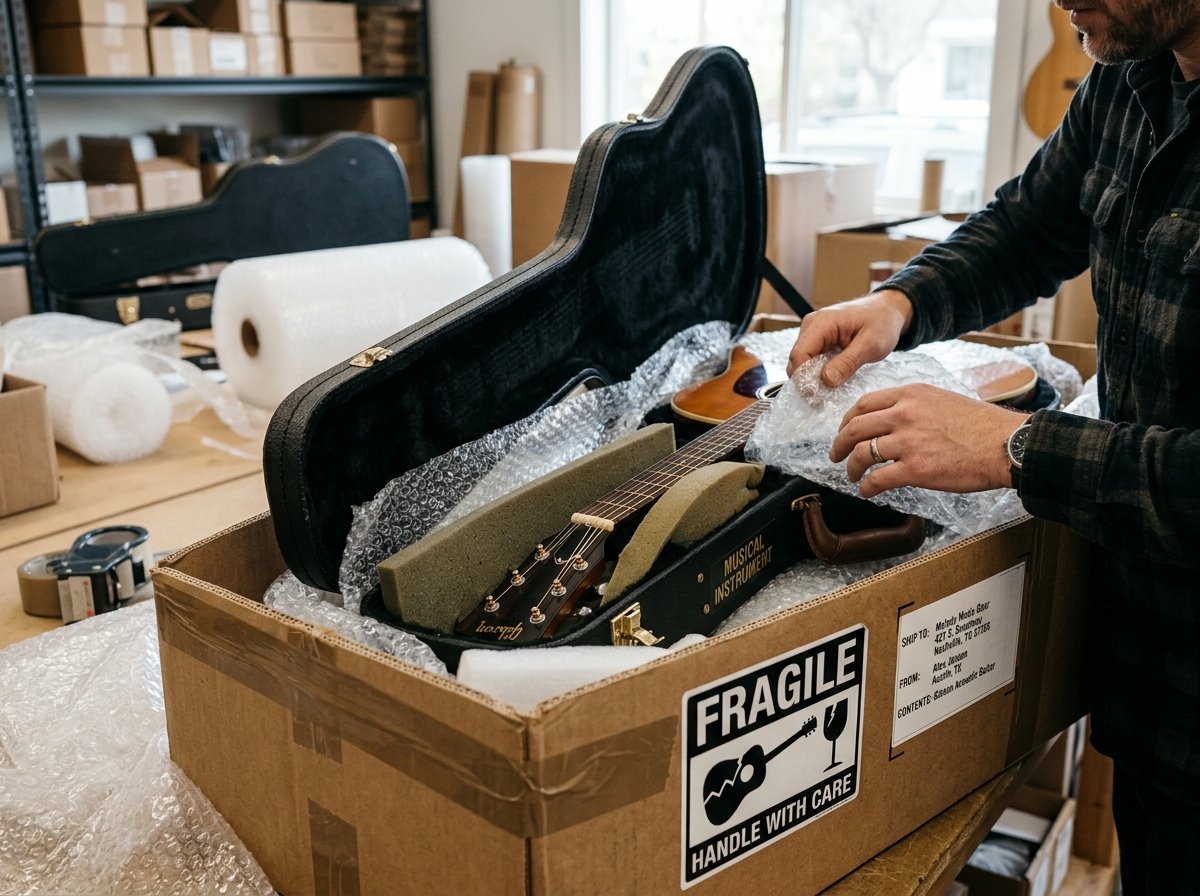
If your instrument came with a hard case, use it. Always. A hardshell case is your first and strongest line of defense. Soft gig bags offer minimal protection during shipping — they’re designed for carrying, not for being tossed around in a warehouse.
Don’t have a hard case? You can often buy one secondhand or rent one for shipping purposes. For guitars, a basic hardshell case costs between $50–$100 and is absolutely worth it compared to replacing a broken instrument worth ten times that amount.
Before you close the case, make sure the instrument doesn’t move inside it. If there’s any gap between the instrument and the case walls, fill it with soft materials — rolled-up t-shirts, foam padding, or acid-free tissue paper. The goal is zero movement.
Loosen the Strings
This is something many first-timers skip, and it’s a costly mistake. On stringed instruments like guitars, violins, cellos, and basses, the strings create constant tension on the neck. During shipping, temperature changes and vibrations can warp or even crack the neck if the strings are taut.
You don’t need to remove the strings entirely. Just detune them by two or three steps so the tension drops significantly. This small step can save you from a very expensive repair.
Protect the Vulnerable Parts
Every instrument has its weak spots. Here’s how to handle them:
For guitars and string instruments: Wrap the headstock (the top part where tuning pegs are) in bubble wrap separately. This area is the most common break point. Place a piece of cardboard between the strings and the fretboard to prevent imprints. If the bridge is removable, take it off and pack it separately.
For brass instruments (trumpets, saxophones, trombones): Remove the mouthpiece and any detachable slides. Wrap each piece individually. The bell (the flared open end) dents incredibly easily — stuff it gently with packing paper from the inside, then wrap the outside.
For keyboards and pianos: If it’s a portable keyboard, wrap it in a thick moving blanket first, then bubble wrap. Protect the keys by placing a layer of foam or cardboard over them. For digital pianos, remove the stand and pedals, packing each component separately.
For drums: Remove the drumheads if possible. Pack hardware (stands, pedals) separately from shells. Nest smaller drums inside larger ones with padding between them.
For woodwinds (flutes, clarinets, oboes): Disassemble into sections. Wrap each section individually in soft cloth first (to prevent scratching), then bubble wrap. Pay special attention to keys and pads — they bend easily.
Choose the Right Box
Your box should be at least 3–4 inches larger than the case or wrapped instrument on every side. That extra space is for cushioning material, not emptiness.
If you’re wondering which box type works best for oddly shaped items, the guide on how to choose the right box size breaks it down really well.
For large instruments like cellos or double basses, you might need custom crating. Some shipping stores and luthiers offer custom wooden crates built to the exact dimensions of your instrument. Yes, it’s pricier, but for an instrument worth thousands, it’s a no-brainer.
Layer Your Cushioning
Here’s the order that works best:
Put a 3-inch layer of packing peanuts or crumpled paper at the bottom of the box. Place the cased or wrapped instrument on top. Fill all remaining gaps with more cushioning — sides, top, everywhere. The instrument shouldn’t shift at all when you gently shake the box.
Pro Tip: Do the shake test before sealing. Pick up the box and give it a moderate shake. If you feel anything moving inside, add more padding. If nothing moves, you’re good.
Wondering how much protective material you actually need? Check out this practical guide on how much bubble wrap you need — it’s surprisingly helpful for oddly shaped items like instruments.
Seal and Label Properly
Use heavy-duty packing tape — not masking tape, not duct tape. Apply it along every seam and edge of the box. Then add these labels clearly:
FRAGILE — MUSICAL INSTRUMENT — THIS SIDE UP
Write it in big, bold letters on at least three sides of the box. Some couriers offer fragile stickers, but writing it yourself as a backup never hurts.
Choosing the Right Shipping Method
Packing is half the battle. The other half is choosing how you’re actually going to send it.
Courier Services vs. Freight Shipping
For most instruments (guitars, violins, trumpets, keyboards), standard courier services like FedEx, UPS, DHL, or USPS work fine — as long as the package falls within their size and weight limits. Most couriers accept packages up to 150 lbs and 108 inches in combined length and girth.
For oversized instruments like upright pianos, harps, or drum kits, you’ll need freight shipping. Freight carriers handle larger, heavier shipments on pallets. Companies like FreightPros, uShip, and R+L Carriers specialize in this.
Quick comparison:
A guitar in a hardshell case typically costs $50–$150 to ship domestically via courier, depending on distance and speed. A keyboard might run $80–$200. An upright piano via freight? You’re looking at $300–$800+ domestically, and significantly more for international routes.
Speed vs. Safety
Here’s a real question people face: should you pay for faster shipping, or is standard fine?
Faster shipping usually means fewer handling points. Your package gets transferred between fewer trucks, warehouses, and sorting facilities. Fewer touchpoints = less risk of damage. So for valuable instruments, spending a bit more on expedited service often makes sense.
If you’re trying to decide between shipping speeds, the breakdown of standard vs. expedited shipping explains the actual differences in transit handling — not just delivery time.
Ground vs. Air — What’s Better for Instruments?
Ground shipping is gentler. Packages on trucks experience less dramatic pressure and temperature changes compared to air cargo holds, where temperatures can drop significantly and pressure fluctuations can affect wooden instruments.
That said, ground shipping takes longer, which means more time exposed to potential warehouse heat or cold during stops. For domestic shipping, ground is generally safer for instruments. For international shipping, air is often the only practical option, and modern cargo holds are climate-controlled on most major airlines.
The ground vs. air shipping comparison covers this topic in more detail if you’re weighing the two.
Shipping Musical Instruments Internationally
Sending a guitar from New York to Los Angeles is one thing. Sending it from New York to London, Tokyo, or Sydney is a whole different game.
Customs Documentation You’ll Need
Every international shipment requires a customs declaration form (usually CN22 or CN23 for postal services, or a commercial invoice for courier services). For musical instruments, you’ll typically need to include:
The instrument’s description (brand, model, type), its declared value, whether it’s new or used, the country of manufacture, and the purpose of shipment (gift, sale, personal use, temporary export for a performance).
If you’re shipping a vintage or antique instrument, some countries require additional documentation proving the instrument isn’t a protected cultural artifact. Instruments made before 1950, for instance, might face scrutiny at customs in the EU.
Watch Out for Wood and Material Restrictions
This is something most people don’t think about until their package gets stuck at customs. Many instruments contain materials that are regulated under international trade laws.
Rosewood (used in fingerboards and bodies of many guitars) is regulated under CITES (Convention on International Trade in Endangered Species). If your instrument contains Brazilian rosewood, you may need a CITES permit to ship it internationally. Indian rosewood was partially deregulated in 2019, but regulations vary by country and can change.
Ivory (found in keys of older pianos, some vintage bows, and inlays) is heavily restricted or completely banned in international trade under most circumstances. If your instrument has ivory components, research the destination country’s laws carefully.
Tortoiseshell picks and certain animal-hide drum heads may also face restrictions depending on the destination.
Knowing what’s banned from international shipping can save you from nasty surprises and confiscated instruments at the border.
Import Duties and Taxes
Most countries charge import duties on musical instruments. The rates vary widely. The US charges around 3.2–5.3% duty on most instruments. The UK applies VAT at 20% on top of any duty. Australia charges GST at 10%. Canada’s rates range from 0–7% depending on the instrument type.
If you’re shipping to a specific country, check their customs website or use a duty calculator (sites like SimplyDuty or the official customs portals). Your courier should also provide estimated duties at the time of booking.
Insurance: Don’t Skip This
Here’s the honest truth — even if you pack everything perfectly, accidents happen. Trucks get into wrecks. Packages fall off conveyor belts. Warehouses flood. You can’t control everything.
How Much Coverage Do You Need?
Insure your instrument for its full replacement value, not its purchase price from ten years ago. If you bought a guitar for $800 in 2015 and the same model now costs $1,200, insure it for $1,200.
For vintage, rare, or custom instruments, get a professional appraisal before shipping. Insurance claims without proof of value are incredibly difficult to win.
Most major couriers offer basic insurance (sometimes called “declared value coverage”) up to certain limits — FedEx and UPS typically offer up to $100 of default coverage, with options to buy more. Third-party insurance providers like Shipsurance, InsureShip, or ParcelInsure often offer better rates for high-value items.
The guide on insurance for shipped packages explains how coverage actually works and what it doesn’t cover — which is equally important to know.
Document Everything Before Shipping
Before you seal that box, take detailed photos of the instrument from every angle. Photograph the serial number, any existing wear or damage, the packing process, and the sealed box with labels visible.
If you ever need to file a claim, these photos are your strongest evidence. Without them, you’re basically asking the courier to take your word for it — and they usually won’t.
Special Considerations by Instrument Type
Not all instruments ship the same way. Here are some specific tips for the most commonly shipped types.
Guitars (Acoustic and Electric)
Acoustic guitars are more fragile than electric ones because of the hollow body. The soundboard (top panel) is usually made of thin spruce or cedar and can crack easily. Always ship acoustics in a hardshell case with the neck and headstock well-padded.
Electric guitars are sturdier but heavier. Their pickups and electronics can be damaged by strong magnets or extreme cold. Wrap the body snugly and make sure the toggle switches and volume knobs are protected.
Did you know? The most common shipping damage for guitars isn’t a cracked body — it’s a broken headstock. The angled headstock design on Gibson-style guitars makes them especially vulnerable at the neck joint. Extra padding at this specific point is critical.
Violins, Violas, and Cellos
These instruments are some of the most fragile things you’ll ever ship. The bridge (the small piece of wood that holds the strings up) should be removed before shipping and packed separately, wrapped in tissue. A bridge snapping during transit can gouge the instrument’s top.
The bow should be loosened (hair tension released) and packed in its own protective tube or holder. Never ship a bow with the hair tight — it damages both the hair and the bow’s camber.
For cellos, the endpin should be retracted and locked. Consider double-boxing: put the cello in its hard case, then put the entire case inside a larger box with generous cushioning.
Keyboards and Digital Pianos
Most modern keyboards are relatively sturdy, but their LCD screens and control panels are not. Place a protective layer of foam directly over the panel before wrapping the whole unit.
Remove any detachable parts — sustain pedals, power adapters, music rests, and stands. Pack these separately to avoid them rattling around and scratching or denting the keyboard body.
If you’re shipping a keyboard as part of a larger move, the tips in the shipping guide for relocations can help you plan the logistics alongside your other belongings.
Drums and Percussion
Drum shells are tougher than most instruments, but the hardware (lugs, tension rods, rims) can bend or break during shipping. Remove drumheads and pack them flat with cardboard dividers. Cymbals need individual sleeves or bags — stacking bare cymbals together is a recipe for cracks and keyholing.
For a full drum kit, shipping individual pieces in separate boxes is safer (and often cheaper) than trying to cram everything into one massive crate.
What to Do If Your Instrument Arrives Damaged
Nobody wants to think about this, but it’s better to be prepared.
Step 1: Document the damage immediately. Open the package with someone present if possible (a witness helps). Take photos of the damaged packaging AND the damaged instrument before touching or moving anything.
Step 2: Keep all packaging materials. The courier may need to inspect them as part of the claim investigation.
Step 3: File a claim within the carrier’s deadline. FedEx gives you 60 days, UPS allows 60 days for domestic and 15 days for international, and USPS allows 60 days. Don’t wait — the sooner you file, the smoother the process.
Step 4: Provide your pre-shipping photos, purchase receipts, appraisal documents, and insurance details.
If your package tracking says delivered but nothing showed up, the steps in the package marked delivered but not received guide can help you sort that out quickly.
Cost-Saving Tips That Don’t Compromise Safety
Shipping instruments can be expensive. Here are some ways to bring the cost down without cutting corners on protection.
Compare courier quotes before booking. Prices for the same route can vary by 30–50% between carriers. Use comparison tools or multi-carrier platforms to find the best rate. The guide on how to compare courier quotes walks you through this process.
Use dimensional weight to your advantage. Couriers charge based on either actual weight or dimensional weight (whichever is higher). A guitar in a giant box will cost more than the same guitar in a snug, properly-sized box — even though the actual weight is the same. Pack efficiently without sacrificing cushioning.
Ship during off-peak seasons. Avoid holiday rushes (November–December, Valentine’s week, Mother’s Day period) when courier networks are overloaded and packages spend more time in crowded facilities. Your instrument is safer and shipping is cheaper during quieter months like January–March.
Ask about musician or specialty shipping programs. Some couriers and logistics companies offer specific programs for musical instrument shipping with better handling protocols. Companies like Pak Mail and The UPS Store often provide custom packing services designed for instruments.
FAQ
Can I carry a musical instrument on a plane instead of shipping it?
Yes, many airlines allow small instruments (guitars, violins, small brass instruments) as carry-on luggage if they fit in the overhead bin. Under the US FAA Modernization and Reform Act of 2012, airlines must allow instruments as carry-on if they fit safely. Larger instruments like cellos can sometimes get their own seat (you’ll need to buy an extra ticket). For very large instruments, checked baggage or cargo shipping is the only option.
How do I ship a musical instrument I sold on eBay or Etsy?
Pack it exactly as described in this guide — hard case, padding, proper box, shake test. Use the platform’s integrated shipping tools to generate labels and tracking. Always insure for the full sale price. For eBay sellers, the guide to selling on eBay and shipping internationally covers the complete process from listing to delivery.
Is it safe to ship a vintage or very expensive instrument?
It can be, but you need to take extra precautions. Use professional packing services (many luthiers and music shops offer this), get a professional appraisal for insurance purposes, use a carrier with a proven track record for high-value items, and always buy full-value insurance. For instruments worth over $5,000, consider specialty art and instrument shipping companies like Cadogan Tate or Masterpiece International.
Do I need to declare a musical instrument at customs?
Yes, always. Every international shipment requires a customs declaration. Even if it’s a personal instrument you’re sending to yourself in another country, you need to declare it with the correct value. Failing to declare or undervaluing an instrument can result in fines, confiscation, or return of the shipment.
How long does it take to ship a musical instrument domestically?
Standard ground shipping within the US typically takes 5–7 business days. Expedited options can deliver in 2–3 days, and overnight or next-day services are available for most domestic routes (though they cost significantly more). The actual transit time depends on distance, carrier, and time of year.
Your Instrument Deserves Better Than “Good Enough”
Shipping a musical instrument is one of those things where cutting corners just isn’t worth it. A $20 saving on cheaper packaging can lead to a $500 repair bill — or worse, an instrument that can never be restored to what it was.
Take the time to pack it right. Choose a reliable carrier. Insure it for its real value. And document everything before it leaves your hands.
If you’ve never shipped something this fragile or valuable before, treat this as a learning experience. Once you’ve done it right the first time, you’ll know exactly what to do every time after. Your instrument — and whoever is waiting for it on the other end — will thank you for the extra effort.