
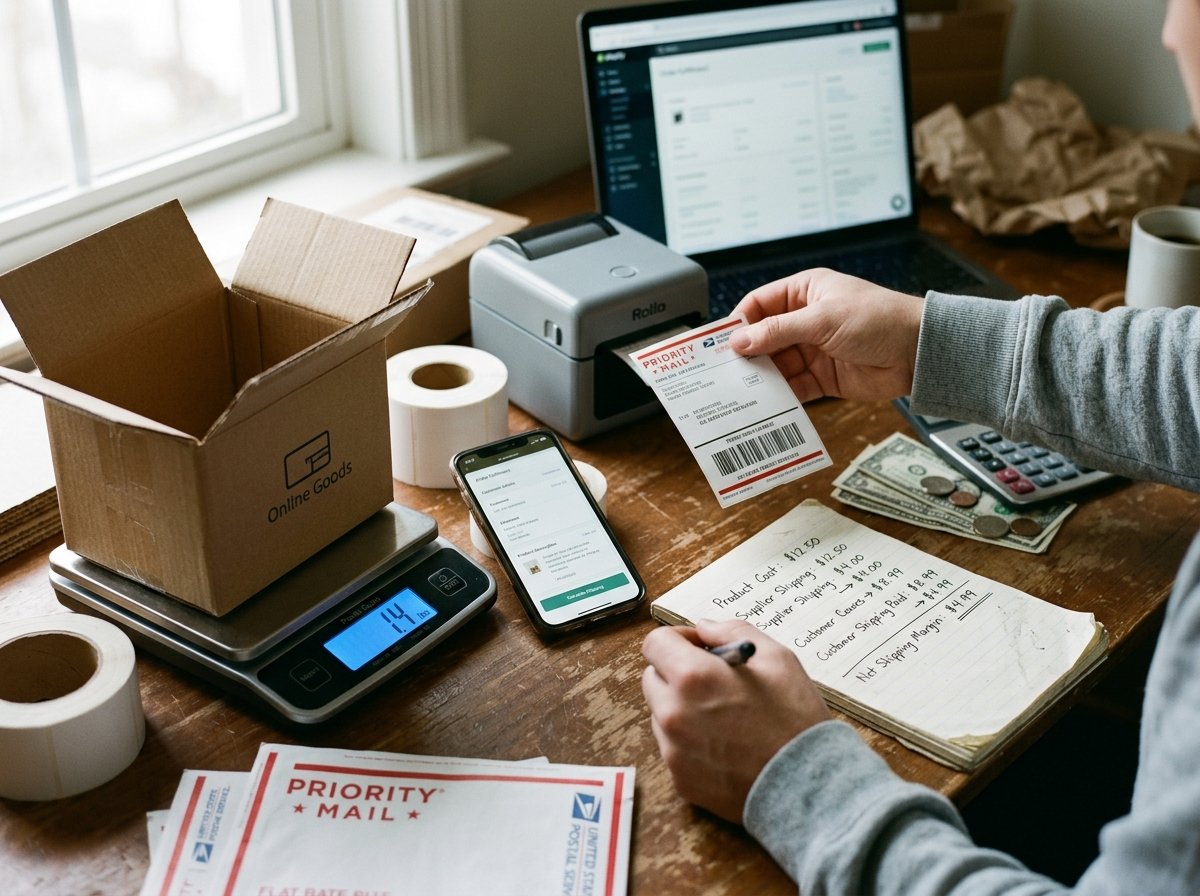
Most people who start dropshipping lose money in the first few months — not because their products are bad, but because they never really understood shipping costs. They see “free shipping from supplier” and think they’re sorted. Then the orders start coming in, and suddenly there are carrier fees, zone charges, customs costs, and customer complaints about 3-week delivery times.
Shipping in dropshipping isn’t just a logistics detail. It’s the thing that quietly decides whether your margins survive or collapse. And once you actually understand how it works — not just the surface stuff — you can price smarter, pick better suppliers, and stop losing money on every second order.
What Dropshipping Actually Means for Shipping
Before we get into costs, let’s make sure the foundation is clear.
In a traditional retail setup, you buy stock, store it, and ship it yourself when someone orders. In dropshipping, you skip the middle part. When a customer orders from your store, you forward that order to your supplier, and they ship it directly to your customer. You never touch the product.
That sounds clean and simple. And honestly, it can be — if you understand the shipping layer properly.
The catch is that you don’t control the shipping. Your supplier does. Which means their carrier choice, their packaging, their dispatch speed — all of that affects your customer’s experience. And when something goes wrong, the customer calls you, not the supplier.
This is why understanding shipping costs, timelines, and structures isn’t optional in dropshipping. It’s the actual business.
How Dropshipping Shipping Costs Are Actually Calculated
This is where most beginners get confused. Shipping isn’t just one flat number. It’s built from multiple layers.
Weight and Dimensions
Carriers don’t just charge by weight. They also use something called dimensional weight (or volumetric weight). Basically, if your product is light but takes up a lot of box space, you’ll be charged based on the size, not the actual weight.
Say you’re dropshipping a foam pillow. It might weigh 300 grams, but it ships in a large box. The carrier calculates the box volume and compares it to the actual weight — then charges you whichever is higher. Understanding how dimensional weight is calculated can save you from some genuinely surprising invoices.
Shipping Zones
Carriers divide the world into shipping zones based on distance from the origin point. The further the destination, the higher the zone number, and the higher the cost.
If your supplier ships from China to the US, the zone pricing for East Coast vs. West Coast deliveries will differ. That 2-dollar difference per order might look small, but multiply it across 500 monthly orders and it becomes significant.
ePacket, Standard, and Express Options
Most AliExpress-era dropshippers know ePacket — it was the budget shipping method that made lightweight China-to-US shipping somewhat bearable. It offered decent speeds (10–20 days) at low cost.
But ePacket isn’t the whole picture anymore. Today’s dropshippers work with a range of shipping methods:
- Standard shipping — cheapest, slowest (often 15–45 days from overseas suppliers)
- ePacket / similar economy options — moderate cost, 10–20 days for supported routes
- Express shipping — DHL, FedEx, UPS — fast (3–7 days), but significantly more expensive
If you’re comparing couriers for international routes, a side-by-side look at DHL vs FedEx for international shipping can help you pick the right balance of cost and speed.
Handling Fees
Some suppliers charge a small handling fee on top of the shipping cost. It’s usually $1–$3, but it’s worth knowing upfront. Always ask your supplier if handling fees are included in their quoted shipping price or added separately.
The Real Cost Problem: Where Dropshippers Bleed Money
Here’s the honest version that most guides don’t say clearly enough.
Shipping costs in dropshipping are often unpredictable. Your supplier might quote $3 for a product, $2 for shipping. You price your product at $18 thinking you’ll make decent margins. Then you realize shipping to a remote ZIP code costs $6, not $2. Or your customer orders two items, and the supplier ships them in two separate packages — double the shipping cost.
These aren’t edge cases. They’re patterns.
The Multi-Supplier Problem
If your store sells products from three different suppliers and a customer orders one item from each, you’ll pay three separate shipping fees. The customer sees one “checkout” and pays one shipping fee. You absorb the rest.
This is one of the most common margin killers in dropshipping, and it’s easy to miss when you’re just starting out.
The fix? Either source your main products from one primary supplier, or be very deliberate about which product combinations you promote together. Some dropshippers solve this by building niche stores around a single supplier’s catalog.
Free Shipping Offers That Aren’t Free
When you offer “free shipping” to customers, you’re not making shipping free — you’re building that cost into your product price. The question is whether you’ve built it in correctly.
A lot of dropshippers just add a flat $3–$5 to their product price to cover shipping. That works if your average shipping cost is actually in that range. But if you’re shipping bulky products, selling to multiple countries, or dealing with suppliers who have variable shipping rates, a flat buffer often isn’t enough.
A smarter approach: calculate your average shipping cost across 20–30 real orders from your supplier to your main target markets. Use that real number as your base, then add a small buffer. It’s less romantic than “free shipping always,” but your margins will thank you.
Shipping Timelines and Customer Expectations
Cost is one side of the equation. Time is the other.
In 2026, customers have been trained by Amazon to expect fast delivery. A 3-week shipping window from an overseas supplier isn’t automatically a dealbreaker — but only if you’re transparent about it. Hidden long delivery times are a trust-killer.
How to Set Expectations Without Losing Sales
Be upfront on your product pages. “Ships in 7–14 business days” is honest. Don’t write “fast shipping” if it’s going to take 3 weeks. Some customers are fine waiting if the price is right — but they need to know upfront.
Also worth knowing: different routes have genuinely different timelines. If your supplier ships via standard China Post to the US, 15–25 days is realistic. If they use DHL Express, 5–7 days is achievable but costs significantly more. There’s no magic middle — you make a tradeoff.
Understanding the difference between economy and express international shipping helps you decide which tier makes sense for your product price point. A $9 product probably can’t absorb express shipping costs. A $60 product might be able to — and should, because a customer who paid $60 expects reasonable speed.
Pricing Strategy: Building Shipping Costs Into Your Numbers
This is the section that actually makes or breaks dropshipping profitability.
Option 1: Include Shipping in Product Price
Most stores that offer “free shipping” do this. You bake the average shipping cost into your retail price. It feels seamless to the customer.
The downside: you need accurate average shipping data, and it can make your products look more expensive compared to competitors who show lower product prices with added shipping at checkout.
Option 2: Charge Shipping Separately
Some stores show a lower product price and add shipping at checkout. This can increase cart abandonment — people see the final price jump and bail. But it also means each order’s shipping is covered, without you guessing at averages.
This works better for stores selling heavier or bulkier items where shipping costs vary a lot. If you’re selling something like car parts or large accessories, transparent shipping charges make more sense than guessing and absorbing losses.
Option 3: Tiered or Conditional Free Shipping
This is the middle ground many successful stores use. Something like: “Free shipping on orders over $35.” It encourages larger orders, covers your shipping costs on higher-ticket purchases, and still gives customers the feel-good of “free shipping.”
If you ever scale to the point of managing bulk orders, bulk shipping discounts become a real tool worth exploring — especially if you’re negotiating directly with suppliers or carriers.
Choosing the Right Supplier Based on Shipping
Not all suppliers are equal, and the cheapest product price doesn’t always mean the lowest total cost. Shipping quality from the supplier side includes:
Dispatch speed — How quickly do they actually ship after an order is placed? Some suppliers list 1-day processing but actually take 4–5 days.
Carrier reliability — Does your supplier use a carrier with decent tracking? A package without real-time tracking updates is a customer service headache waiting to happen.
Packaging quality — Bad packaging leads to damaged goods, which leads to returns and refunds. Your packaging choices directly affect shipping damage rates, even in dropshipping where you don’t pack the item yourself. Ask suppliers for packaging samples or reviews from other sellers.
Returns handling — Before you commit to a supplier, understand their returns process. If a customer wants to return a product, do they ship it back to China? To a local returns warehouse? Who pays return shipping? This affects how you write your return policy. For a practical look at managing returns as an online seller, this guide on handling returns walks through the key decisions.
International Dropshipping: The Extra Layer
Selling to international customers adds customs, duties, and import tax into the shipping cost picture.
When your supplier ships from China to a customer in the UK, that package might be subject to UK import VAT and customs duties depending on the declared value. Post-Brexit, the UK applies VAT on goods over £135. In the EU, the threshold has changed similarly. If you’re selling to Australia, the GST rules apply.
These costs can either land on your customer (bad experience if they weren’t warned) or on you (eating into margins). Either way, you need to know they exist before you start selling internationally.
Quick Fact: Since July 2021, the EU removed the €22 VAT exemption on low-value imports. All goods sold into the EU now attract VAT, regardless of value. If you’re dropshipping into Europe, this affects your pricing math.
For country-specific rules, it’s worth checking shipping restrictions to the UK and shipping restrictions to Australia before you open up international sales.
Also, certain products have additional shipping restrictions internationally — electronics, cosmetics, liquids, batteries. If you’re dropshipping phone accessories or skincare products, make sure your supplier can legally ship those items to your target markets. Items banned from international shipping is a useful reference before you commit to a product category.
Automating Shipping in a Dropshipping Store
At some point, manually forwarding orders to suppliers becomes unsustainable. Tools like DSers, AutoDS, Zendrop, and CJDropshipping automate the order fulfillment process — including generating tracking numbers and syncing them to your store.
This matters for shipping because automated tracking updates reduce “where’s my order?” customer service tickets by a significant margin. Customers who can see their package moving are far more patient than customers staring at a blank tracking page.
If you’re running a store on Shopify or WooCommerce, setting up automated shipping for your online store is worth the upfront effort. It saves hours weekly once orders start scaling.
FAQ
Q: How much should I charge for shipping in my dropshipping store?
There’s no universal number. Your shipping charge (or the amount you bake into your product price) should reflect your actual average shipping cost from your supplier to your main customer markets. Calculate this across real orders — not just supplier quotes. A common starting point for lightweight products to the US from Asia-based suppliers is $3–$6 per order, but this varies significantly by product weight, destination, and shipping method chosen.
Q: Can I offer free shipping and still be profitable in dropshipping?
Yes, but only if your product price margin is wide enough to absorb the cost. Free shipping isn’t actually free — you’re just including the cost in the product price. If your product costs $8 from the supplier, shipping costs $4, and you sell it for $18, you have $6 to work with for ads, platform fees, and profit. That’s workable. But if shipping unexpectedly rises to $7, your margin shrinks fast. Always calculate based on real numbers, not estimates.
Q: What happens when a customer doesn’t receive their dropshipped package?
This is more common than people expect, especially with long international shipping routes. Most suppliers provide tracking numbers, but tracking from overseas carriers isn’t always reliable until the package reaches the destination country’s postal network. If a package is marked delivered but the customer says it hasn’t arrived, check the steps for handling packages marked delivered but not received. As the seller, you’re responsible for resolution — even though you didn’t ship it. Build a clear policy before this situation happens, not after.
Q: Is it better to find local suppliers to reduce shipping costs and time?
Often, yes. Local suppliers (or suppliers with warehouses in your target market) eliminate international shipping timelines and usually reduce shipping costs. Many US-based dropshippers now work with suppliers who hold inventory in the US, cutting delivery to 3–5 days. The tradeoff is usually a higher product cost. Whether that tradeoff is worth it depends on your margins and how much delivery speed affects your conversions.
Closing Thoughts
Shipping is the part of dropshipping that separates stores that quietly die from stores that actually build something. The business model works — but not by accident. It works when you know your real shipping costs, choose suppliers based on reliability not just price, set honest delivery expectations, and price your products with actual math behind them.
Start with one supplier, one main product category, and one or two target markets. Get your shipping costs dialed in for that setup before expanding. The complexity grows naturally — you don’t need to solve international shipping zones on day one.
Once the numbers are honest and the expectations are clear, dropshipping stops feeling like gambling and starts feeling like a real business.